


Intent-based detection
It’s not just about human or bot—it’s about intent. Our AI detects malicious vs. legitimate intent, whether it’s a bot, a human, or an AI agent.


DataDome’s multi-layered AI detection engine stops cyberfraud before it happens, blocking malicious intent in real time—at the edge.

It’s not just about human or bot—it’s about intent. Our AI detects malicious vs. legitimate intent, whether it’s a bot, a human, or an AI agent.

Our detection engine processes 5 trillion signals daily and learns in real time—not just from your environment, but from threats observed across our entire customer base.

Our AI runs at the edge 24/7, analyzing every request, not a sample. That means threats are stopped before they ever touch your websites, apps, or APIs—unlike CDNs or WAFs that let bad traffic slip through.

All AI models powering DataDome are built in-house by our own team of expert threat researchers. We don’t rely on third-party pre-trained models or external providers.

Most bot detection tools rely on static, rule-based logic that can’t keep pace with emerging threats. DataDome’s AI engine is different. It continuously learns and adapts in real time using both supervised and unsupervised models, enabling it to identify and respond to new attack patterns instantly. It’s why leading brands trust us to stop the threats others miss.
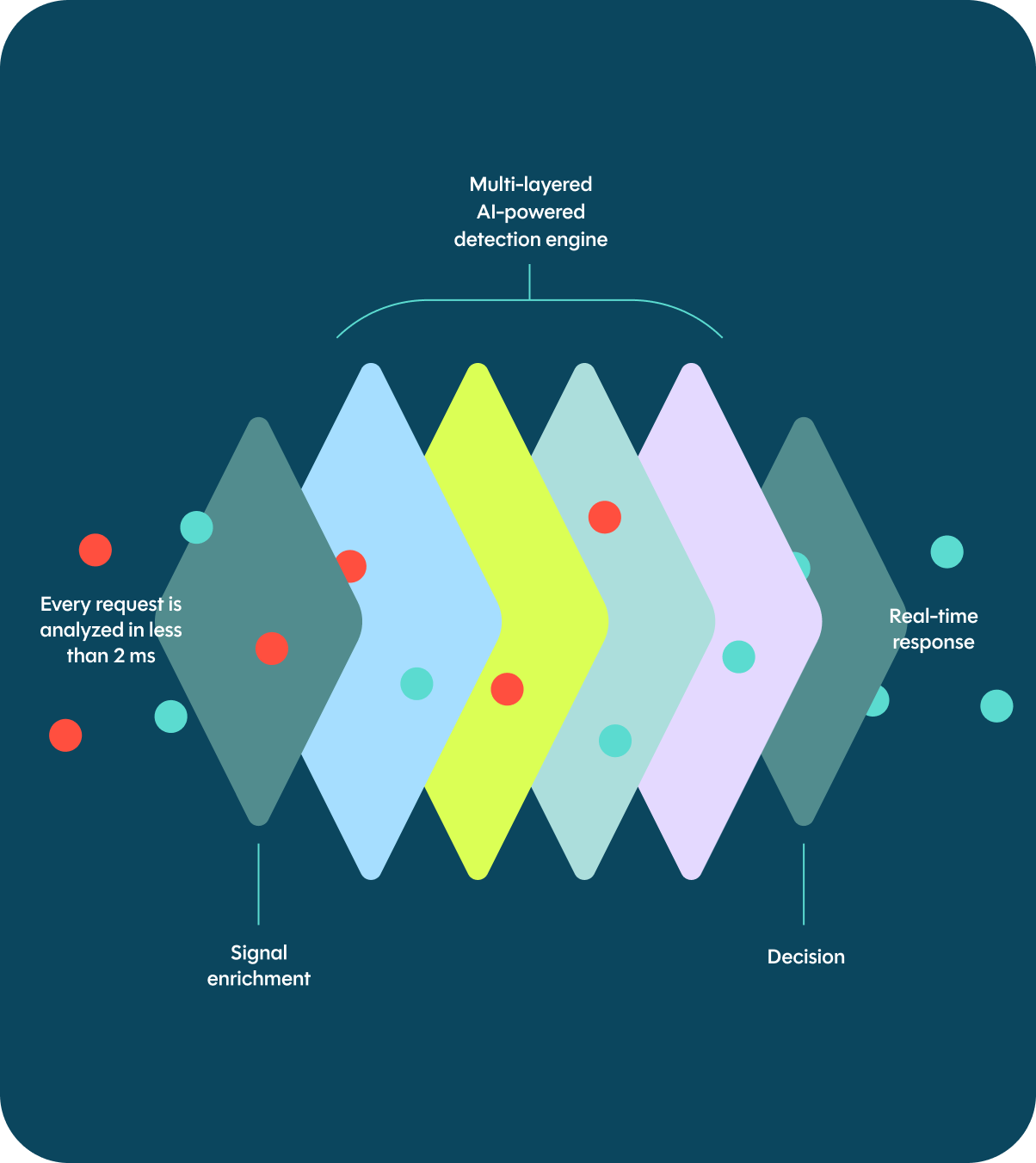
Integrated with AI-driven insights to enhance detection and response, signature-based detection identifies known threats instantly based on fingerprints, traffic patterns, and behavioral anomalies.
Detects suspicious activity by analyzing user behavior across time. We look for micro-signals that indicate fraudulent intent.
Our AI distinguishes between good automation (like search engine crawlers and helpful AI agents) and malicious bots, ensuring precise detection with minimal false positives.
DataDome’s AI is constantly learning from real-world threats, adapting to new bot tactics faster than fraudsters can evolve.


DataDome’s AI retrains in real time to stay razor-sharp. With over 90% of our models auto-generated daily, we adapt faster than fraudsters can pivot—while our in-house experts ensure every model runs with precision.
Hundreds of models analyze behavior, fingerprints, and traffic patterns to detect fraud. Over 85,000 models are tailored by customer and use case, powered by 300,000 precision rules. It runs on autopilot for users, and custom rules are available when you need them.

We use advanced algorithms like CatBoost ML, genetic algorithms, fuzzy logic, and more, to detect evolving attack patterns. By applying hundreds of AI and machine learning models, we can detect and stop fraud before it happens.

Through advanced statistical modeling, data mining, and contrast set mining, we uncover hidden anomalies and correlations that other solutions miss. We leverage a high volume of incoming data and feedback loops to detect and correct model divergence.

We build behavioral models and leverage anomaly detection and intent-based modeling to distinguish helpful bots and welcome AI agents from the malicious ones.

Our engine combines signature-based detection with real-time adaptation, using collective intelligence to continuously learn from every request across hundreds of customers to stay ahead of evolving threats.
Custom-built by DataDome’s threat research team, our AI models are named after great minds—philosophers, inventors, and pioneers who changed the world. Explore below how each model plays a specialized role in blocking cyberfraud.
Lovelace

Named after Ada Lovelace, a foundational thinker in computing. This model is specialized in fingerprint scoring for API servers.
Cardano

Named after Girolamo Cardano, a pioneer in probability theory. This model performs confidence scoring on Layer 1 decisions.
Leibniz

Named after Gottfried Wilhelm Leibniz, who advanced formal logic. This model provides normalized account scoring using graph neural networks.
Franklin

Named after Benjamin Franklin, a versatile innovator and thinker. This model scores email trust using fuzzy logic on the email pattern.
Bernoulli

Named after Jacob Bernoulli, a father of modern probability. This model scores IP, AS and User Agent reputations using PU-Learning.
Arendt

Named after Hannah Arendt, a political and ethical theorist. This model blocks high-scoring IPs using fuzzy logic.
Spinoza

Named after Baruch Spinoza, known for rationalist system-building. This model blocks IPs via scoring and hard rules.
Descartes

Named after René Descartes, thinker of reason and duality. This model detects client-side behavior using real-time signal modeling.
Hume

Named after David Hume, an empiricist philosopher focused on observed behaviors. This model automatically adjusts behavioral thresholds based on session stats.
Pascal

Named after Blaise Pascal, a pioneer of probability and decision theory. This model detects session anomalies from aggregated IP and sessions behaviors.
Kant

Named after Immanuel Kant, who explored how we perceive the world and structures. This model interprets real-time JS keyboard input to detect bots.
Venn

Named after John Venn, inventor of the Venn diagram. This model applies tagging based on IP aggregation and behavioral overlap.
Turing

Named after Alan Turing, a pioneer in machine reasoning. This model generates detection rules from time-based signal patterns.
Curie

Named after Marie Curie, known for discovering hidden elements and signal discovery. This model extracts detection rules from fingerprint scoring anomalies.
Darwin

Named after Charles Darwin for its work on biological evolution. This model explores rule generation via genetic modeling techniques.
Popper

Named after Karl Popper, philosopher of science and falsifiability. This model identifies anomalies via distribution shifts.
Bayes

Named after Thomas Bayes, a probability theorist. This model uses change-point heuristics for detecting sudden traffic shifts.
Godel

Named after Kurt Gödel, logician of incompleteness. This model flags edge-case anomalies across large field cardinalities.
Searle

Named after John Searle, known for theories of interpretation. This model refines account protection rules based on feedback loops.
Foucault

Named after Michel Foucault, theorist of hidden systems and power structures. This model detects subtle browser-level TCP signal differences.
Russell

Named after Bertrand Russell, logician and system critic. This model generates fallback rules in realtime during attack escalation.
Babbage

Named after Charles Babbage, the father of pattern computing. This model generalizes detection rules across customers.
Chomsky

Named after Noam Chomsky, linguist and cognitive theorist. This model performs structural refinement on detection rules.
Socrates

Named after Socrates, master of questioning and critique. This model creates signature-based embeddings and detects bots using real-time clustering on those embeddings.
Marconi

Named after Guglielmo Marconi, inventor of wireless transmission and radio telepathy. This model detects residential proxies by tracing hidden signal paths.

With AI everywhere, fraud is evolving—it’s no longer just about bot or not. Humans use AI agents to transact, and bots aren’t always bad. DataDome’s detection engine goes beyond identity verification to also analyze intent, distinguishing between good automation and malicious activity to stop fraud before it happens. Identity tells you who or what. Intent tells you why. And in the AI era, you need both.

Tell me more
Tell me more

Tell me more
Tell me more
Tell me more
Tell me more

Tell me more

Protecting your business against cyberfraud starts here.