


A New Frontier for CISOs: Bridging the Gap Between Fraud and Cybersecurity
Malicious bots are no longer just a cybersecurity issue. They represent a widespread challenge that impacts multiple teams across an organization—from IT and cybersecurity to fraud prevention, marketing, and even product teams. Whether it’s click fraud, account takeovers, inventory scalping, or DDoS attacks, bots infiltrate and disrupt different areas of a business, creating issues that can’t be solved in isolation.
The traditional separation between cybersecurity and fraud teams is increasingly unsustainable. As Gartner® notes in their 2024 Emerging Tech: Security — Cyber-Fraud Fusion Is the Future of Online Fraud Detection report, “fraudsters don’t operate in silos, they don’t discriminate when it comes to the tools or tactics utilized; it’s all about effectiveness, and they will look across the entire technical landscape for vulnerabilities and opportunities. Fraud has tended to focus on point-in-time solutions, focused on specific use cases. However, the problem is much larger than that; a more comprehensive and holistic approach (that connects isolated teams and systems) is required. ” Tackling the issue of bots and online fraud requires a unified platform that serves the needs of various teams.
As online threats grow more sophisticated, CISOs must recognize that bot attacks are a shared problem. This core insight has given rise to a new approach—Cyberfraud Prevention & Protection—representing the convergence of cybersecurity and fraud teams into a unified force. According to Gartner®, “by 2028, 20% of large enterprises are expected to adopt cyber-fraud fusion teams, up from less than 5% today.”1
A unified approach, which Gartner® predicts will become the norm, combines cyber threat intelligence, fraud operations, and information security into a cohesive strategy, creating “a defense in depth framework” that addresses modern threats more effectively. Much like the earlier revolution of DevOps in the tech industry, Cyberfraud is breaking down silos to create a more comprehensive and effective defense against the full spectrum of digital threats across the customer journey – from demand gen through purchase and beyond.
Bot Management: A Foundation for Cyberfraud Prevention
At the core of many cyberattacks and fraud schemes are bad bots, the primary tool that cybercriminals use for executing large-scale, automated attacks and fraud. Bots are responsible for various activities—from scraping and content theft to DDoS attacks to ad fraud, payment fraud, and account takeovers.
On the cybersecurity front, bots exploit apps and APIs to scrape content and overwhelm servers with DDoS attacks, potentially leading to IP theft, service outages, and data breaches.
Protecting these digital front doors is critical to stopping attacks before they cause damage. What may start out as a seemingly minor issue, such as a bot probing a system, can quickly escalate into a serious breach if not addressed early. As Gartner® highlights, “Controls have largely been reactive to fraud for many years, neglecting many of the more mature, holistic approaches that cybersecurity has followed. This reactive response strategy sometimes results in controls being introduced so late that adversaries have already moved on to different tactics or techniques that may go undetected by the new control.” However, with the rise of cyber-fraud fusion, organizations can catch threats further upstream and proactively block them.
On the fraud side, bots are involved in a range of malicious activities, from card cracking and payment fraud to account takeovers, click fraud, and influence fraud. Bots often begin by testing credentials or identifying weak spots in business logic, which may seem to be initially low-risk. However, if left unchecked, these activities can lead to large-scale fraud.
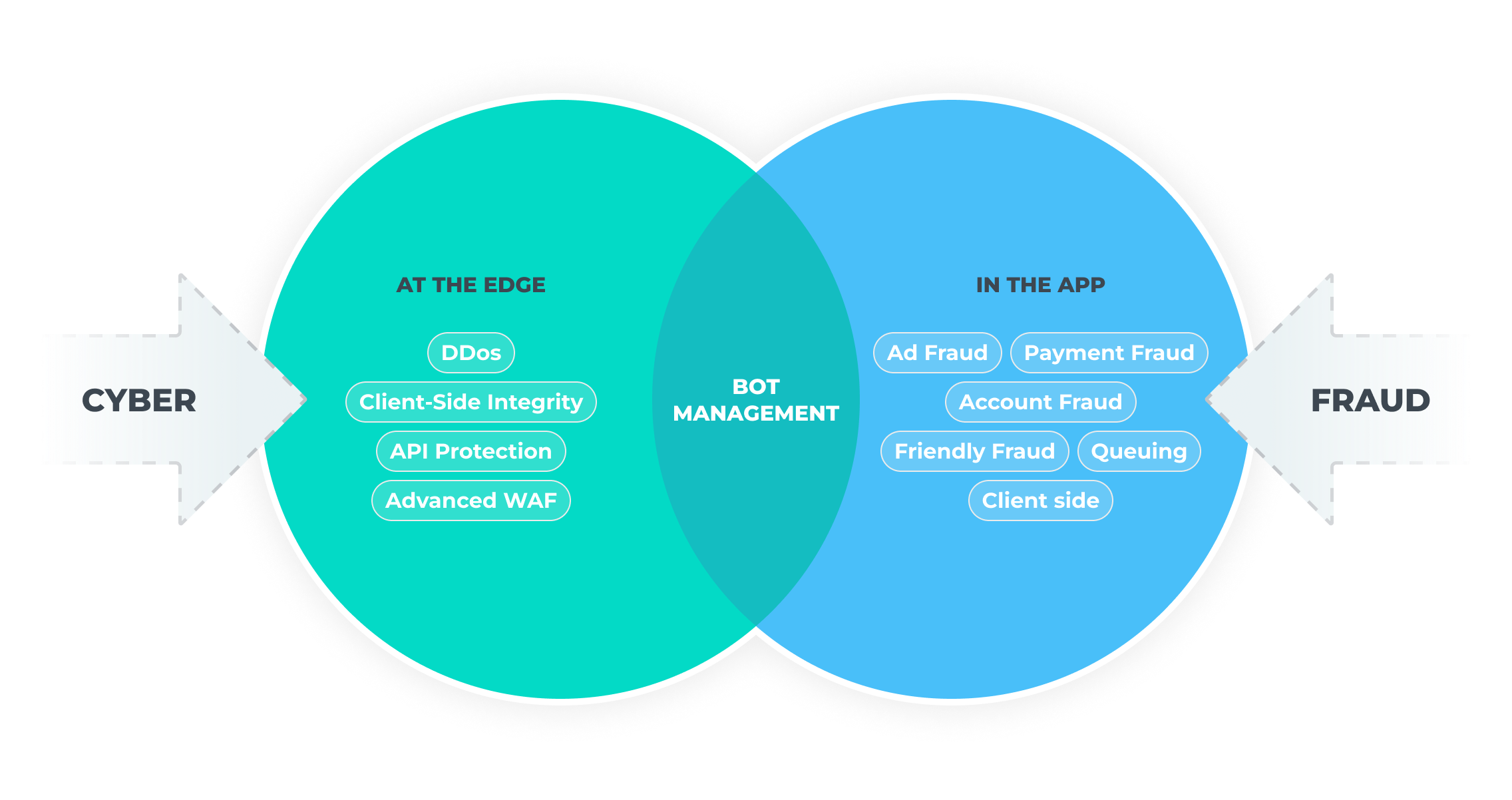
By deploying an advanced bot management solution, organizations establish a critical line of preventative defense that spans both cybersecurity and fraud threats as well as threats that are at the edge versus inside of your applications—significantly reducing risks from financial loss, poor customer experience, and data breaches.
The Unsustainable Consequences of Siloed Teams & Tools
Traditionally, cybersecurity and fraud prevention teams have operated in separate silos, each focusing on their specific domains: cybersecurity teams managing threats to IT infrastructure and data and fraud teams tackling financial crimes and policy violations. While this separation may have made sense in the past, it now leads to several key challenges:
- Lack of Integrated Threat Intelligence: Siloed teams miss critical insights by not sharing data across the attack lifecycle. Leveraging downstream behaviors can enhance upstream threat detection.
- Inefficient Resource Use: Redundant efforts, tool sprawl, and siloed operations increase costs and slow response times. Often, entire fraud teams exist because earlier cyber actions weren’t taken.
- Inconsistent Defense Strategies: Misaligned defense approaches can create protection gaps. For example, while one team may block credential stuffing, the other may be unaware of related account takeover attempts.
The Convergence of Cybersecurity & Fraud Teams: A New Paradigm
Forward-thinking organizations are now embracing Cyberfraud Protection, which brings cybersecurity and fraud teams together to create an integrated defense strategy. By combining expertise, tools, and data, these teams can collaborate more effectively to detect and respond to digital threats.
Real-World Example: Target’s Unified Approach
As Target shared on its blog, its approach to combating organized retail crime provides a compelling example of the benefits of merging cybersecurity and fraud prevention efforts. Facing increasingly sophisticated fraud tactics that span both digital and physical environments, Target recognized the need for a more integrated approach.
By combining the expertise of its cybersecurity and fraud prevention teams, Target developed a comprehensive strategy to address threats across all touchpoints. For example, their integrated teams worked together to combat reseller bots that surged during the pandemic, leveraging shared intelligence to protect both inventory and customer experience. This collaboration allowed Target to detect and block automated fraud without disrupting legitimate customer activities, demonstrating the value of a unified Cyberfraud approach.
The Cyber-Fraud Kill Chain: A Comprehensive Framework
The Cyber-Fraud Kill Chain is another key component of this new Cyberfraud paradigm. As Gartner® highlights in their Emerging Tech: Security — Cyber-Fraud Fusion Is the Future of Online Fraud Detection report, “The cyber-fraud kill chain has emerged as a form of “fraud intelligence.” It combines common methodologies widely used within cybersecurity to profile the tools, tactics, and procedures (TTPs) of adversaries by creating a holistic framework from which policies and rules can be added to fraud prevention platforms.”
Benefits of Shared Data & A Unified Cyberfraud Protection Platform
A unified Cyberfraud Protection platform offers numerous advantages by promoting shared data and integrated platforms:
- Enhanced Collaboration & Efficiency: A shared platform improves collaboration between cybersecurity and fraud teams.
- Proactive Threat Detection: Integrating cybersecurity and fraud data reveals patterns that could be missed in isolation.
- Better ROI: Consolidating tools into one platform reduces complexity and costs, while faster detection minimizes financial losses, improving long-term ROI.
- Improved Insight & Analytics: A unified view of the attack landscape helps teams detect and respond to complex threats more accurately.
- Stronger Compliance & Reporting: A single platform streamlines data collection, making compliance and reporting easier.
Embracing the Cyberfraud Revolution
By breaking down the silos between cybersecurity and fraud teams, organizations can create a more comprehensive defense strategy that leverages shared data, tools, and expertise to combat both cyber threats and online fraud more effectively. Much like the DevOps revolution before it, Cyberfraud represents a new era in threat detection and prevention, one that is poised to reshape the future of online security and fraud management. CISOs can begin to experiment and test this approach with a small scope, such as a particular problematic app or endpoint, then learn, iterate, and expand over time.
Learn more about the DataDome Cyberfraud Protection Platform and claim your Vulnerability Scan.
Gartner® Disclaimer
1Gartner, Emerging Tech: Security — Cyber-Fraud Fusion Is the Future of Online Fraud Detection, Dan Ayoub, Pete Redshaw, 7 September 2023
GARTNER is a registered trademark and service mark of Gartner, Inc. and/or its affiliates in the U.S. and internationally and is used herein with permission. All rights reserved.

Related posts

Account Protect Updates: Clearer Visibility, Stronger Signals, & More Control
Tell me more

Libération Leverages DataDome + Arc XP to Neutralize Malicious AI Scraping in <2 Milliseconds
Tell me more

Etix Stops Ticket Scalping Without Slowing Down Real Fans
Tell me more

Travel Fraud: What It Is & How to Prevent It
Tell me more

