
How to Prevent a Brute Force Attack with these 5 Powerful Strategies
Brute force attacks have evolved from simple password guessing into sophisticated, AI-powered campaigns that can crack complex passwords in minutes rather than months. What makes them particularly dangerous is their persistence: Bots can run continuously for weeks, trying millions of combinations while perfectly mimicking human behavior to avoid detection.
Key takeaways
- Modern brute force attacks use sophisticated automation and AI to crack passwords faster than ever while mimicking human behavior to avoid detection.
- Multiple attack vectors exist beyond simple password guessing, including credential stuffing, password spraying, hybrid attacks, and rainbow table techniques.
- Attacks can persist undetected for weeks or months as hackers use distributed IP addresses and human-like browsing patterns to blend with legitimate traffic.
- Traditional security measures like rate limiting and WAFs often fail against advanced bots that can adapt their behavior and scale across massive IP ranges.
- Comprehensive protection requires behavioral analysis and AI-powered detection that can identify subtle patterns distinguishing bots from genuine users.
What is a brute force attack?
A brute force attack is a cyberattack method that uses the trial-and-error method to systematically guess passwords, login credentials, or encryption keys. Attackers use automated tools to try every possible combination of characters until they find the correct one that grants access to a user account or system. This is how brute force attacks work: by leveraging automation to guess passwords at high speed, targeting user accounts and sensitive data through persistent, repeated attempts.
A simple brute force attack involves trying every possible password combination without shortcuts or intelligent guessing to break into user accounts, especially those protected by weak or short user passwords. The longer the password length, the more difficult it becomes for attackers to succeed with this method. Attackers may also use brute force techniques to target encryption keys, applying the same exhaustive approach to gain unauthorized access to encrypted data.
Let’s look at real-world examples to see how brute force attacks have impacted organizations.
Examples of high-profile brute force attack incidents
Dell data breach (2024)
In May 2024, Dell suffered a massive brute force attack affecting 49 million customers(1). The threat actor, known as Menelik, created multiple partner accounts on Dell’s company portal and launched sustained brute force attacks, sending over 5,000 requests per minute for nearly three weeks.
The attack involved approximately 50 million requests and captured about 49 million customer records, including names, addresses, service tags, and warranty information. The most concerning aspect was that Dell remained completely unaware of the ongoing attack despite the massive volume of automated requests hitting their systems.
Ubaldi online supermarket
Ubaldi, an online supermarket for home appliances and products, has also been subject to a brute force attack. Bots were targeting their website’s login endpoint, testing a large number of email addresses and passwords. Vincent Salard, Ubaldi.com’s CIO, explained the challenge:
“The mass use of email addresses and password libraries, which ill-intentioned people were testing by launching brute force attacks on our website, looking for valid combinations that they could then sell as a consolidated database,” Salard said.
Ubaldi decided on DataDome to protect itself against these attacks. DataDome blocked all malicious bots from spamming their website and significantly reduced the toll of these bots on Ubaldi’s server resources.
What are the different types of brute force attacks?
Brute force attacks come in several forms, each with unique characteristics and methods. Understanding these differences is crucial for effective prevention. Most attacks are credential-based attacks carried out by threat actors seeking financial gain or data theft.
Online vs. offline attacks
Online brute force attacks target a running website or mobile app. They’re convenient because you can send bots to any online website, but they can be quite slow because the hacker needs to wait for the targeted server to respond. Companies also tend to rate-limit their vulnerable endpoints, further slowing such attacks.
Offline brute force attacks are only possible when a hacker has gained access to a database file with encrypted information. Once a hacker gets their hands on such a file, they can try different keys to decrypt the information on their computer instead of on a distant server, which makes offline attacks significantly faster.
Dictionary attacks
Dictionary attacks use a predefined list of common passwords and words to guess the correct password. The hacker’s bots rotate through combinations of dictionary words to guess usernames and passwords. Dictionary attacks work because people frequently use dictionary words in their passwords.
Hybrid attacks
A hybrid brute force attack combines a dictionary attack with a basic brute force attack. When dictionary attempts fail, the attacker switches to systematic character combinations, trying every possible arrangement of letters, numbers, and symbols. This method is particularly effective because it targets both common password patterns and complex combinations.
Password spraying
Password spraying applies a single common password across multiple accounts. Instead of trying many passwords against one account, attackers flip the script—testing commonly used passwords like “Password123!” or “Summer2024” against thousands of usernames. This method stays under the radar by avoiding account lockout policies that trigger after too many failed attempts on a single account.
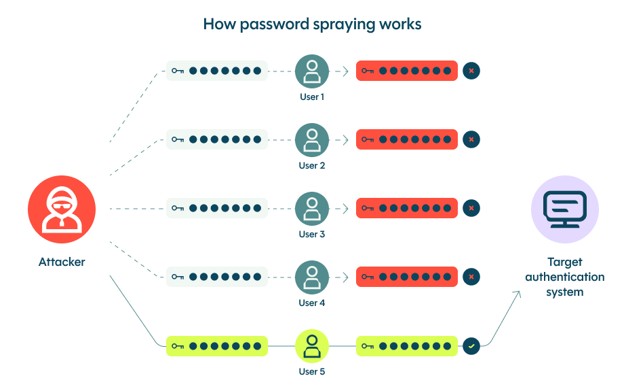
One password tested against many accounts
Reverse brute force attacks
A reverse brute force attack starts from a publicly known or leaked password. With that password, the hacker will use automation to search for a matching username, account number, or key. This method leverages passwords leaked from previous data breaches that can be found online.
Credential stuffing
Many users use the same credentials for multiple accounts.Credential stuffing exploits this by reusing stolen username-password combinations to gain unauthorized access to other accounts. Hackers use automated tools to try these stolen credentials across various websites until they find matches.
Rainbow table attacks
Rainbow tables are precomputed tables containing hash values used to crack passwords. Rainbow table attacks can crack hashes of passwords that have been hashed using various algorithms, including MD5, SHA-1, and NTLM. Attackers can quickly look up the corresponding plaintext for a given hash without the computationally intensive process of hashing all possible plaintexts.
How does a brute force attack work?
Before we cover in detail how you can detect and prevent the bots that come with a brute force attack, let’s cover how they work. A brute force bot attack typically involves the following steps:
- Target URL address and parameter values: Hackers identify target site pages and preconfigure the necessary parameter values in their brute force attack tools. In addition to generic login pages, content management systems’ (CMS) admin pages are frequent targets:
a. WordPress wp-admin or wp-login.php login pages
b. Magento /index.php and admin pages
c. Joomla! Administrator
d. vBulletin admincp - Run brute force processes: The bots attempt to guess potential passwords by checking against a list of words found in a dictionary, using a rainbow table of calculated password hashes, or evaluating rules based on site features such as user and page name patterns.
- Extract content and data: For any of the login attempts that are successful, attackers extract proprietary content and data from the target website for fraudulent use, economic gain, and additional attack vectors.
Understanding the attacks is essential for identifying and stopping brute force attacks. Next, let’s look at how you can spot the signs of a brute force attack in progress.
How can you identify a brute force attack?
The purpose of a brute force attack is to gain access to hidden or protected information, such as user or admin accounts. The pages that are the gateways to such information are the primary target of a brute force attack. Key traffic indicators of a brute force attack include:
- Huge traffic spikes on login pages
- Multiple requests from the same IP addresses
- High volumes of failed login attempts
- Requests from unusual geographic locations
Key behavioral indicators include:
- Systematic login attempts on multiple accounts
- Requests at inhuman speeds
- Identical user agent strings across requests
- Lack of typical human browsing patterns
Auditing authentication logs can reveal patterns such as a high number of failed logins and attempts to access accounts using non-existent usernames, both of which are strong indicators of brute force activity. Monitoring authentication logs for these signs is essential for detection.
Using security information and event management (SIEM) tools helps organizations monitor and alert on suspicious login attempts. Regular monitoring of login activities and authentication logs is crucial to identify and respond to brute force attacks before they escalate.
How to prevent brute force attacks
Modern brute force operators design bots that mimic human behavior and use very large numbers of different IP addresses. Traditional rule-based security measures, such as WAFs, are unable to stop these sophisticated attacks. Instead, here are five powerful ways to stop a brute force attack:
1. Password security fundamentals
Generate strong, unique passwords with a password manager, using these specifications:
- Minimum 15 characters long (preferably longer)
- Combination of uppercase, lowercase, numbers, and special characters
- Avoid dictionary words from any language
- Never reuse passwords across accounts
2. Access control measures
Limit login attempts by:
- Setting maximum failed attempts before account lockout
- Implementing progressive delays between attempts
- Restricting login attempts from single IP addresses
- Creating temporary lockouts that increase in duration
Monitor IP addresses and locations:
- Track login activities, including failed attempts and source IPs
- Set up alerts for login attempts from anomalous locations
- Block known malicious IP ranges
- Implement geofencing where appropriate
3. Authentication enhancements
Deploy multi-factor authentication (MFA):
- Require additional authentication beyond passwords
- Use hardware tokens for high-risk accounts
- Consider biometric authentication where suitable
- Avoid SMS-based MFA due to SIM swapping vulnerabilities
4. Infrastructure hardening
Secure server configurations:
- Change default admin usernames to something other than ‘admin’
- Hide admin and customer login pages by changing default names
- Disable root SSH logins by setting “PermitRootLogin no”
- Use secure password hashing with salting practices
Create unique login URLs for different user groups, making it more challenging and time-consuming for attackers to locate authentication endpoints.
5. Advanced behavioral monitoring
Observe user behavior patterns:
- Monitor accounts with high activity levels but no purchases
- Track unusual login times or locations
- Identify rapid-fire login attempts across multiple accounts
- Analyze session patterns for automated behavior
Implement zero-trust architecture that verifies every access request regardless of source or user credentials.
DataDome’s protection against brute force attacks
DataDome protects against brute force attacks through a multi-layered approach combining two purpose-built products: Bot Protect and Account Protect.
Bot Protect
DataDome Bot Protect blocks automated brute force attacks before they reach your login page.
Our AI-powered detection analyzes behavioral patterns and technical signals in real time, identifying malicious bots in under 2 milliseconds. With a false positive rate below 0.01%, legitimate users never experience friction while credential stuffing and password guessing attempts are stopped cold.
Account Protect
DataDome Account Protect helps prevent sophisticated brute force attacks targeting user accounts by:
- Analyzing signals like IP/device fingerprints, email reputation, and behavioral patterns
- Detecting anomalies such as rapid login attempts, mismatched locations, and suspicious navigation flows
- Leveraging network intelligence from 5 trillion daily signals across DataDome’s customer base
- Returning risk-based recommendations (Allow, Challenge with MFA, Review, or Deny)
Better than WAFs
Traditional WAFs rely on static rules and signatures—blocking known threats but missing sophisticated attacks that adapt their behavior. DataDome takes a different approach: intent-based detection.
By analyzing behavioral patterns and technical signals in real time, DataDome identifies malicious intent, whether it comes from automated bots, manual attacks, or hybrid operations. This stops credential stuffing, account takeovers, and brute force attempts before they succeed—without disrupting legitimate users.
| Capability | Without DataDome | With DataDome |
| Detection speed | Minutes to hours (manual) | < 2ms (automated) |
| Distributed attacks | ❌ Hard to detect | ✅ Detected & blocked |
| Low-and-slow attacks | ❌ Bypasses rate limits | ✅ Behavioral analysis |
| Engineering overhead | 🔴 High (3–4 FTEs) | 🟢 ~2h/week |
| Cross-network intelligence | ❌ None | ✅ Full network sharing |
| Credential stuffing | ❌ Partially mitigated | ✅ 99% reduction |
| Mobile & API coverage | ❌ Often missing | ✅ Full coverage |
Ready to protect your site against brute force attacks? Book a demo to learn more about DataDome, or run a free Vulnerability Scan to see if your site is vulnerable to bad bots and malicious AI agents.
FAQ
A bot detection tool prevents brute force attacks better than traditional security measures, such as a WAF. In addition, the right bot protection solution will block all bots, not just the ones set up for brute force attacks. This means you’ll also be protected against web scraping, DDoS attacks, scalping, and more.
Hackers primarily use automated software tools and bots to launch brute force attacks, as manual attempts would be too slow and inefficient. Popular tools include specialized brute force programs that can generate millions of password combinations per second, as well as offensive security tools like Cobalt Strike and Metasploit. Many attackers also deploy botnets to distribute their attacks across thousands of different IP addresses

Related posts

How Kiabi Cut Malicious Login Attempts & Gained Instant Threat Visibility
Tell me more

What Is Account Takeover Fraud? Attacks, Signs, & Prevention
Tell me more

Account Protect Updates: Clearer Visibility, Stronger Signals, & More Control
Tell me more

How Effective Is CAPTCHA? Does It Really Stop Bots?
Tell me more