



GUIDE
The Guide to Readying Your Business for Agentic Commerce
The question isn’t whether agentic commerce will transform your business—it’s whether you’ll be ready to capitalize on it. Download this guide to learn how to turn AI agent traffic into a competitive advantage while protecting against emerging fraud risks.
4
2
0
0
9
X
6
6
0
5
AI traffic has grown 4x in just 8 months (Src: DataDome)
4
9
9
4
0
.
7
4
2
5
4
3
5
9
1
X
8
1
9
8
AI-driven traffic converts 4.4× better than traditional search traffic (Src: Semrush)
$
8
2
6
2
1
6
4
0
2
T
1
8
8
6
By 2030, agent-orchestrated commerce could generate $1T in U.S. B2C revenue (Src: McKinsey)
$
1
2
7
6
9
5
6
4
7
T
2
8
6
2
By 2030, AI Agents could drive nearly $9 trillion in global online spending. (Src: Ark Investments)
Bottom line: The businesses that establish AI agent strategies now will set the standards and capture early-mover advantages.

What’s inside the guide
- The state of agentic commerce
- Real-world use cases
- Benefits vs. risks framework
- 10 critical questions for your team
- Leadership action checklist
- Monetization strategies
- Solutions to stopping AI fraud
- Strategic implementation guidance

Who this guide is for
Security & Fraud Teams managing new threat vectors and attack surfaces
Marketing Leaders optimizing for AI-driven discovery and traffic
Product Teams building agent-ready infrastructure and APIs
E-commerce Directors balancing opportunity and risk in agentic transactions
Executive Leadership setting strategy for the next era of digital commerce
FAQs
What is agentic commerce?
Agentic commerce refers to transactions or purchase journeys initiated, guided, and/or completed by AI agents instead of humans. Unlike traditional bots with narrow tasks, AI agents like ChatGPT, Perplexity, Amazon’s Rufus, and specialized shopping assistants can browse, query, interpret, and act on digital content autonomously on a user’s behalf. This shift is redefining how consumers discover and purchase products online.
How significant is AI agent traffic growth?
AI agent traffic is accelerating rapidly. DataDome’s 2026 State of Bot & Agent Security Report found that DataDome’s network saw 52.7 billion AI agent and LLM crawler requests between July 2025 and June 2026, representing an 82.3% increase. Additionally, AI agents generated 605.6 million requests to high-risk endpoints in H1 2026, including login pages, payment flows, and account-creation pages—a clear signal that agentic traffic is targeting deeper into the customer journey. Major platforms like Google, PayPal, Amazon, and Perplexity are all launching agentic commerce solutions right now.
What are the main security risks of AI agent traffic?
AI agents introduce several new fraud vectors: agent impersonation (malicious actors posing as trusted agents), AI agent takeover (compromised accounts executing fraudulent transactions), MCP server attacks (exploiting Model Context Protocol vulnerabilities), and credential stuffing at agent scale. Traditional security tools can’t distinguish between legitimate agents acting with good intent and malicious bots impersonating agents. This requires intent-based detection that analyzes what traffic is trying to accomplish, not just verifying identity.
What is Bot & Agent Trust Management?
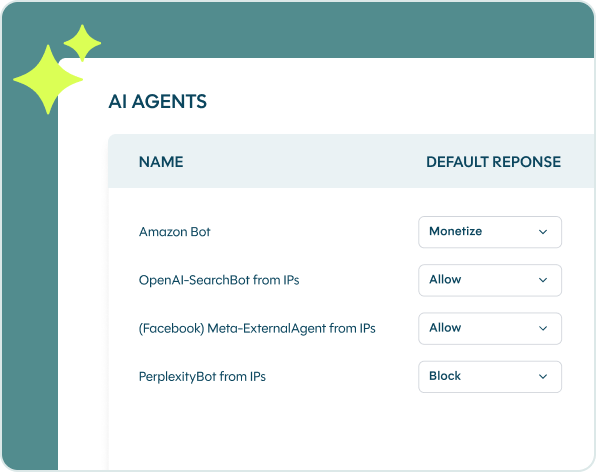
Bot & Agent Trust Management represents the evolution beyond traditional bot detection. Instead of simply asking “Is this human or bot?”, it provides visibility into which AI agents are accessing your infrastructure, verifies agent identity and intent, assigns dynamic trust scores, enforces policies in real time, and enables monetization opportunities. This infrastructure allows businesses to safely enable valuable AI agent interactions while blocking fraud and abuse—creating a competitive advantage rather than treating all automation as a threat.

BOT & AGENT TRUST
Ready your business for agentic commerce with DataDome
The DataDome Cyberfraud Protection Platform lets through trusted agents, bots, and humans, while stopping malicious ones in real time.