


How Proxy Providers Obtain Residential Proxies
According to DataDome research, only 16% of websites can detect bots that use residential proxies. This means that 84% of businesses are completely exposed to attackers who route their traffic through a residential internet connection.
It’s why residential proxies have become the weapon of choice for advanced bot operators. Unlike data center proxies, residential proxies look like legitimate human traffic because they use real home internet connections. But how do proxy providers get access to millions of residential IP addresses? There’s more than one answer to that question. Let’s start with the basics.
What is a proxy?
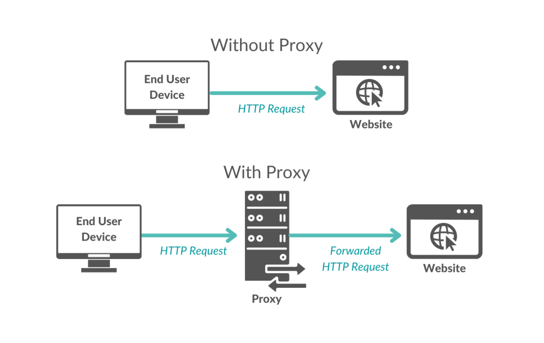
A proxy is a program that enables users to change their IP address by routing traffic through someone else’s infrastructure. Humans use proxies for anonymity and privacy purposes, while malicious bot operators use them to avoid being detected and blocked. The schema below shows the two routes an HTTP request can take, first without a proxy, then with a proxy.
Why are residential proxies so attractive to attackers?
Hackers, fraudsters, and bot operators use residential proxies for a variety of reasons:
- Residential proxies blend in perfectly. They use IP addresses from internet service providers (ISPs) like AT&T, Comcast, and Verizon. These are the same IPs your customers use at home. When a bot makes a request through a residential proxy, it looks identical to a human browsing from their living room.
- Traditional blocking doesn’t work against residential proxies. Most security tools block based on IP reputation. Data center IPs get flagged quickly because they’re obviously not human. But residential IPs have clean reputations by default. They’re harder to detect and even harder to block without affecting real customers.
- Scale beats detection. Modern residential proxy networks rotate through millions of different IP addresses. Each IP might only send one or two requests before switching. This makes pattern-based detection nearly impossible with traditional tools.
How do proxy providers build residential networks?
Behind every residential proxy network are millions of real devices: smartphones, laptops, routers, and smart home gadgets. But how do proxy companies gain access to these devices? Some methods involve willing participants who understand the trade-off. Others exploit users who have no idea their internet connection is being shared. Here are the four main techniques proxy providers use to build their networks:
Method 1: Mobile app SDKs
Proxy providers offer software development kits (SDKs) to mobile app developers as an alternative to ads for monetization. The process works like this:
- Developer integrates the SDK into their app
- Users download the app and accept terms
- SDK runs in background, routing proxy traffic through user’s device
- Provider pays developer based on traffic volume
Over 300 million application instances worldwide contain such SDKs1. In 2024 alone, Google removed 28 malicious apps containing the PROXYLIB library that turned devices into proxy nodes without clear user consent2.
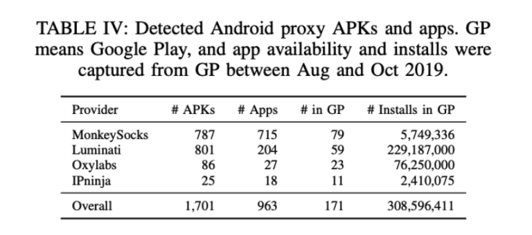
308 million installs on Android devices
Method 2: Browser extensions
Proxy providers contact popular browser extension developers, offering payment to include their proxy code in app updates. This approach works because browser extensions have broad permissions and run constantly in the background, while users rarely read privacy policies or understand what permissions they’re granting.
Security researchers from GitLab found that compromised extensions affected over 3.2 million users in early 20253. Extensions marketed as ad blockers, VPNs, and productivity tools secretly routed traffic through users’ connections.
Method 3: Compromised IoT devices and routers
Many residential proxy IPs come from hacked devices that can’t give consent. Attackers commonly target:
- Routers: 13,000 MikroTik routers were hijacked in 2024 to create proxy networks4
- Security cameras: 15% of IoT botnet devices are IP cameras5
- Smart home devices: Anything connected to home Wi-Fi becomes a potential proxy node
In 2024, Dutch and U.S. authorities dismantled a 7,000-device proxy botnet that had generated over $46 million in revenue since 20046.
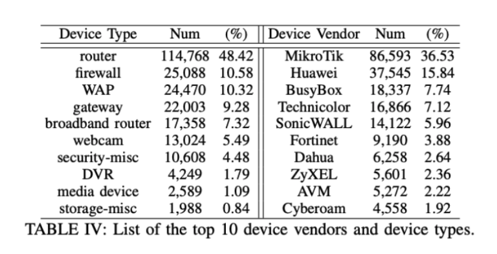
The types of devices typically used for residential proxy abuse(7)
Method 4: Build-your-own networks
Companies like Proxidize sell hardware that automates clusters of SIM cards, creating legitimate mobile proxy networks. These setups can manage hundreds of 4G/5G connections simultaneously, providing clean mobile IPs without compromising user devices. This method is growing as providers seek more control and legitimacy compared to other acquisition methods.
Why does traditional security fail against residential proxies?
Traditional security relies on blocking “bad” IP addresses. That’s not hard for data center proxies. But residential IPs look good by default because they belong to legitimate ISPs and real households. This makes IP reputation almost entirely useless against residential proxy attacks.
Rate limiting doesn’t work either, because attackers rotate through millions of different residential IPs. Each IP might only make one request before switching, making rate limiting ineffective. Most security tools don’t catch the subtle geographic inconsistencies that could reveal proxy usage.
Residential proxy abuse requires a stronger defense
Modern bot detection software analyzes behavior patterns instead of just IP addresses. Even if bots use residential IPs, they still behave differently than humans through subtle timing patterns, request sequences, and interaction methods.
DataDome’s bot protection solution examines hundreds of signals simultaneously: browser fingerprints, timing patterns, mouse movements, request sequences, and device characteristics. This creates a comprehensive behavioral profile that’s much harder for bots to fake than simply rotating IP addresses. DataDome analyzes these signals in real-time, making decisions in under 2 milliseconds without disrupting legitimate users.
Because many residential proxies are shared across multiple bot operators, DataDome’s machine learning models can identify behavioral patterns that reveal proxy usage regardless of IP reputation. The platform continuously learns from billions of requests across its network, spotting new proxy patterns as they emerge and updating detection models automatically.
The bottom line
Residential proxies represent a fundamental shift in how bots evade detection. With 84% of websites unable to detect residential proxy abuse, attackers have a massive advantage. The solution isn’t better IP blocking. It’s behavioral detection that looks beyond IP addresses to identify non-human patterns. As the residential proxy market continues growing, businesses need protection that can spot sophisticated bots regardless of how legitimate their IP addresses appear.
Want to see how residential proxy traffic is hitting your site? DataDome’s advanced behavioral bot detection identifies residential proxy abuse in real-time, protecting your business without blocking legitimate customers. Try DataDome’s free 30-day trial today.
References
- https://xianghang.me/files/ndss21_mobile_proxy.pdf
- https://www.helpnetsecurity.com/2024/03/26/smartphone-apps-proxy-network/
- https://www.aboutchromebooks.com/banned-chrome-extensions/
- https://thehackernews.com/2025/01/13000-mikrotik-routers-hijacked-by.html
- https://www.trendmicro.com/en_gb/research/25/a/iot-botnet-linked-to-ddos-attacks.html
- https://thehackernews.com/2025/05/breaking-7000-device-proxy-botnet-using.html
- https://www-users.cse.umn.edu/~fengqian/paper/rpaas_sp19.pdf

Related posts

Why Layering a Specialist Bot & Agent Trust Solution With Your CDN Is Now Essential
Tell me more

Introducing DataDome’s AI Key Takeaways Feature: Understand Your Protection at a Glance
Tell me more

Beyond Detection Accuracy: Measuring the Real Business Impact of Bot Management
Tell me more

How Kiabi Cut Malicious Login Attempts & Gained Instant Threat Visibility
Tell me more

