


What is a Virtual Waiting Room? Your Guide to Online Queue Management
A virtual waiting room is software that holds excess web traffic in a queue when demand exceeds capacity, then releases visitors back to your site at a controlled rate. It keeps your infrastructure live during ticket sales, product launches, and viral spikes.
Virtual waiting rooms have become standard infrastructure for managing traffic surges, but not all queue management systems are built the same. This guide covers how virtual waiting rooms work, when businesses need one, and what separates modern solutions from legacy approaches.
Key takeaways
- A virtual waiting room intercepts visitors before they reach your application and admits them at a controlled rate, especially during peak traffic periods.
- Modern waiting rooms must distinguish between humans, malicious bots, and authorized AI agents. Treating all three as identical visitors crowds out the visitors who matter most to your business.
- Legacy systems make a single check at entry. Modern systems provide continuous validation throughout the session.
- Edge-native, fail-open architectures keep your site live even if your waiting room provider has an issue. Off-domain redirects create dependencies on third-party infrastructure.
- Buying criteria for a queue management system should center on detection accuracy, continuous validation, configuration speed, and AI agent trust framework capabilities.
What is a virtual waiting room?
A virtual waiting room software sits in front of your website or app. When traffic exceeds the threshold you set, new visitors are held in a queue and admitted at the rate your infrastructure can handle.
Visitors typically see a branded page with their position, an estimated wait time, and live updates, while only a manageable number of active users are let through.
Without a virtual waiting room, sudden traffic spikes can overwhelm databases, payment processors, and inventory systems. With it, your infrastructure stays within capacity no matter how many people show up.
But the rise of agentic traffic means modern waiting rooms must move beyond simple volume control. According to DataDome’s 2026 State of Bot & Agent Security Report, malicious automated traffic grew 9x faster than human traffic between July 2025 and June 2026, with DataDome’s network recording 52.7 billion AI agent and LLM crawler requests over that period. Additionally, the report found that only 2.4% of tested websites were fully protected against bots and spoofed AI agents. A waiting room that cannot separate a real person from a bot—or distinguish authorized agents from malicious ones—is no longer sufficient.
How does a virtual waiting room work?
Most virtual waiting room systems follow four stages: interception, queuing, validation, and admission.
- Interception: When demand crosses a configured threshold, new requests are intercepted at the network edge before they reach your server, protecting your infrastructure from traffic spikes and server overload.
- Queuing: Visitors are placed in a virtual queue, usually first-in, first-out, and assigned a unique token that tracks their position. For scheduled events, some systems randomize position at the moment a sale opens, which neutralizes the advantage of arriving milliseconds early.
- Validation: This is where most systems are weakest. The waiting room evaluates request signals to decide whether the visitor is a person, an authorized AI agent, or a malicious bot. Basic implementations check the user agent and IP. Stronger systems continuously analyze dozens of behavioral and device-level signals, not just at entry.
- Admission: Once capacity opens up, visitors are released to the site with a cryptographic token that prevents queue-jumping. The release rate is configurable, so teams can slow admission if backend systems start to degrade.
The architectural choice behind these stages matters more than most realize. Edge-native waiting rooms run at the CDN level and never redirect traffic off your domain. Older systems use HTTP 302 redirects to route visitors through the vendor’s infrastructure. If the vendor has an outage during an active queue, redirected visitors can’t reach your site and complete their purchase. Off-domain handoffs can also interfere with SEO.
4 reasons businesses need automated queue management
Automated queues protect what matters most during high-traffic events: revenue, reputation, and reliability.
Here are four reasons why a queue system is an important part of visitor management:
1. Infrastructure protection
A traffic surge can trigger cascading failure. Your database hits connection limits, application servers run out of memory, and your entire stack can collapse under load it was not sized to handle.
An automated queue meters admission based on real-time capacity, keeping backend systems within thresholds.
2. Customer experience & brand reputation
Fairness matters. When customers are competing for limited inventory, a visible waiting room signals that everyone is being served in order, resulting in a better customer experience.
Without a transparent virtual waiting room, customers refresh endlessly and blame your brand when they fail to get through.
3. Inventory security
Fraudsters using scalping bots exploit the system, locking up inventory and preventing legitimate buyers from completing transactions.
A queue with bot detection identifies and deprioritizes fraudulent traffic, ensuring real customers and authorized agents get through to the inventory.
4. Operational control
An automated queue gives teams decision-making power in real time. You control who gets in, how fast, and under what conditions.
Modern waiting rooms also let businesses decide whether to enable agentic commerce. You can allow authorized AI shopping agents into the queue while blocking malicious bots and unauthorized agents.
What are the main use cases for virtual waiting rooms?
You need virtual waiting room technology anytime demand can plausibly exceed supply, especially in the following instances:
- Ticket sales and live events: Concerts, sporting events, and festival on-sales generate extreme demand on the web. Traffic spikes routinely exceed inventory by orders of magnitude, and ticket scalping bots are a pervasive threat.
- Product drops and flash sales: Limited-edition releases in retail, fashion, sneakers, and consumer electronics attract scalper bots designed to claim inventory at machine speed. Without a clean virtual queue, real customers lose to bad bots every time.
- Travel and hospitality fare releases: Promotional fare windows draw scraper bots and aggregators. Traffic surges can slow performance and crowd out legitimate customers.
- Gaming launches and in-game events: A waiting room admits players at a rate matchmaking and inventory systems can support.
- Unplanned traffic surges: Viral moments, influencer mentions, and PR coverage can drive unforeseen traffic surges. An always-on waiting room activates when traffic exceeds a specific threshold.
- Public-sector and regulated registrations: Application windows, license releases, and benefit enrollments are often subject to first-in-first-out fairness rules. A bot jumping the queue can become a compliance issue.
Why legacy virtual waiting rooms fail against modern bot & AI agent threats
Legacy virtual waiting rooms were built for traffic volume, not traffic quality. That design breaks down when bots and unauthorized AI agents flood the queue alongside real customers.
There are three key reasons why legacy waiting rooms fail:
1. One check at the door
Most queue vendors evaluate a visitor once at entry, then admit them. After admission, behavior goes unmonitored. This works for humans, who behave consistently. It fails against bad bots that enter the queue dormant, then activate once admitted to scrape inventory or hammer checkout at machine speed.
Modern virtual waiting rooms provide continuous validation, re-evaluating visitors throughout the session and forcing suspicious users out if behavior changes.
2. Limited signal depth
Legacy queue systems check a limited number of server-side signals per request. Today’s malicious automated traffic mimics human behavior, rotates IPs, and uses residential proxies. Without analyzing hundreds of client- and server-side signals per request, legacy systems can keep virtual waiting rooms free of malicious traffic.
3. No framework for AI agents
Authorized AI shopping agents are now part of the traffic mix. Gartner projects that 33% of enterprise software applications will include agentic AI by 2028, up from less than 1% in 2024.
However, legacy waiting rooms have no native way to distinguish an authorized AI agent from a malicious one. They either block all automation—losing legitimate traffic—or allow all automation, which lets unauthorized agents through. Neither outcome serves the business.
5 capabilities to look for in a modern virtual waiting room
If you are evaluating providers, focus on five capabilities:
1. Detection accuracy and signal depth
Standard waiting rooms check user agent, referer, and IP. That is not enough against modern bots. Look for systems that evaluate at least 30 server-side signals per request and use behavioral models trained on a large daily signal volume.
2. Continuous validation
The system should re-evaluate visitors after admission, not only at entry. Ask vendors directly: can you filter out dormant bots and AI agents that change behavior after entry? Most cannot.
3. AI agent trust framework
You need configurable policies for AI agents distinct from humans and bots. That includes the ability to authorize specific agent types—such as consumer shopping agents—and the ability to implement access policies by agent type.
4. Edge-native and fail-open
Traffic should never leave your domain. The system should be fail-open by design: even if the vendor has an issue, the next request should be evaluated normally.
5. Configuration speed
During a live event, configuration changes must propagate immediately, without delay. Anything slower means your operations team cannot react to what is happening in real time, and risks website crashes or performance degradation.
Pro tip: Run a discovery question on every vendor: “After a visitor is admitted from the queue, can your system force them back if they start behaving suspiciously?” If the answer is no, you have a single-point check, not continuous protection.
Deploy fraud-free waiting rooms with DataDome Priority Protect
A virtual waiting room is the access control layer for high-value moments when bots, AI agents, and real customers all arrive at once, and ensures the right traffic gets through.
If you’re auditing your online queue platform, you should assess whether your current solution can tell a malicious bot from a customer or authorized AI agent in real time, and whether it continuously assesses the intent behind each request to identify when behavior changes.
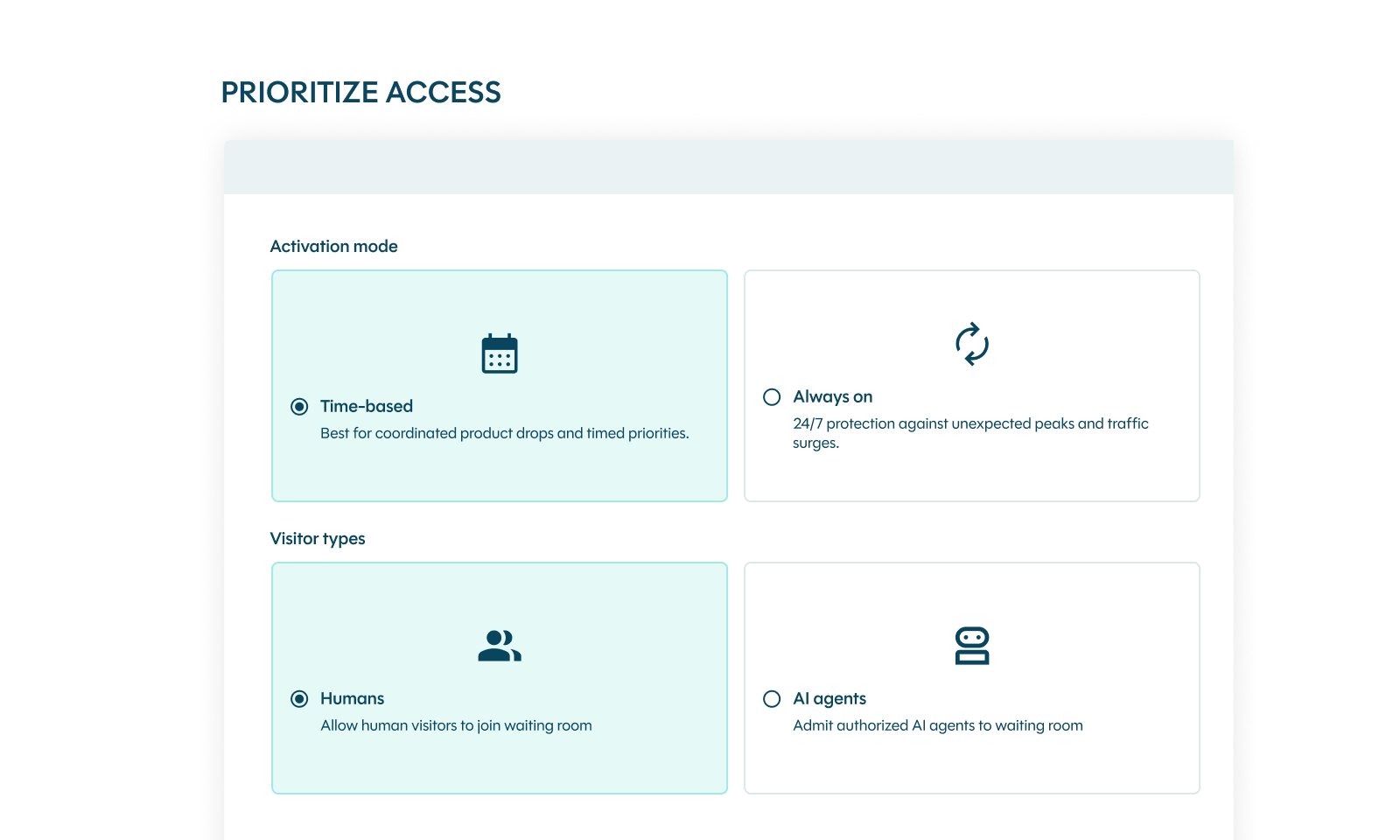
DataDome Priority Protect is the only solution in the virtual waiting room category built directly on a bot management engine that processes 5 trillion signals daily across 85,000+ AI models. That foundation drives the continuous validation and AI agent classification that legacy virtual waiting rooms were never built for.
To see how Priority Protect offers secure access to clean waiting rooms, book a demo today.
Virtual waiting room FAQs
A load balancer distributes incoming requests across multiple servers. It is stateless and does not cap how many visitors can be active at once. A virtual waiting room is stateful, caps total concurrency, and admits visitors at a controlled rate. The two solve different problems and are typically used together.
Not for handling traffic spikes. Autoscaling reacts in minutes, but a Black Friday or ticket on-sale traffic surge can happen in seconds. Scaling every backend service to handle a 100x peak that lasts an hour is also expensive. A waiting room caps concurrency at a level your normal capacity supports.
A modern one does not have to. Look for systems with explicit AI agent policy controls, including the ability to permit specific agent types while blocking unauthorized automation.
They can be, depending on the architecture. Off-domain 302 redirects insert third-party URLs into the user journey, which can interfere with crawlers and link equity. Edge-native systems that keep traffic on your domain do not have this problem.

Related posts

Introducing DataDome’s AI Key Takeaways Feature: Understand Your Protection at a Glance
Tell me more

Beyond Detection Accuracy: Measuring the Real Business Impact of Bot Management
Tell me more

Meta’s Muse Is Bringing Agentic Browsing to the Masses. Here’s Why That Matters
Tell me more

How Kiabi Cut Malicious Login Attempts & Gained Instant Threat Visibility
Tell me more

