
How to Prevent Ticket Scalping: 3 Strategies to Protect Your Business from Ticket Bots
If you run an online ticketing business, you know how much ticket scalping attacks can frustrate your customers.
The numbers prove it: According to O2 and YouGov data, people in the UK spend an extra £145 million (~$200 million) a year due to expensive ticket resales(1). That’s unfair to real fans, because scalpers use sophisticated bots that regular customers don’t stand a chance against.
This article will explain what ticket scalping is, its impact, how ticket scalping bots work, and how you can stop ticket scalping attacks with solutions that deploy quickly and easily.
Key takeaways
- Bot attacks increase ticket costs: Real fans pay millions extra each year due to scalping, while the secondary ticket market continues to grow rapidly.
- Multiple threats beyond scalping: Bots cause server crashes, steal content, commit payment fraud, and tie up inventory without buying.
- Traditional security fails: Modern bots mimic human behavior so well that basic CAPTCHAs and IP blocking can’t stop them.
- Real-time protection works: Advanced bot detection stops attacks in milliseconds using machine learning and shared intelligence.
What is ticket scalping?
A ticket scalper is a bot programmed to buy as many tickets as possible for resale at high markups. These bots target popular events like concerts and sports games or popular products like consoles, sneakers, and graphics cards.
Because bots work faster than humans, they snap up huge numbers of tickets before real customers can buy them at fair ticket prices.
The impact of ticket scalping bots
The ticketing industry is big business. The music event market alone is projected to hit $487 billion by 2032(2). This massive market attracts cybercriminals looking to steal their share. With success: The US secondary ticket market is expected to grow by 18.4% annually from 2024 to 2029, growing by $19.97 billion in that period(3).
As the market grows, so does the scale of bot attacks: O2 blocked more than 50,000 ticket bots in just six weeks(1), proving that reselling tickets relies heavily on automated scalping. Individual attacks can be massive too:
- One ticket broker grabbed 30,000 “Hamilton” tickets in 2015-2016.(4)
- Hacking group Sp1d3rHunters helped hackers create more than 38,000 duplicate concert tickets.(5)
Ticket scalping doesn’t just affect concerts and sporting events. The travel and hospitality industry is affected too, accounting for 27% of all bot-related activity worldwide(6).
DataDome’s State of Bot & Agent Security Report 2026 found that scalping is on the rise, increasing 290.7% between July 2025 and June 2026.
How do scalping bots work? 5 step overview
1. Choose a target
Attackers research upcoming events or products to find the most profitable opportunities. They look for concerts by major artists like Taylor Swift or Beyoncé, championship sports games, or exclusive product launches. High demand combined with limited supply creates the perfect conditions for massive profits on resale sites. Attackers also monitor social media and entertainment news to identify which events will generate the most hype.
2. Test defenses
Weeks or months before major sales, criminals test what protections exist. They send small amounts of scalper bots to buy lower-demand tickets. Small test volumes often go unnoticed among real buyers. They test different user agents, IP rotation patterns, and purchase behaviors to see what gets their bots blocked and what doesn’t.
3. Gather stolen payment data
Many attackers source stolen credit card information from dark web marketplaces before launching their attacks, although scalping attacks don’t always involve stolen payment data. Fresh card data costs just a few dollars per card, but it eliminates the financial risk entirely.
Some criminals use card cracking attacks on smaller e-commerce sites to validate which cards still work before using them on high-value ticket purchases. This approach turns ticket scalping into pure profit, since they’re not investing their own money.
4. Attack when tickets go live
When tickets officially go live, attackers deploy hundreds or thousands of bots or compromised AI agents simultaneously, each programmed to navigate the ticketing website, select the maximum number of tickets, and complete purchases within seconds.
Modern attacks increasingly use AI agents that can adapt their behavior in real time to evade detection. Agentic commerce also poses new threats for the ticketing industry, as scalpers hide behind the rise of legitimate agent-assisted transactions.
In a recent scalping attack stopped by DataDome, attackers launched more than 16 million malicious requests targeting sporting event tickets. The 6-day attack involved nearly 4 million unique IP addresses and reached over 133 requests per second at peak velocity. DataDome stopped the attack, and no tickets were lost to scalpers.
5. Resell at high markup
Attackers immediately list secured tickets on secondary marketplaces like StubHub, Vivid Seats, or social media platforms. They typically mark up ticket prices by 200-500% or more, depending on demand.
How to prevent ticket scalping: 3 key strategies
Establish buying limits
Buying limits restrict how many tickets each customer can buy per transaction, session, or day. You might limit customers to four tickets per checkout or eight tickets within 24 hours.
Buying limits help slow basic attacks, but they create friction for legitimate customers. Corporate groups, families, and fan clubs often need more tickets than limits allow. When real customers hit these restrictions, they end up paying markups on secondary markets.
Plus, sophisticated attackers circumvent buying limits by creating dozens of fake accounts with different email addresses, payment methods, and IP addresses. AI agents make this even easier—they can automate account creation and coordinate purchases across hundreds of identities simultaneously.
Use virtual waiting rooms for high-demand sales
Virtual waiting rooms manage traffic spikes during major ticket releases by controlling how many users can access the checkout process simultaneously.
Instead of overwhelming your servers and giving bots a speed advantage, waiting rooms create a fair, first-come-first-served queue that legitimate customers can trust.
The right queue management system should:
- Filter fraud in real time: Continuously analyze visitors throughout their entire session, not just at entry, to detect and remove bots and malicious AI agents before they reach checkout
- Prioritize legitimate traffic: Give real customers and authorized AI shopping assistants fair access while filtering out unauthorized agents and bots
- Prevent infrastructure overload: Control checkout flow to keep your platform stable during peak demand
- Provide visibility into AI agent traffic: Distinguish between legitimate AI-assisted purchases and scalping bots using the same AI agents
DataDome’s Priority Protect is the only virtual waiting room built with real-time fraud detection inside. Unlike traditional queue solutions that bolt on bot detection as an afterthought, Priority Protect continuously evaluates every request throughout the session, analyzing 5 trillion signals daily to remove fraudulent traffic before it can inflate wait times or crowd out real buyers.
Invest in bot and agent trust management
Traditional bot detection can’t keep up with modern threats. Attackers use AI agents that mimic human behavior, adapt to defenses in real time, and hijack legitimate AI shopping assistants with malicious automation.
You need bot and agent trust management that:
- Detects intent, not just automation: Distinguishes between legitimate purchases (human or AI-assisted) and fraud based on behavioral analysis
- Provides complete visibility: Shows you which bots, AI agents, and LLM crawlers are accessing your platform
- Analyzes every request: Not just samples—100% traffic analysis in real time
- Adapts continuously: Learns from new attack patterns across a network of protected sites
- Works without friction: Blocks fraud in milliseconds while legitimate customers check out seamlessly
How to stop ticket scalping with DataDome
DataDome stops ticket scalping across websites, mobile apps, and APIs. We detect intent in real time—whether traffic comes from traditional bots, AI agents, or humans—and block fraud in under 2 milliseconds.
DataDome deploys in minutes and runs on autopilot. Here’s how:
- Real-time threat detection: Our multi-layered AI engine analyzes 5 trillion signals daily using thousands of machine learning models to detect new attack patterns instantly. When we identify a new threat on any protected site, all customers get automatic protection in real time.
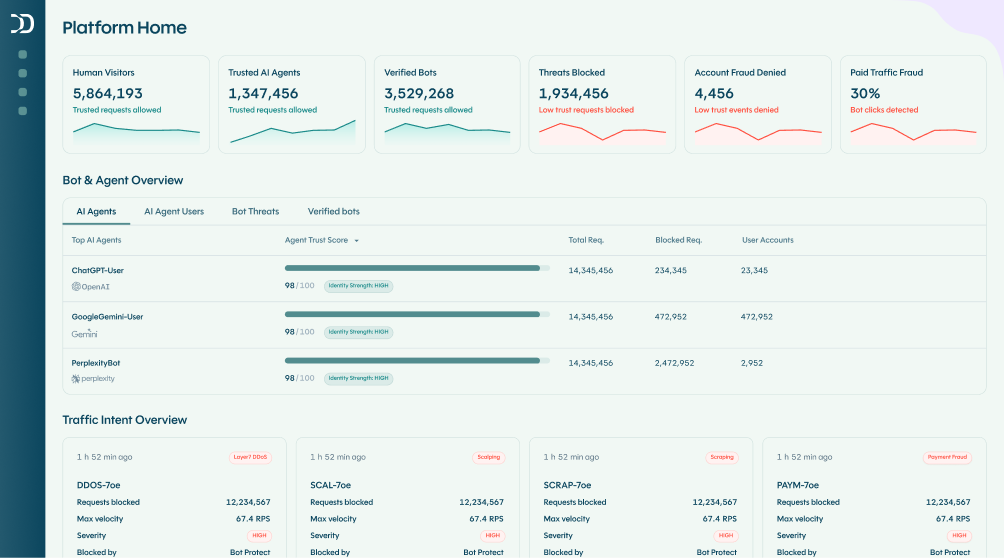
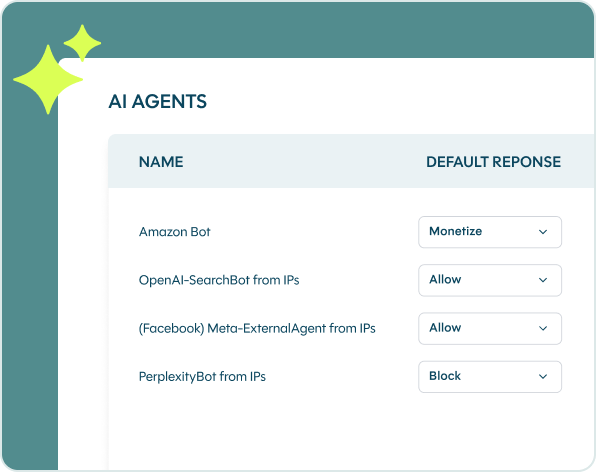
- Complete traffic visibility: Get full visibility into all traffic accessing your ticketing platform. Our dashboard shows you which AI agents are attempting purchases, their behavior patterns, and whether they’re legitimate or fraudulent. You control which agents can buy tickets, and which get blocked entirely.
- Account fraud protection: Scalpers create thousands of fake accounts or take over existing accounts to circumvent buying limits. DataDome’s Account Protect stops account creation fraud, credential stuffing, and account takeover attacks that enable large-scale ticket scalping.
- Customizable policies: Monitor your traffic in real time with extensive customization options for fine-tuning security policies. Set rules for different agent types, adjust detection sensitivity, and track attack patterns across your entire user journey.
And with Priority Protect, DataDome’s intent-aware virtual waiting room that continuously validates every request to keep the queue clean. This way, you can ensure every spot in your queue goes to a genuine fan, not a scalper.
Don’t wait for the next major scalping attack to expose your website’s vulnerabilities. Book a demo to see how DataDome protects ticketing platforms from bots and AI agent threats today.
Ticket scalping FAQ
Legitimate AI shopping assistants help customers find and purchase tickets, but malicious actors can compromise or impersonate these agents to automate scalping at an unprecedented scale. Because of agentic commerce, modern ticket scalping protection requires intent-based detection to distinguish between authorized AI agent purchases and fraud.
Unfortunately, the vast majority are not. According to DataDome’s State of Bot & Agent Security Report 2026, 65.3% of domains are unprotected against bots and spoofed AI agents. Scalpers take advantage of this vulnerability by deploying advanced AI-driven attacks that easily bypass traditional security controls like WAFs and basic rate limiting to hoard ticketing inventory.
Traditional scalping bots follow fixed, predictable scripts to scrape data or spam checkout forms. In contrast, malicious AI agents can simulate human behavior, adapt to defenses, and make real-time purchasing decisions at scale. Because nearly 80% of websites fail to verify AI agent identity, spoofed AI agents can easily make their way in. Ticketing platforms must upgrade to bot and agent trust management software that focuses on intent, not identity, to properly prevent attacks.
References
- https://news.virginmediao2.co.uk/latest-o2-and-yougov-data-nearly-three-quarters-of-concertgoers-want-to-see-rules-against-the-resale-of-tickets-for-profit/
- https://www.globalinsightservices.com/press-releases/music-event-market/
- https://www.technavio.com/report/north-america-secondary-tickets-market-analysis
- https://www.yahoo.com/entertainment/ticketmaster-says-bot-army-bought-225556452.html
- https://www.404media.co/the-ticketmaster-hack-is-becoming-a-logistical-nightmare-for-fans-and-brokers/
- https://www.techradar.com/pro/security/plane-tickets-are-getting-more-expensive-and-ai-bots-may-well-be-the-reason-why-heres-what-you-need-to-know

Related posts