
Agentic Commerce in Ticketing: Opportunities, Threats, & How to Stay Ahead
Picture this: It’s 10 a.m. on a Friday, and Taylor Swift tickets just dropped. But you’re not frantically refreshing Ticketmaster. You’re not even at your computer.
Instead, your AI agent is handling it: comparing prices across platforms, monitoring inventory in real time, and completing checkout the second that floor seats hit your target price. The entire transaction happens in under three seconds. You get a notification: “Purchase complete.”
That’s the reality of agentic commerce, and it’s already here.
73% of consumers are already using AI for shopping. And with industry giants like OpenAI and Visa already developing the protocols and payment networks needed for widespread adoption, AI agents are quickly becoming transactional actors.
Ticketing, with its high-demand inventory, time-sensitive purchases, and notorious scalping bot problem, is ground zero for this shift. This article breaks down what agentic commerce means for the ticketing industry, plus the opportunities it creates and new threats it enables.
What is agentic commerce, and why is ticketing a prime use case?
Agentic commerce definition
Agentic commerce is when AI agents autonomously browse, compare, decide, and transact on behalf of users. Your AI assistant doesn’t just recommend the best seats—it buys them once your specified requirements are met. No clicks, no checkout forms, and no human required.
Why ticketing is a perfect agentic commerce use case
Ticketing has all of the conditions that make AI agents useful:
- High-frequency, time-sensitive decisions: Timing is everything for presales and price drops. Humans can’t monitor multiple platforms 24/7, but AI agents can.
- Multiple competing platforms: Ticketing platforms have different inventory, pricing, and availability. Agents excel at comparison tasks across fragmented marketplaces to help consumers get the best deal.
- Machine-speed checkout: Agent-authorized purchases eliminate the checkout friction buyers hate. Your agent can complete a purchase before you’d normally finish typing your card number.
- Manual, tedious tasks: Monitoring on-sale dates, setting price alerts, and managing resale listings are time-consuming. Agents automate these activities completely.
AI agents turn ticket buying from a high-stress race into a hands-off process. Instead of hunting for deals and battling checkout queues, you set preferences and let your agent do the work.
How can ticketing platforms benefit from agentic commerce?
Agentic commerce means purchases are completed without consumers ever visiting your site. Agents handle the buying journey entirely.
This shift creates challenges, like data attribution and compressed conversion funnels, but it also unlocks new opportunities:
Reduced cart abandonment
Ticketing sees cart abandonment rates above 70%. AI agents that complete purchases without hesitation could largely eliminate this problem for agent-driven flows, allowing ticket marketplaces to capture more revenue.
Better fan experience through improved accessibility
Agentic commerce lowers barriers for consumers who struggle with high-traffic on-sale chaos. When legitimate fans can send their own agents to ticket sales, it levels the playing field against sophisticated scalpers using existing bot tools. No more refreshing pages for hours or losing tickets in checkout.
When agents handle the stressful parts of ticket buying—like comparing prices and racing through checkout—fans associate the ticketing platform with convenience, not frustration.
Platforms that enable seamless agentic commerce build loyalty that extends beyond agent-driven purchases. The platform that made buying easy becomes the default choice, even when fans buy manually.
Agent-first infrastructure as a competitive advantage
The platforms that invest in agent-friendly infrastructure now will capture the majority of agent-driven transactions later. This might look like offering premium API access to AI assistant companies—faster responses, priority inventory, exclusive pre-sale windows. Or, it might entail partnering with AI platforms to become their default ticketing provider.
5 ways agentic commerce enables attacks, fraud, & operational challenges in ticketing
The same infrastructure that enables legitimate AI agents to buy tickets also creates new attack vectors for scalpers and operational headaches for ticketing platforms.
Here are the five biggest challenges:
1. Ticketing sales become DDoS attacks
When thousands of AI agents flood ticketing platforms during high-demand drops, the traffic pattern looks identical to a DDoS attack. Unlike human buyers who click and wait, agents query availability continuously, testing multiple seat combinations simultaneously, and executing purchases the millisecond inventory appears. Infrastructure built to handle 50,000 human buyers refreshing pages now faces 500,000 agent requests per second.
Without agent trust frameworks that distinguish legitimate consumer agents from scalper bots, ticketing platforms face a difficult operational challenge: how do you manage agent-driven traffic spikes without blocking legitimate purchases or letting scalpers through?
DataDome’s Priority Protect is a virtual waiting room with real-time intent detection that gives businesses an agent trust framework to properly manage the traffic increase. Priority Protect continuously evaluates traffic throughout the session, distinguishing legitimate consumer agents from scalper bots during high-demand drops.
Unlike traditional queue systems that only verify at entry, Priority Protect monitors intent at every step, catching bots and malicious agents that adapt their behavior once inside. This ensures clean queues where real fans and authorized agents get fair access to inventory.
2. Spending authority becomes a new fraud vector
How do you grant an AI agent autonomous purchasing power during a high-demand ticket drop without creating liability for unauthorized spending? Unlike traditional e-commerce, agentic commerce requires pre-authorized spending authority. The agent decides when, where, and how much to spend within limits you’ve set.
Visa’s Trusted Agent Protocol and Mastercard’s Agent Pay enable this through tokenized payments and pre-authorized spending limits. Users can delegate purchasing authority to AI agents with dollar-based constraints (e.g., “spend up to $500 for this purchase”), but granular controls—like restricting to specific events, artists, or merchant platforms—aren’t yet part of these frameworks.
But even with these guardrails, new risks emerge: compromised agents with valid spending authority, agents that misinterpret price signals and overpay on resale markets, or agents that purchase tickets the user didn’t actually want. Who’s liable when an agent buys floor seats for $800 because resale pricing spiked, when the user expected $200 face value?
Ticketing platforms may become the arbiter of disputes between users and their own AI agents—a liability minefield even as payment infrastructure matures.
3. Scalpers will disguise themselves as legitimate agentic commerce
The same agentic commerce protocols designed to enable trusted AI agents also create a blueprint for scalpers to mimic. Bad actors will wrap their bots in legitimate-looking agentic commerce identities, complete with proper API credentials and believable user-agent strings, to bypass defenses designed to stop traditional scalpers.
Ticketing platforms must rethink what “trusted automated buyer” means. Is it the AI platform the agent comes from? The individual user authorizing the agent? The payment token? All three? Without clear standards, scalpers will exploit the gray area.
As ticketing platforms tighten their defenses against agent-wrapped scalper bots, legitimate consumer agents may get caught in the crossfire. A fan’s ChatGPT-powered agent trying to buy Taylor Swift tickets triggers the same behavioral signals as a scalper bot: rapid requests, proxy IP addresses, and non-human interaction patterns.
And with some projections estimating that agentic commerce will account for 37% of UK ticket sales by 2028, platforms that over-block legitimate agents risk losing more than a third of their revenue.
4. Upsell and cross-sell revenue vanishes with agentic purchases
When a consumer browses Ticketmaster, they see upsell opportunities at every step: VIP packages, parking passes, seat upgrades, insurance. When an AI agent buys tickets, it does exactly what it was asked and nothing more.
Agent-driven purchases entirely eliminate the digital storefront. Ancillary products that offset thin ticket margins never surface. The ticket sells, but the high-margin revenue disappears.
5. Behavioral data disappears without browsing signals
Agent-driven purchases compress the entire discovery funnel into a single API call, erasing the behavioral signals ticketing platforms use to optimize inventory, pricing, and promotions. Fewer page views mean less data on what drives purchase decisions or how pricing affects demand.
Without this data, platforms lack visibility into whether the user considered multiple pricing tiers or what messaging drove conversion. This will require ticketing platforms to optimize for agent discovery instead of consumer targeting.
How DataDome helps ticketing platforms navigate agentic commerce
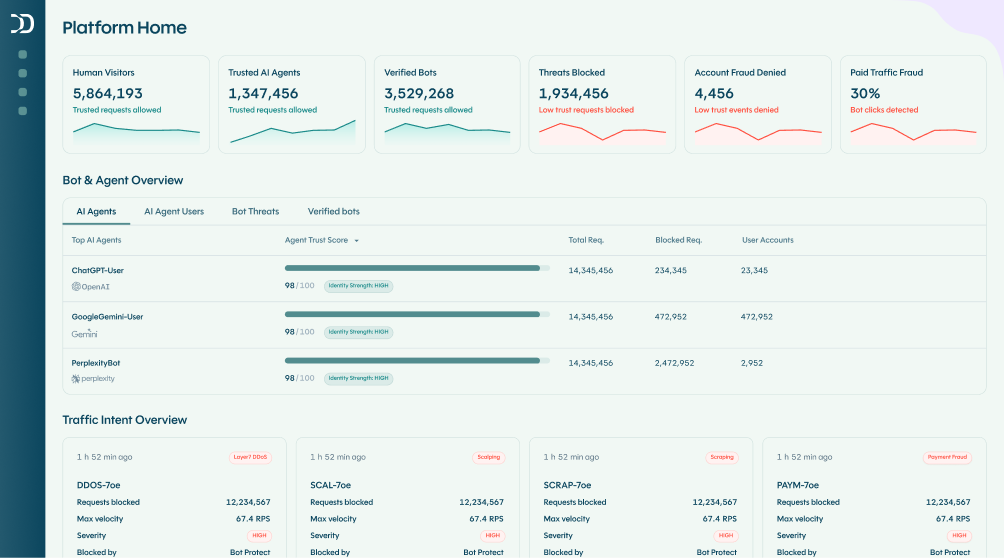
As agentic commerce matures, malicious automated attacks will only become more sophisticated. DataDome’s bot and agent trust management solution is purpose-built to protect high-traffic, high-value inventory from sophisticated threats while enabling real buyers—including legitimate AI agents—to transact seamlessly.
DataDome protects ticketing platforms in three key areas:
- Visibility: Get complete visibility into who’s behind your traffic—whether they’re a human, bot, or AI agent.
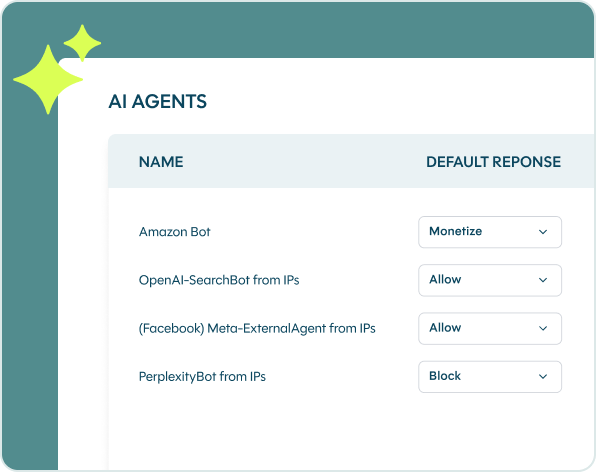
- Control: Gain control over your agentic traffic and decide which agents can access your site, which pages they can visit, and what they can do.
- Trust: DataDome’s agent trust framework is built on intent to stop malicious actors at the edge to prevent fraud before it impacts your business. With thousands of AI detection models that process 5 trillion signals daily, DataDome keeps you ahead of emerging attack vectors.
Agentic commerce is reshaping ticketing—how fans discover events, how they buy tickets, and how platforms protect inventory. The platforms that let legitimate AI agents transact seamlessly while blocking malicious ones will win. The ones that can’t will lose inventory, data, and customers to competitors who can.
Ready to protect your ticketing platform against agent-assisted account takeover, inventory hoarding, and AI data scraping? Book a demo to see how DataDome protects ticketing platforms while enabling frictionless agentic commerce today.
Agentic commerce in ticketing FAQs
AI agents buy tickets by connecting to ticketing platforms through APIs or web interfaces. Users pre-authorize spending limits and set purchase criteria (e.g., “buy floor seats under $200 when available”). The agent continuously monitors inventory across multiple platforms, compares pricing in real time, and executes the purchase the moment conditions are met—using stored payment credentials and tokenized transactions to complete checkout without human clicks.
Not entirely, but it will capture significant market share. Some estimates project that agentic commerce will account for 37% of UK ticket sales by 2028. Many fans will still prefer to browse and purchase manually, especially for high-value or emotionally significant events. However, for routine purchases, price monitoring, and time-sensitive drops, AI agents will increasingly become the preferred method.
Agentic commerce in ticketing is when AI agents autonomously browse, compare, and purchase tickets on behalf of users without human intervention. Instead of manually checking multiple platforms for the best seats, users set preferences (price range, seating section, event) and let their AI agent monitor availability, compare prices, and complete checkout automatically—often in under three seconds.
Upsell revenue often disappears. When AI agents buy tickets, they execute exactly what they were asked—no browsing, no cross-sells, no impulse purchases of VIP packages, parking, or insurance. Platforms must find new ways to expose high-margin add-ons to agents, or accept reduced ancillary revenue.

Related posts

The AI Traffic Report Q3 2026: Agentic Browser Traffic Jumped 4.7x in September as Meta's Muse Hits 29M Requests in 12 Days
Tell me more

Which Industries Are Least Protected From Bots & Spoofed AI Agents in 2026?
Tell me more

AI Traffic Is Up 82%. Can You Tell Which Agents to Trust?
Tell me more

Why Layering a Specialist Bot & Agent Trust Solution With Your CDN Is Now Essential
Tell me more