
The AI Traffic Report Q2 2026: Agentic Traffic Surged 45%, With Meta Taking the Lead
In Q2 2026, DataDome’s network processed 17.7 billion AI agent requests, a 45% increase from Q1, and more than double the pace recorded in our last report.
Scale isn’t the only thing that changed in Q2; behavior did, too. The agents generating the most traffic differ from those in Q1, indicating that the composition of AI traffic is not fixed, and that crawl volume and referral value are moving in opposite directions. What’s more, MCP traffic is now a measurable signal, reflecting an ecosystem in active exploration.
This report draws on DataDome’s network data from April through June 2026, culled from 5 trillion signals analyzed daily across 400+ enterprises.
Key findings
- AI agent traffic surged 45% QoQ. DataDome’s network processed 17.7 billion AI agent requests in Q2 2026, up from 12.2 billion in Q1.
- Meta has taken over the AI web. Meta-ExternalAgent grew +74% QoQ; Meta-WebIndexer grew +163% QoQ. In June 2026, Meta-WebIndexer surpassed Meta-ExternalAgent in monthly volume for the first time.
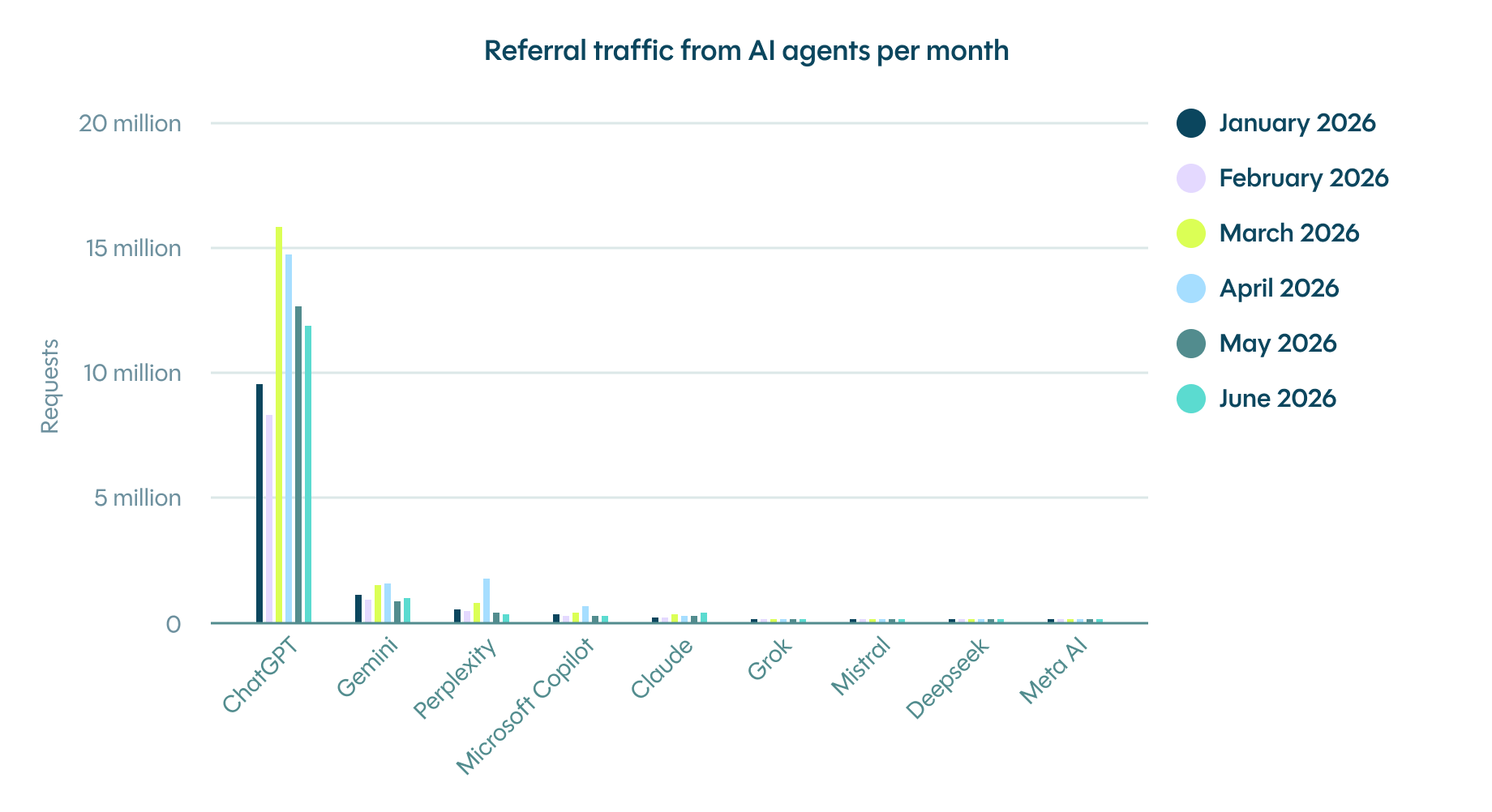
- Crawl volume and referral value are moving in opposite directions. ChatGPT-User, the top agent in Q1, declined 6% QoQ in absolute request volume. Meanwhile, ChatGPT remains the overwhelming leader in AI-driven referral traffic, commanding 80-88% of all AI referrals every month and growing +17% QoQ.
- MCP traffic is now a measurable network signal, with peaks approaching 500,000 requests per day and clear daily usage cycles, representing a new data point that will grow.
AI agent traffic: Volume surges 45% QoQ
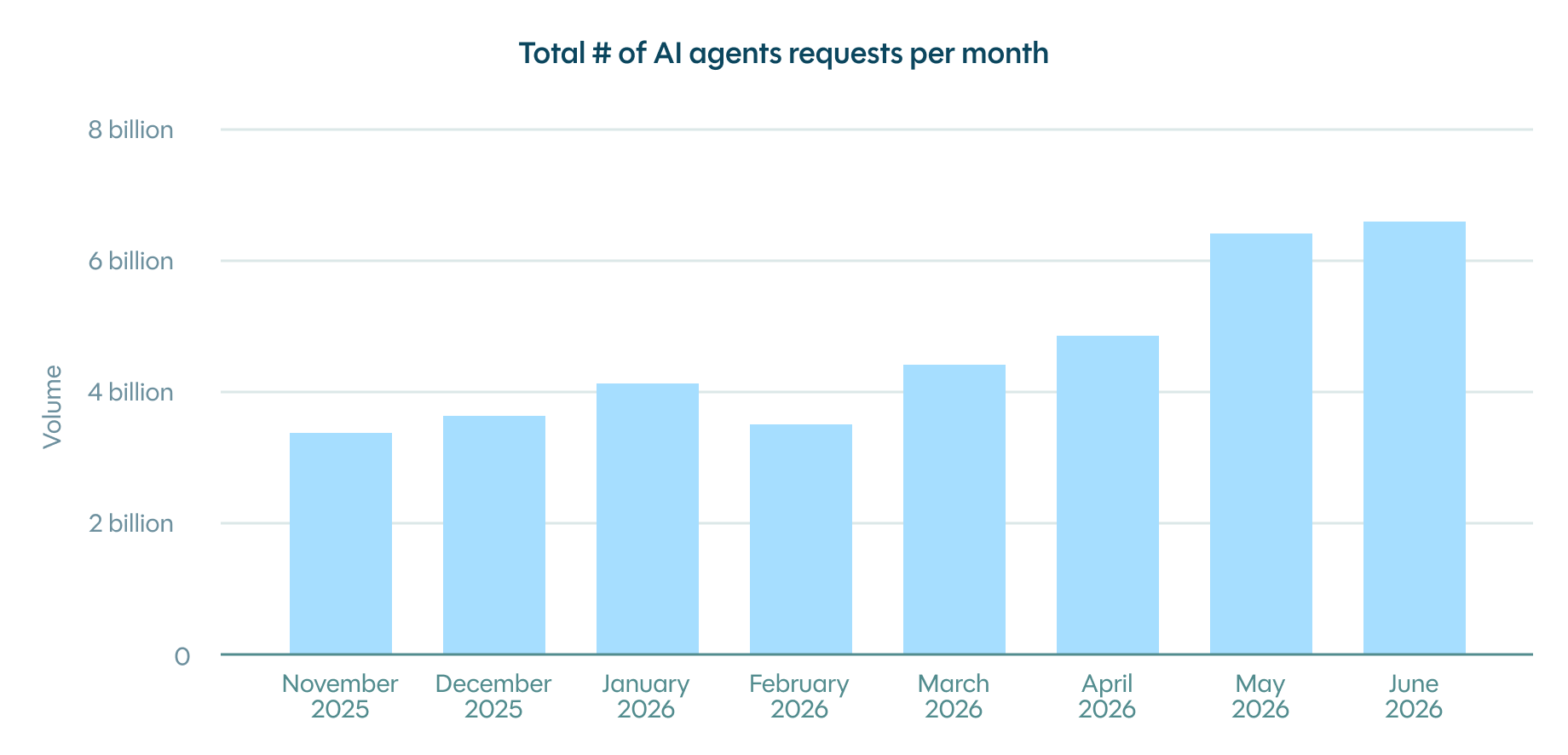
Since the start of 2026, DataDome’s network has processed more than 30 billion AI agent requests in total. In Q2, that traffic surged. DataDome’s network recorded 17.7 billion AI agent requests across April, May, and June 2026, a 45% increase from Q1’s 12.2 billion.
And the monthly trajectory is sharp: April came in at 4.77 billion requests, May surged to 6.29 billion (+32% in a single month), and June held the highest level at 6.60 billion AI agent requests.
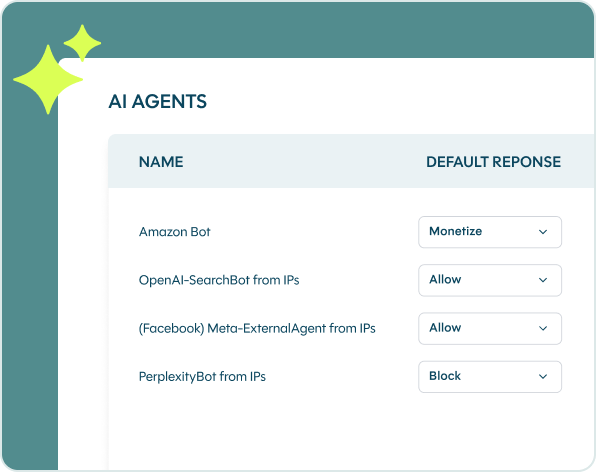
Notably, as AI agent traffic surged, 54% of DataDome customers have already adopted agent trust policies, recognizing that at this scale and pace of change, the ability to distinguish between agents that serve your business and those that simply consume your infrastructure is no longer optional.
Meta’s rising dominance and what it signals
Meta now generates the majority of AI agent traffic on DataDome’s network, and the nature of that traffic is changing.
To understand why, it helps to know what Meta’s two agents actually do. Meta-ExternalAgent works like a researcher: it travels across the web reading content to help train Meta’s AI models. It is oriented toward large-scale data collection with no traffic benefit to the sites it visits. Conversely, Meta-WebIndexer works more like Google’s crawler: it continuously reads and indexes web content so that Meta AI can give users up-to-date answers when they search. Same company, two very different jobs.
In Q2, both agents grew substantially. Meta-ExternalAgent grew +74% QoQ, from 3.1 billion to 5.3 billion requests. Meta-WebIndexer grew even faster, up +163% QoQ from 1.4 billion to 3.75 billion. Together they account for the majority of all AI agent traffic on DataDome’s network, a dominance that didn’t exist in Q1.
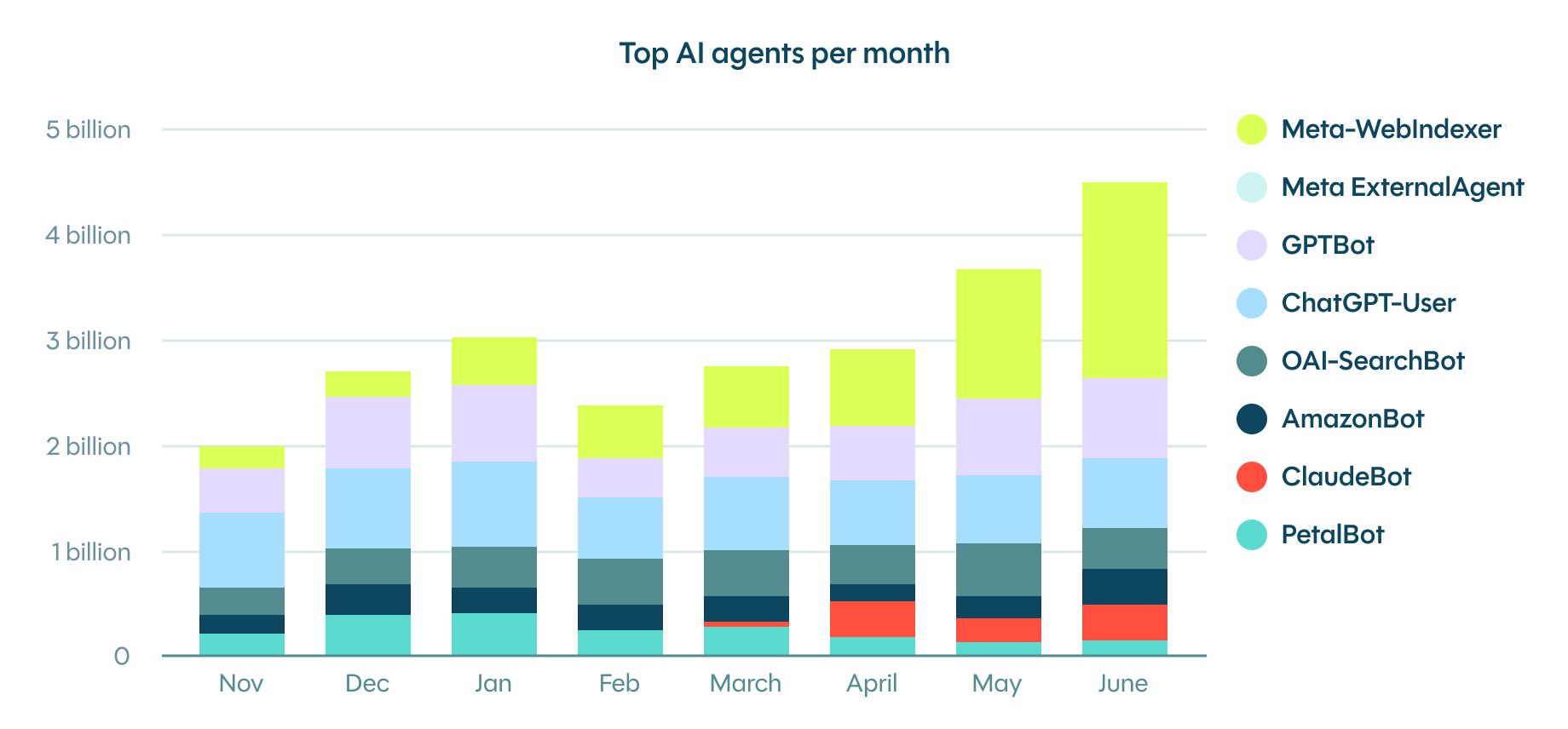
In June 2026, Meta-WebIndexer exceeded Meta-ExternalAgent in monthly volume for the first time. Whether that marks a sustained directional shift or a one-month fluctuation, it is worth watching as Q3 data comes in. What the overall trend does suggest is that Meta is investing increasingly in the “answering” side of AI, building the infrastructure to respond to real-time queries and not just the “learning” side.
Crawl volume and referral value are moving in opposite directions
Not all AI agent activity is created equal, and Q2 made that clearer than ever.
Take ChatGPT, for example. ChatGPT-User, which fetches live pages to answer real-time questions, visited websites 6% less in Q2 than it did in Q1. At the same time, real people using ChatGPT clicked through to websites 17% more, with ChatGPT accounting for upwards of 80% of all AI-driven referral traffic. In other words, ChatGPT is showing up on your server logs less, but sending you more actual visitors.
Meta tells the opposite story. Its two agents generated 9.1 billion requests to sites on DataDome’s network in Q2, more than half of all AI traffic on the network. But those billions of visits sent almost no real visitors back to those sites in return. Put plainly, Meta is one of the largest consumers of web infrastructure today, and website owners get nothing back for it.
Among the other AI tools sending real visitors to websites, Claude saw the sharpest growth in Q2, up +111% from 415,000 to 876,000 referral visits. Perplexity grew +37%. Grok, which had a small but notable presence in Q1, dropped 74% to just 24,000 referral visits by the end of the quarter.
MCP traffic is now a measurable signal
Model Context Protocol (MCP) is the connective layer between AI agents and external tools, data sources, and enterprise services. Since late April 2026, MCP traffic has surged across DataDome’s customer base: from negligible volume to over 130,000 requests per three-hour window within a single week, stabilizing at sustained daily baselines with peaks approaching 500,000 requests per day.
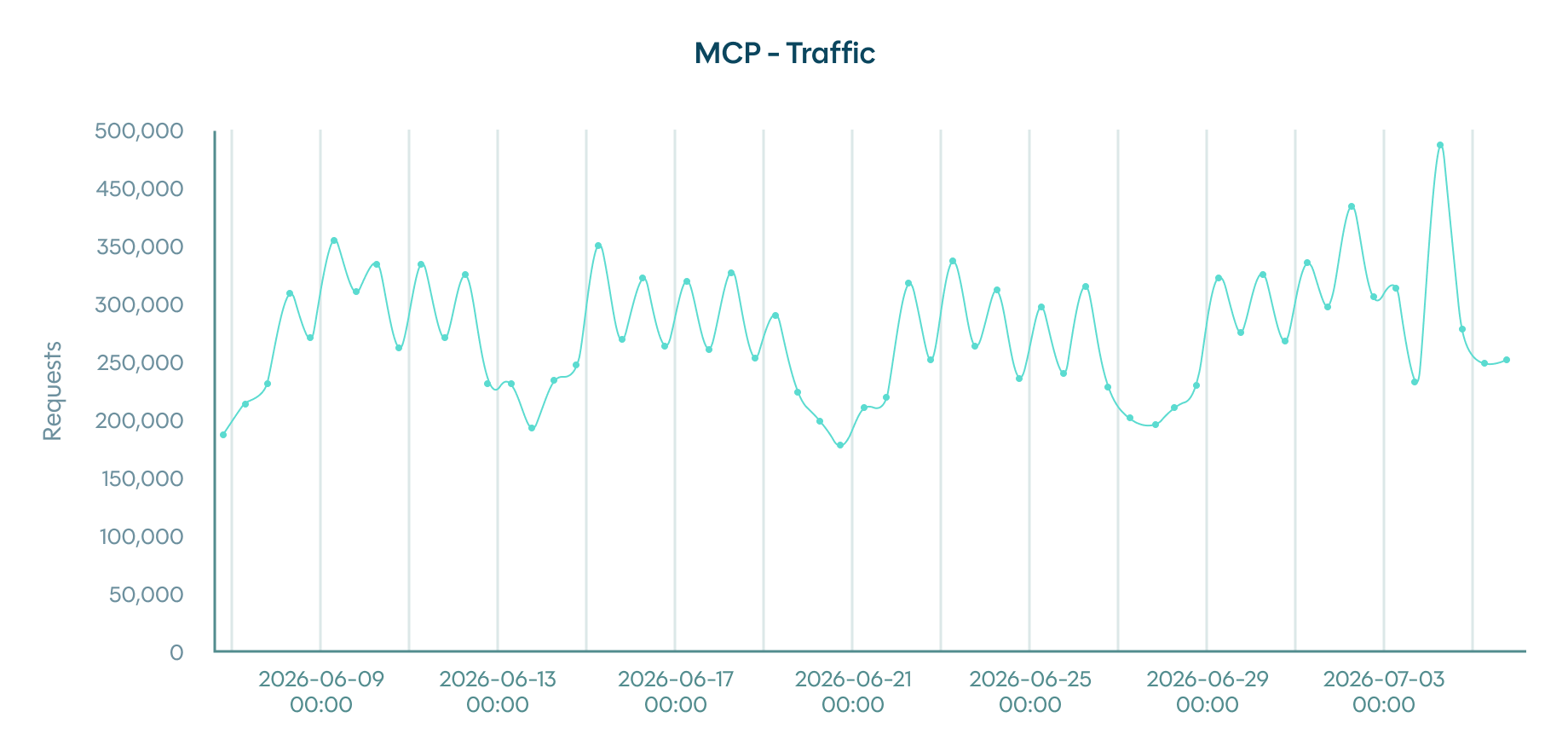
The traffic patterns reflect an ecosystem in active exploration.
The most common request types are evenly distributed across: initialize (20.3%), tools/list (19.7%), prompts/list (20.1%), and notifications/initialized (19.1%). Agents and clients are connecting to MCP servers and enumerating their capabilities, discovering what they can do before they do it.
MCP traffic critically differs from standard crawler traffic in that it is intent-bearing. A tools/list call is not reading content; it is an agent taking inventory of what it can act on. As MCP adoption grows, this traffic layer will become an early indicator of agentic activity before task execution begins, and a new surface for both visibility and risk.
Implications & risks
- The agent landscape is growing fast. AI agent traffic grew 45% in a single quarter, and the top agent rankings shifted between Q1 and Q2. Reviewing and updating agent policies is no longer excessive; it is baseline maintenance.
- Meta’s traffic volume is an infrastructure cost, not a business signal. Meta-ExternalAgent and Meta-WebIndexer together generated the majority of Q2 AI traffic on DataDome’s network, with negligible referral value to the sites they visited. Treating all AI agent traffic as equivalent means subsidizing agents that deliver nothing in return.
- The agent sending you visitors is not the one hitting your servers hardest. ChatGPT drives upwards of 80% of AI-driven referral traffic while its crawler volume declined. Optimizing visibility and access policies for the most recognizable or talked-about agents, rather than the ones generating business value, is a structural blind spot.
- MCP is a new attack surface that is already active. MCP traffic is growing, and its dominant request types (tools/list, initialize) reflect agents inventorying what they can act on before they act. Organizations that begin instrumenting for MCP patterns now will have far more lead time than those that wait for abuse to surface.
Recommendations
- Implement agent-level classification, not just bot/not-bot detection. Meta-ExternalAgent and Meta-WebIndexer require different responses. ChatGPT-User and ChatGPT agent require different responses. Treat them accordingly.
- Monitor MCP traffic now, before task-level abuse scales. The tools/list and initialize patterns are already measurable. Establishing a baseline now enables anomaly detection later.
- Apply behavioral analysis to autonomous agents. Session simulation, form interaction, and API sequencing patterns are detectable with the right instrumentation, but not with signature-based approaches designed for crawlers.
- Validate AI agent identity. User-agent strings are not sufficient for identification. Web Bot Auth (WBA) and IP validation against published crawl ranges are the minimum bar for establishing that an agent is who it claims to be.
- Revisit allowlist logic. Any policy that grants automatic access based on a trusted agent name—ChatGPT-User, PerplexityBot, Meta-ExternalAgent—is exposed. Spoofing of well-known identities remains active and should be assumed in any allowlist design.
Conclusion
The headline from Q2 is straightforward: AI agent traffic grew 45% in a single quarter, Meta now accounts for the majority of it, and the gap between the agents consuming your infrastructure and the agents delivering you value has never been wider.
But the more useful takeaway is what the data reveals about where things are heading. Meta’s shift toward real-time web indexing, ChatGPT’s declining crawl volume alongside rising referral traffic, and the emergence of MCP as a measurable network signal all point to the same underlying trend: AI agents are becoming more purposeful, more varied, and harder to manage with a one-size-fits-all approach.
The organizations that will be best positioned in Q3 and beyond are not necessarily those with the most restrictive bot policies. They are those that can tell the difference between a Meta crawler consuming bandwidth with no return, a ChatGPT session sending real visitors, and an MCP client inventorying what it can act on. That kind of granular visibility into who is on your network, what they are doing, and whether it serves your business is what agent trust policies are built for. The 54% of DataDome customers who have already adopted them are a leading indicator of where the rest of the market is heading.

Related posts

The AI Traffic Report Q3 2026: Agentic Browser Traffic Jumped 4.7x in September as Meta's Muse Hits 29M Requests in 12 Days
Tell me more

Which Industries Are Least Protected From Bots & Spoofed AI Agents in 2026?
Tell me more

AI Traffic Is Up 82%. Can You Tell Which Agents to Trust?
Tell me more

Why Layering a Specialist Bot & Agent Trust Solution With Your CDN Is Now Essential
Tell me more