
Agentic Commerce Security: How to Protect Your Business From AI Agent Threats
AI shopping agents are changing how people buy online. DataDome detected nearly 1.2 billion requests from OpenAI crawlers alone in June 2025, showing the massive scale of AI-driven traffic hitting e-commerce platforms. According to McKinsey research, the US B2C retail market alone could see up to $1 trillion in orchestrated revenue from agentic commerce, with global projections reaching as high as $3 to $5 trillion(1).
But this shift towards agentic AI brings new security challenges. When artificial intelligence agents can browse products, compare prices, and complete purchases on behalf of users, businesses need to verify which agents are legitimate and which are malicious. Traditional security relied on static classifications: allowlisting known crawlers and blocking unknown automation. AI agents break this model because their trustworthiness depends on current behavior, not just identity.
Key takeaways
- AI agents behave differently than traditional bots. They adapt in real time and make autonomous decisions, requiring intent-based detection instead of rule-based blocking.
- Not all AI agents should have the same access. Trust-based security assigns different permission levels based on agent identity, behavior, and business relationships.
- Blocking legitimate agents costs sales. Customers arriving via AI agents convert better than traditional search traffic, so security must protect your business without disrupting helpful agents.
- MCP servers create new attack surfaces. Model Context Protocol gives AI agents standardized access to your systems, requiring proper authentication and behavior monitoring.
- The shift is happening fast. With AI agents expected to handle significant e-commerce interactions over the next few years, businesses need security that adapts as agent capabilities evolve.
What is agentic commerce security?
Agentic commerce security protects online businesses from malicious AI agents while allowing legitimate ones to operate. It identifies which agents from the AI ecosystem are accessing your site, verifies their intent, and applies the right level of access control based on their behavior. Unlike traditional bot detection that simply blocks automated traffic, AI commerce security distinguishes between:
- Legitimate AI shopping agents: ChatGPT Agent, Perplexity Comet, and other AI assistants that help real users find and buy products
- Malicious AI bots: AI automation that scrapes pricing data, inventory levels, or proprietary content without your permission
- Fraudulent agents: AI systems designed to exploit vulnerabilities, manipulate checkout processes, or conduct payment fraud, sometimes by pretending to be legitimate agents.
The goal is to enable helpful AI agents while blocking harmful ones.
Why does agentic commerce need different security?
Agentic commerce requires a fundamental shift in how we think about security. The challenge isn’t distinguishing between humans, bots, and AI agents. It’s about verifying identity and evaluating behavior regardless of who or what is making the request. A human using an AI agent to place a legitimate order looks similar to a fraudster using an AI agent to test stolen credentials. Here are three reasons why agentic commerce security focuses on identity and behavior:
1. AI agents operate autonomously
Traditional bots follow simple scripts. Autonomous agents incorporate autonomous decision-making, adapting their behavior based on what they find. This makes them harder to detect using rule-based workflows that look for repetitive patterns.
An AI agent might browse product pages for minutes, add items to a cart, then suddenly change course based on new information. This natural variation mirrors human behavior, which is exactly why static detection methods struggle.
2. AI agents access multiple systems
A single AI assistant might connect to your product catalog, payment gateway, inventory system, and customer service platform in one session. Each connection point creates a potential vulnerability if the agent’s credentials are compromised or if the agent itself is malicious.
Agents typically spend significant time researching products before initiating any purchase, browsing through catalogs, comparing specifications, and checking availability. This extended research phase means agents need broad access to your website before making transactions.
3. AI agents can be manipulated
Just as AI agents can help users, they can also be tricked. Malicious actors can:
- Feed false information to agents to manipulate their recommendations
- Compromise agent credentials to make unauthorized purchases
- Use social engineering to bypass agent safety guardrails
- Deploy adversarial attacks against the AI models powering agents
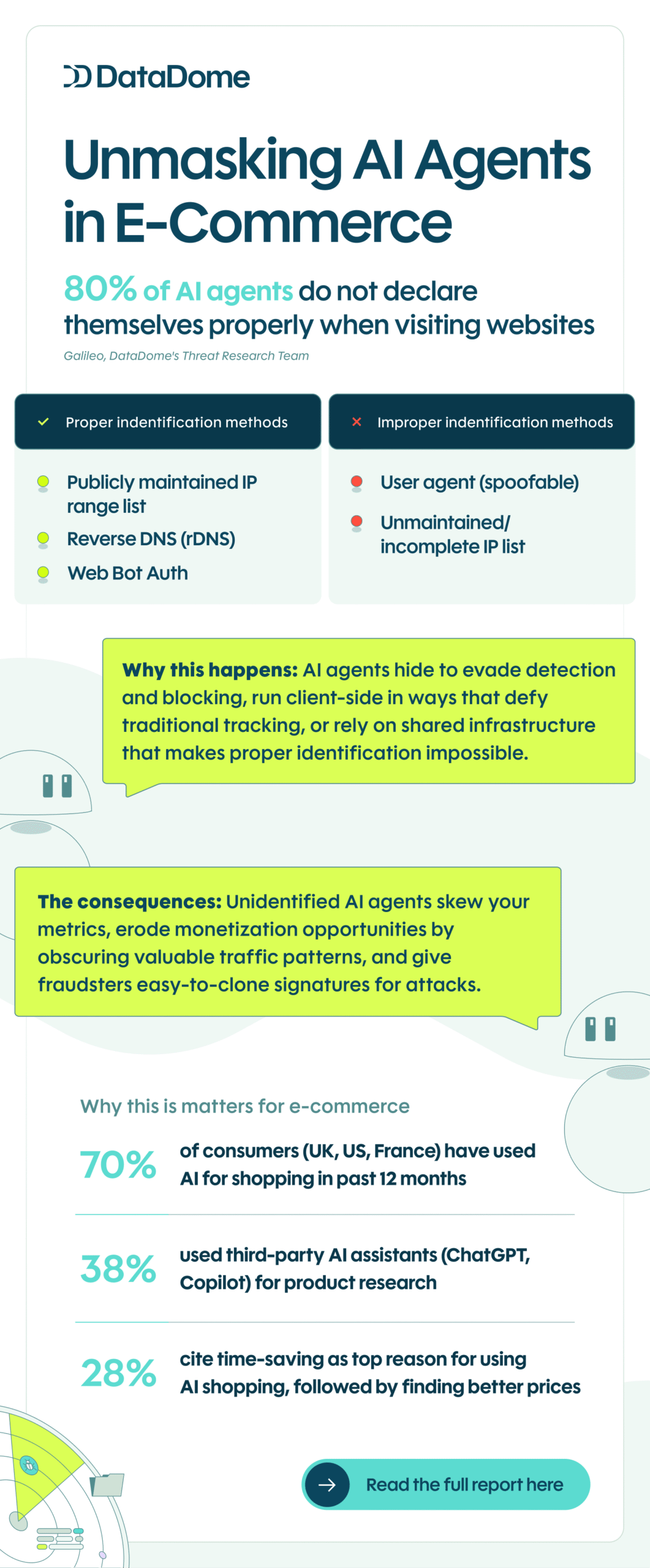
Security platforms are already seeing AI agents being used for malicious purposes, from credential stuffing to inventory scraping. However, when businesses implement proper agent verification and behavior monitoring, these attacks become much easier to detect and block before they cause damage.
What are the key agentic commerce security risks?
Understanding specific agentic commerce security threats helps you build appropriate defenses.
Unauthorized data harvesting
AI agents can systematically scrape your prices, product descriptions, customer reviews, and inventory levels. This competitive intelligence gathering happens at machine speed across your entire catalog.
Some agents claim to be legitimate shopping assistants but actually feed data to competitor analysis tools or price comparison engines that undermine your pricing strategy.
Payment fraud and account takeover
When AI agents can initiate transactions, compromised agent credentials become a direct path to e-commerce payment fraud. An attacker who gains control of a user’s AI shopping agent can make unauthorized purchases, change delivery addresses, or extract stored payment information.
E-commerce fraud losses in e-commerce reached $44.3 billion in 2024 and are projected to surpass $100 billion by 2029(2). AI-powered fraud tools are accelerating this trend, with GenAI-enabled scams increasing significantly every year.
Scalable abuse of promotions and policies
AI agents can test promo codes at scale, exploit return policies across thousands of products simultaneously, or identify and abuse pricing errors faster than human users ever could. This programmatic policy abuse drains profit margins and disrupts operations.
Traditional rate limiting doesn’t work well here because legitimate agents also make many rapid requests while researching products.
Loss of customer relationships
When AI agents become the primary interface between customers and your products, you lose direct contact with your buyers. You can’t build brand loyalty with someone you never interact with. Worse, malicious agent interactions might redirect customers to competitors or manipulate which products get recommended.
How to secure and prepare your business for agentic commerce
Effective security requires identifying agents, verifying their intent, and applying appropriate access controls.
Detect and classify AI agents in real time
The first step is knowing which visitors are AI agents and what they’re doing. Modern detection systems analyze:
- Request patterns: How agents navigate your site, which endpoints they access, and the sequence of their actions
- Protocol signals: Whether requests come through LLMs, Model Context Protocol (MCP) servers, or other agent-specific interfaces
- Behavioral fingerprints: How agents interact with JavaScript, handle cookies, and respond to challenges
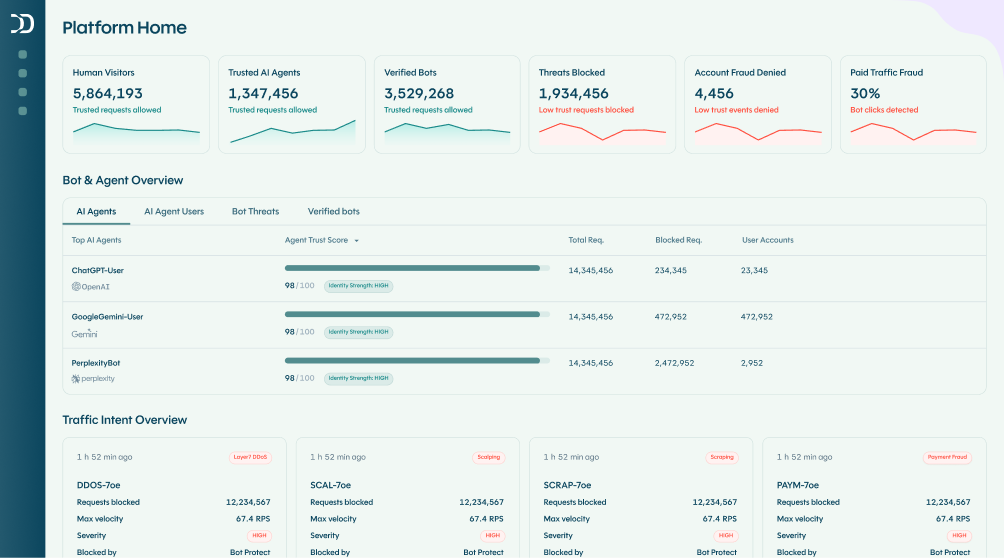
DataDome’s cyberfraud platform analyzes billions of signals in real time to distinguish between human users, legitimate crawlers, and AI-driven bots. The platform leverages machine learning models trained on global traffic patterns to continuously adapt to new automation techniques, ensuring that even stealthy AI agents are detected before they can extract data or misuse your platform. This includes identifying traffic from MCP servers, AI browsers like Comet and Atlas, and AI platforms like ChatGPT and Perplexity.
“To fight AI-driven bots, you have to understand what they’re trying to do, not just who they are. That is what DataDome helps us do,” says Dan Ayash, Director of Advanced Cybersecurity Solutions at PayPal.
Establish agent trust levels
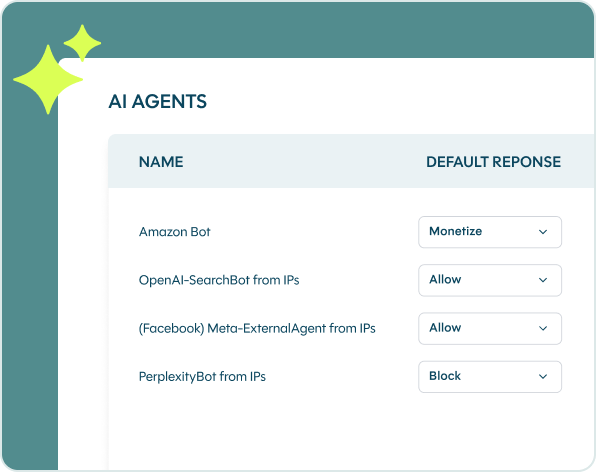
Not every commerce agent should have the same access. An agent trust-based approach assigns different permission levels based on:
- Known agent identity: Is this ChatGPT Agent, an unknown system, or a spoofed identifier?
- Observed behavior: Does the agent’s activity align with legitimate shopping research or aggressive scraping?
- Business relationship: Do you have a formal partnership with the agent provider? Is the agent used by one of your customers?
- Intent signals: Is the agent helping a real user or operating autonomously for data collection?
This trust layer lets you allow helpful, trusted agents, challenge suspicious ones, and block malicious activity without disrupting legitimate AI commerce.
Protect against AI-powered fraud
Traditional fraud detection looks for unusual purchase patterns or suspicious account activity. AI-powered fraud prevention adapts in real time, analyzing:
- Whether an agent’s purchase intent aligns with its research behavior
- If multiple agents share compromised credentials
- Whether agents exploit specific vulnerabilities in your checkout flow
- How agent traffic patterns deviate from known legitimate baselines
DataDome’s AI fraud detection uses behavioral analysis to identify malicious AI agents before they can complete fraudulent transactions. The system adapts as AI agent capabilities evolve, maintaining protection against new attack vectors. An agent that appears legitimate during browsing may reveal malicious intent at checkout, and DataDome adapts its response in real time. This continuous verification maintains protection as AI agent capabilities evolve and ensures that trust decisions reflect current behavior, not past classifications.
Block malicious AI without harming legitimate traffic
The biggest risk in agentic commerce security is blocking helpful agents that would have led to sales. Every blocked legitimate agent request potentially sends that customer to a competitor. Effective security must:
- Allow good agents to research products freely
- Apply verification steps at transaction points, not during browsing
- Respond to suspicious activity with challenges rather than outright blocks
- Monitor conversion impact of any restrictions
What next for agentic commerce security?
The shift to agent-driven commerce is accelerating rapidly. AI agents are becoming a primary channel for product discovery and purchase, bringing both opportunities and security challenges at unprecedented scale.
Businesses that prepare now will have competitive advantages:
- Better customer experiences through seamless agent integration
- Protected profit margins by preventing price scraping and policy abuse
- Stronger security postures that adapt to evolving AI capabilities
- Direct relationships with customers even in an agent-mediated market
DataDome’s MCP protection provides the foundation businesses need to secure this transition. By identifying AI agents at the protocol level and applying real-time trust scoring, companies can enable legitimate AI commerce while blocking malicious activity. This approach protects your business without sacrificing the conversion benefits that helpful AI agents deliver. Learn more here.
FAQ
Agentic AI security protects businesses and users from threats posed by autonomous agents that make decisions and take actions independently. Unlike traditional bot detection that blocks automated traffic, agentic AI security identifies which AI agents are legitimate versus malicious, verifies their intent through behavioral analysis, and applies appropriate access controls. This approach enables helpful AI agents to operate freely while stopping unauthorized data harvesting, fraud attempts, and system abuse.
In agentic commerce, AI agents act as autonomous shopping assistants that research products, compare prices, and make purchase decisions on behalf of users. These agents browse product catalogs, check inventory availability, read reviews, and evaluate options across multiple retailers to find the best match for a customer’s needs and budget. Unlike chatbots or LLMs that simply answer questions, agentic commerce systems can complete entire transactions independently, from product discovery through checkout.
When AI agents operate across international borders, they must handle personal and often sensitive data under different privacy regulations like GDPR, CCPA, and local data protection laws. Users worry about where their payment information, purchase history, and preferences are stored and who can access them. This becomes particularly sensitive when agents make autonomous decisions that involve transferring data between countries with varying security standards, making transparent data handling policies and strong encryption essential for maintaining user confidence in agentic systems.
Start by implementing real-time agent identification and classification to distinguish legitimate shopping agents from malicious bots. Use behavioral analysis rather than static rules to detect suspicious activity, since AI agents adapt their behavior dynamically. Apply trust-based access controls that give verified agents appropriate permissions while challenging unknown or suspicious ones. Protect MCP servers and APIs with proper authentication, monitor agent activity patterns continuously, and ensure security measures don’t block helpful agents that drive conversions. Regular testing and updates are essential as agent capabilities evolve.

Related posts

Which Industries Are Least Protected From Bots & Spoofed AI Agents in 2026?
Tell me more

AI Traffic Is Up 82%. Can You Tell Which Agents to Trust?
Tell me more

Why Layering a Specialist Bot & Agent Trust Solution With Your CDN Is Now Essential
Tell me more
Introducing DataDome’s AI Key Takeaways Feature: Understand Your Protection at a Glance
Tell me more