
Agent Trust Management: How to Secure AI Agents Without Losing Revenue
Artificial intelligence agents are already operating on your website. Some are helpful shopping assistants, while others are scraping your prices and stealing your content. The challenge is telling them apart.
Bot detection has traditionally focused on classification: “is this a human, a good bot, or a bad bot?” AI agents add a new layer of complexity to bot management: these agents often behave quite like humans, adapt in real time, and can even shift from helpful to harmful mid-session.
This is where agentic trust management becomes important. Instead of blocking all automation or trusting everything that looks human, your security system evaluates each agent’s intent and behavior continuously. You decide which AI-powered agents to allow, which ones to block, and which ones to charge for access.
Key takeaways
- The question changed from “bot or not” to “trust or not”: Bot management tools are often great at stopping malicious automation, but AI agents may require decisions that go beyond identity or “human vs. bot”—including behavior over time, intent, and alignment with business rules.
- Trust must be continuous, not permanent: Legitimate AI agents can become compromised or change behavior over time, requiring ongoing monitoring and adaptive authentication policies that automatically adjust permissions based on current actions.
- Visibility comes first: Organizations typically discover far more AI agent traffic than expected when they start monitoring, making comprehensive visibility essential before implementing any trust management policies.
- Agentic trust management enables growth: Rather than just blocking threats, effective trust frameworks allow organizations to safely participate in the agent economy by supporting beneficial automation while maintaining strong security.
What is agentic trust management?
Agent trust management is a security approach that identifies AI agents, evaluates their behavior and intent, and enforces access rules in real-time based on trust levels.
Unlike approaches that rely primarily on static identifiers or point‑in‑time classification, agentic trust management treats trust as dynamic. An agent that appears legitimate initially might start scraping aggressively. A previously unknown agent might prove trustworthy over multiple sessions. Trust scores adjust continuously based on what agents actually do, not just what they claim to be.
The goal is to enable legitimate AI-powered agent use cases, like virtual shopping assistants or automated research tools, while blocking malicious actors who scrape data, create fake accounts, or manipulate pricing.
Why AI agents challenge existing bot management models
Many bot detection approaches were designed around threats with more predictable automation patterns, clearer signals, and detectable signatures. AI agents are different:
- They mimic human behavior more effectively. AI agents can solve CAPTCHAs, navigate sites naturally, and vary their behavior patterns. This can weaken the reliability of any single behavioral signal (like mouse movement or click patterns) and increases the need for layered detection and continuous evaluation.
- They adapt in real-time. When an AI agent encounters resistance, it can change tactics immediately. It might slow down its requests, switch user agents, or route through different IP addresses, all while maintaining its core objective.
- They operate through legitimate protocols. Many AI agents use Model Context Protocol (MCP) servers to access web data through standardized interfaces. These agents present themselves as authorized tools rather than suspicious scrapers.
- They serve mixed purposes. The same AI agent might legitimately help one customer shop while scraping another site’s inventory. Intent varies by context, not by agent identity.
This complexity requires moving from “bot or not” to “build trust or not”. That trust needs to be evaluated continuously.
How AI agents create security and business risks across industries
Autonomous AI agents create measurable, real-world business impact across multiple industries. According to McKinsey research, the US B2C retail market alone could see up to $1 trillion in orchestrated revenue from agentic commerce, with global projections reaching as high as $3 trillion to $5 trillion(1).
E-commerce and retail
AI agents in retail operate at scale. They compare prices across dozens of competitors instantly. They monitor inventory changes in real-time. They create automated purchasing workflows that bypass traditional conversion funnels.
The problems this creates:
- Price scraping distorts competitive strategy. When competitors use AI-powered agents to monitor your pricing minute-by-minute, they can undercut you automatically. You lose pricing control and margin flexibility.
- Inventory scraping reveals business intelligence. Agents that track which products go out of stock give competitors insight into your supply chain, demand patterns, and product success rates.
- Attribution breaks down. When AI agents make purchases on behalf of users, traditional attribution models fail. You can’t accurately measure which marketing channels drive conversions.
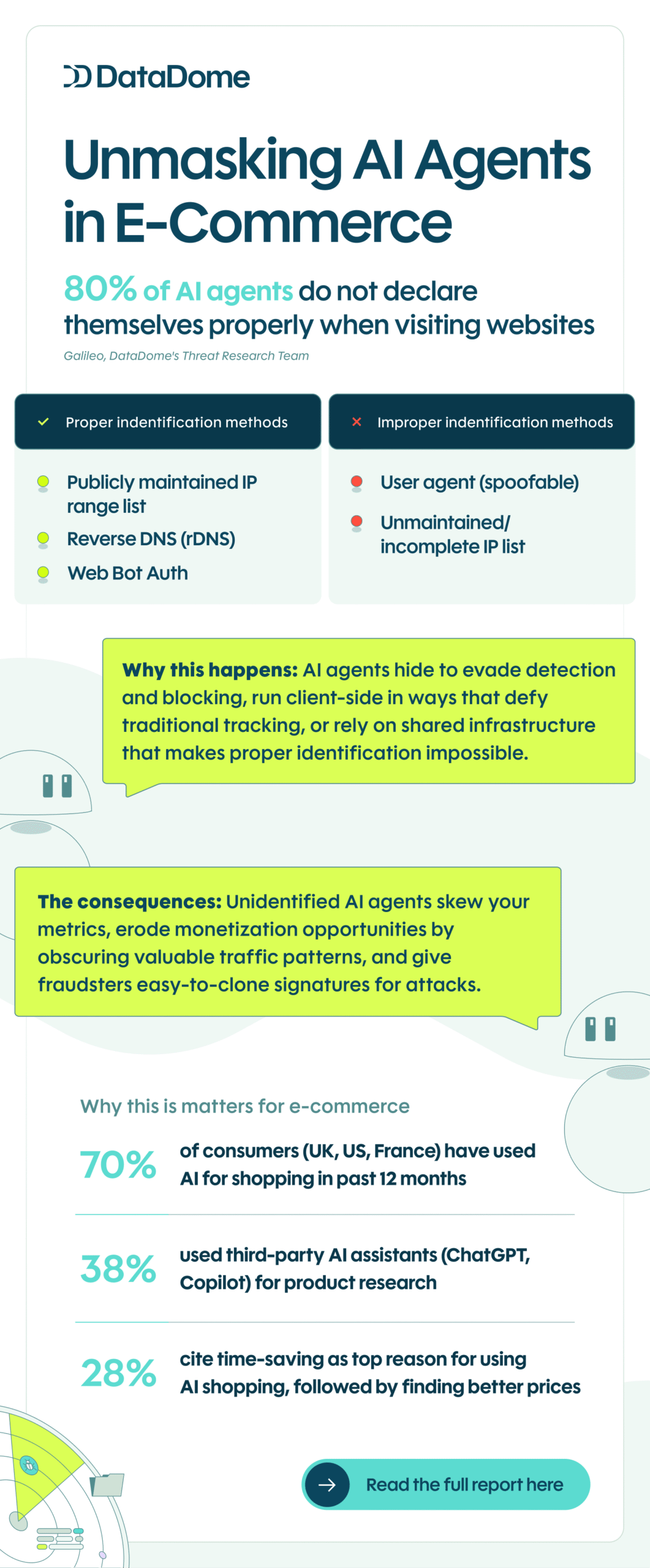
- Fake traffic inflates metrics. AI agents browsing product pages look like interested customers but never convert. This skews analytics and leads to poor business decisions.
Media and publishing
DataDome detected nearly 1.2 billion requests from OpenAI crawlers in June 2025 alone. LLM crawlers and MCP-powered collectors from the AI ecosystem harvest proprietary content at massive scale, often ignoring robots.txt instructions and bypassing access controls.
The impact on publishers:
- Content gets reproduced without attribution or payment. Artificial intelligence trains on copyrighted content, then reproduces it through generated responses without sending traffic back to original publishers.
- Paywalls become less effective. Autonomous AI agents can access subscriber content, then share it freely through conversational interfaces.
- SEO value diminishes. When people get answers from AI systems instead of visiting publisher sites, organic traffic drops.
SaaS and developer platforms
AI agents increasingly integrate with SaaS platforms to automate workflows and extract data. While some integration is legitimate, unauthorized access creates risks:
- Unlicensed data extraction. Agents scrape data from SaaS platforms for training or competitive analysis without proper licensing agreements.
- API abuse. High-volume automated requests from AI agents can overwhelm APIs, degrading service for legitimate users.
- Data exposure. When AI agents access platforms with broad permissions, they might extract sensitive business data that was never intended for external consumption.
The business case for agent trust management
Agentic trust management is about more than just security. It’s about enabling new business models while protecting existing ones.
Protect competitive advantages. Your pricing strategy, inventory levels, and product mix provide competitive differentiation. AI agents that scrape this data at scale give competitors insight that erodes your market position. Agentic trust management safeguards competitive intelligence while allowing customer-facing AI tools to operate normally.
Enable agentic commerce safely. AI shopping assistants and autonomous purchasing agents represent the future of e-commerce: agentic commerce. Blocking all AI agents means missing this trend. Agentic trust management lets you support legitimate AI commerce use cases while blocking abuse.
Monetize AI access. Publishers and content platforms can turn AI traffic from a threat into a revenue stream. By identifying and classifying AI trainers and data brokers, you can enforce licensing agreements and collect payment for content access.
Maintain data accuracy. When AI agents inflate your traffic metrics without converting, it can lead to poor business decisions. Marketing attribution breaks. Product performance analysis becomes unreliable. Agentic trust management separates genuine user interest from AI agent noise.
Reduce fraud risk. AI agents create fake accounts, attempt credential stuffing, and probe for vulnerabilities at scale. Trust-based detection catches these attacks earlier than signature-based approaches.
As Dan Ayash, Director of Advanced Cybersecurity Solutions at PayPal, explains: “To fight AI-driven bots, you have to understand what they’re trying to do, not just who they are. That is what DataDome helps us do.”
How to implement agentic trust management
Implementing agentic trust management requires a systematic approach:
1. Gain visibility into AI agent activity
Start by understanding what AI agents are already accessing your systems. Most organizations underestimate the volume and variety of AI agent traffic they receive. Deploy detection that classifies:
- Known AI agents (ChatGPT browsing, Claude, Perplexity, etc.)
- MCP server connections
- LLM crawlers and scrapers
- Unknown agents showing suspicious patterns
Track which parts of your site or application AI agents access most frequently. Look for patterns that indicate scraping, competitive intelligence gathering, or data harvesting.
2. Define your AI agent policy
Not all AI agents should be treated the same. Decide which behaviors you want to:
- Allow freely: Research agents, accessibility tools, legitimate shopping assistants
- Allow with restrictions: AI crawlers that respect rate limits and robots.txt
- Monetize: Data brokers, AI trainers, commercial scrapers
- Block entirely: Malicious actors, unauthorized scrapers, impersonators
Your policy should align with business objectives. If you’re a publisher, you might monetize AI training data. If you’re in e-commerce, you might prioritize protecting pricing data while enabling shopping assistants.
3. Implement trust-based access control
Configure access rules that adapt to agent behavior:
- Set baseline trust scores for known agent categories
- Define triggers that increase or decrease trust (rate limit violations, suspicious patterns, etc.)
- Establish thresholds for different actions (rate limiting, blocking, human verification challenges)
- Create exemptions for verified trusted agents
The system should make initial classification decisions but optimize those decisions based on observed behavior.
4. Monitor and adjust
AI agent behavior evolves rapidly. Your policies need to evolve with them:
- Review trust score distributions regularly
- Identify new agent types as they emerge
- Adjust rate limits and access rules based on business impact
- Track false positives (legitimate agents getting blocked) and false negatives (malicious agents getting through)
Regular monitoring ensures your agentic trust management stays effective as the AI ecosystem changes.
DataDome’s approach to agentic trust management
DataDome’s Agentic Commerce Trust solution provides comprehensive protection for the agentic commerce era, giving you visibility, control, and trust across all your digital surfaces.
See and understand agentic traffic: AI agents and LLM crawlers are already visiting your product pages, APIs, and applications. Sometimes to help customers place orders, sometimes to exploit your platform. DataDome gives you full, real-time visibility into the humans, bots, and AI agents interacting with your websites, mobile apps, APIs, and MCP servers.
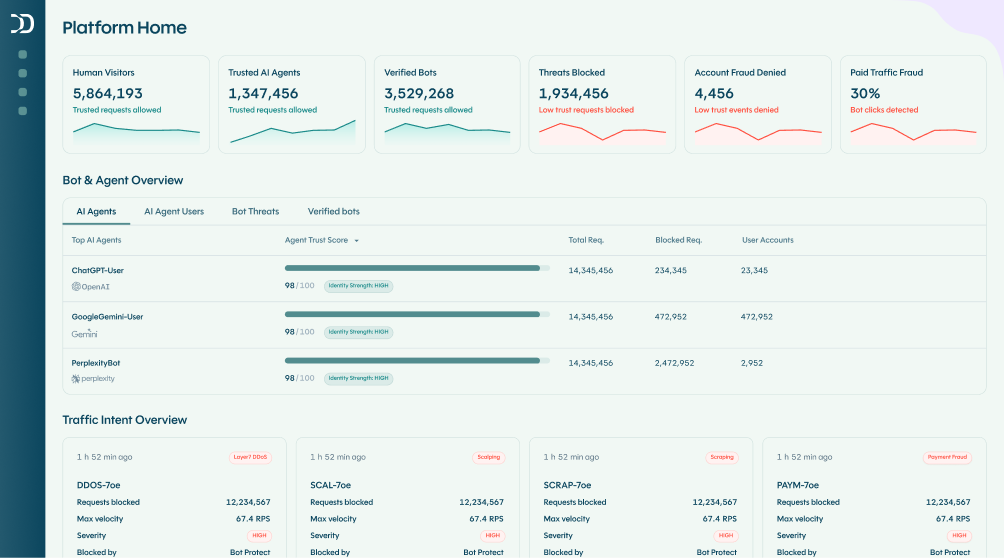
Full visibility in under 2 milliseconds: Our platform detects and classifies all traffic (human, bot, and AI agent) across your entire digital presence. The intuitive dashboard reveals verified, unknown, and untrusted agents across the user journey, showing exactly what content they access and how they behave.
Understand intent at a glance: See which AI agents are browsing, comparing prices, or completing purchases. Track traffic patterns and behavioral trends before they distort analytics or commit fraud.
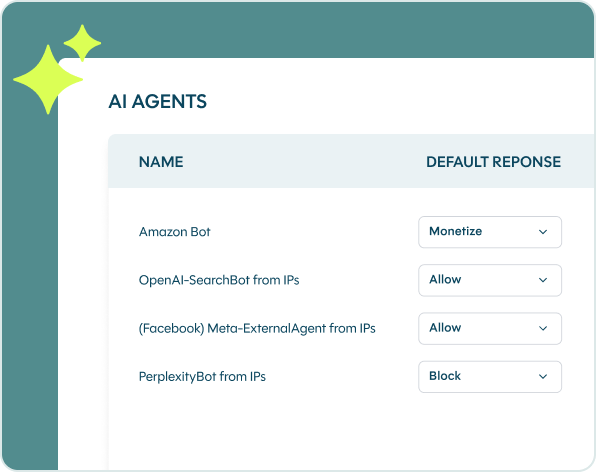
Control which AI agents can interact, and how: Allow, block, or rate-limit agents and LLM crawlers by name and source, at the page, API, or action level. This includes specialized detection for MCP-origin traffic, allowing differentiated access rules for agent-to-application communications.
Enable legitimate AI agents to browse, compare, and buy: With less than 0.01% false positives, DataDome delivers frictionless, trusted AI-assisted shopping experiences that turn agentic traffic into measurable revenue.
The future of AI agent security
The next five years will define how businesses interact with AI agents. The global AI agents market is projected to reach $50.31 billion by 2030(2). The AI era is well and truly upon us. As adoption accelerates, organizations face a choice: Block all AI agents and miss opportunities, or develop sophisticated trust frameworks that enable good actors while stopping bad ones.
Trust has become the new currency in the AI agent economy. According to research from Deloitte(3), the connection between societal trust and economic performance is well documented: A 10-percentage point increase in trusting people within a country raises annual per capita real GDP growth by about 0.5 percentage points. As more transactions are handled by AI agents, that trust relationship is evolving.
The fundamental question facing organizations is: can AI agents be trusted? How do you build trust with AI? At their core, trust in AI agents rests on two components: competence (the ability to execute) and intent (the purpose behind actions). While few question the competence of advanced AI, intent remains unclear without proper verification systems.
Agentic trust management provides that framework. It moves security from binary allow/block decision-making to nuanced, adaptive trust policies that align with business objectives.
FAQ
GenAI agents are AI systems powered by generative AI models that can take actions autonomously to achieve specific goals. Unlike simple chatbots, GenAI agents can plan multi-step tasks, interact with external systems through APIs, make decisions based on context, and adapt their approach based on results. For example, a GenAI shopping agent might research products across multiple sites, compare prices, and complete a purchase, all without human intervention at each step.
Agentic trust is the confidence that agent interactions happen to their stated purposes and within defined guardrails. When agentic trust is high, users let AI agents handle sensitive tasks like financial transactions or data access without constant oversight. When trust is low, people micromanage or avoid using AI agents entirely. Trust depends on two factors: competence (can the agent execute tasks reliably?) and intent (will it act in my best interest?). Organizations build agentic trust through transparency, consistent behavior, clear boundaries, and accountability.
References
- https://www.mckinsey.com/capabilities/quantumblack/our-insights/the-agentic-commerce-opportunity-how-ai-agents-are-ushering-in-a-new-era-for-consumers-and-merchants
- https://www.grandviewresearch.com/industry-analysis/ai-agents-market-report
- https://www.deloitte.com/content/dam/insights/articles/2024/us144378_econ-trust-and-economic-prosperity/di-econ-trust-and-economic-prosperity.pdf

Related posts

The AI Traffic Report Q3 2026: Agentic Browser Traffic Jumped 4.7x in September as Meta's Muse Hits 29M Requests in 12 Days
Tell me more

How to Stop Bot Traffic From Crashing Your Site During Black Friday 2026
Tell me more

Which Industries Are Least Protected From Bots & Spoofed AI Agents in 2026?
Tell me more

AI Traffic Is Up 82%. Can You Tell Which Agents to Trust?
Tell me more