


How to Detect & Prevent Credential Stuffing Attacks
Every day, millions of stolen usernames and passwords are tested against login pages across the web. Most businesses don’t know it’s happening until accounts start getting compromised.
Credential stuffing is one of the most widespread forms of automated fraud—and one of the most misunderstood. Unlike brute force attacks that randomly guess passwords, credential stuffing is precise: attackers already have your users’ credentials. They just need to find where else those credentials work.
This guide covers what credential stuffing is, how it leads to account takeover (ATO), how it compares to related attacks like brute force and password spraying, and what effective detection and prevention actually looks like.
What is credential stuffing?
Credential stuffing (OAT-008) is an automated threat that uses malicious bots to “stuff” known usernames and passwords (typically sourced from data breaches) into online login pages to gain unauthorized access to user accounts.
Hundreds of millions of accounts are exposed in data breaches every year. Because password reuse is so common, attackers with access to a stolen credentials list can test those same username-password pairs across dozens of other sites—turning one breach into many account takeovers.
How does a credential stuffing attack work?
Credential stuffing relies on the widespread problem of password reuse to gain access to online accounts. Because 81% of people reuse the same or similar passwords for multiple accounts, malicious threat actors with access to a list of leaked credentials have an easy time finding valid login and password combinations.
Here’s the anatomy of a typical credential stuffing attack:
- An attacker creates one or multiple bots that can access login pages from multiple websites in parallel. These bots are often disguised as humans and can run through many different IPs.
- The bots rapidly run their list of compromised credentials through the login pages of the websites and apps they’re targeting.
- Once they’ve gained access to a user account, the bot is programmed to take personally identifiable information, credit cards, linked bank accounts, etc. This is now an account takeover.
- The hacker eventually collects a vast trove of valuable information that they can either resell on the dark web or keep for other nefarious purposes.
When cybercriminals succeed in taking control of an online account, they can perform unauthorized transactions, unbeknownst to the victims. These often go undetected for a long time because logging in isn’t a suspicious action. It’s within the business logic of any website with a login page.
To give you an idea of the scale of a credential stuffing attack: a DataDome customer came under attack with 5.7 million requests from 250,000 different IP addresses and 8,000 autonomous systems across 215 countries and independent territories. The hackers behind this attack were sophisticated. Each IP address only generated between 10-20 requests to try to evade detection.
More recently, a global fintech platform was the target of a week-long credential stuffing attack. Attackers launched more than 7.4 million bot-driven login attempts using 4.4 million unique IP addresses—many of them residential proxies routed through major ISPs like Comcast, AT&T, and Telefonica to blend in with legitimate traffic. DataDome’s behavioral analysis and fingerprint correlation identified the attack early. More than 6.2 million malicious login attempts were blocked without any disruption to real users.
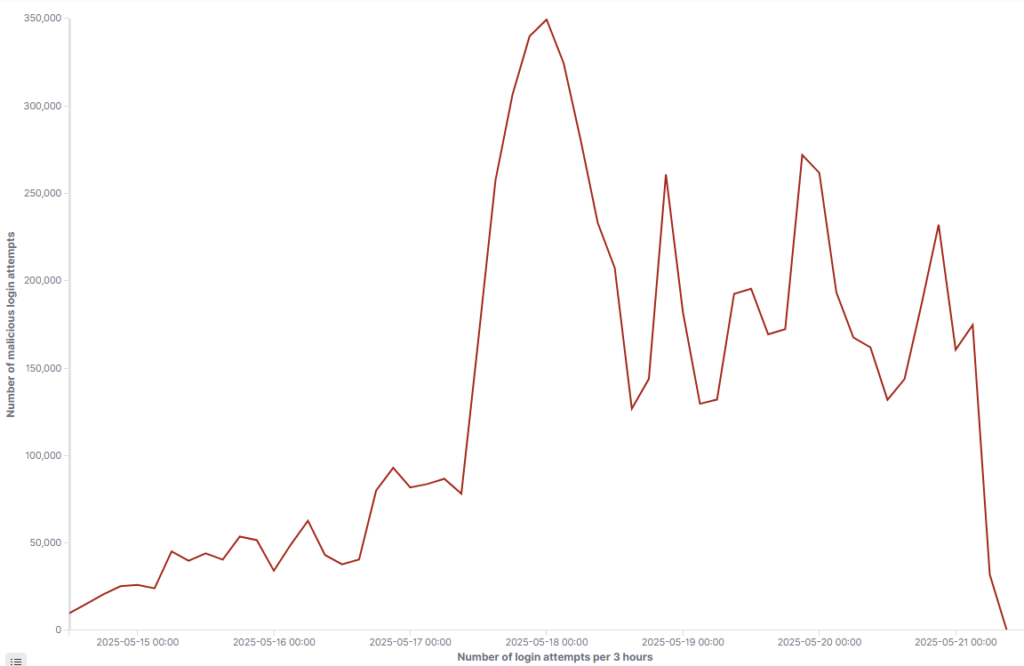
Malicious login attempts on the fintech platform per 3-hour window
Why do attackers commit credential stuffing attacks?
When a credential stuffing is successful, hackers gain access to a user’s account. This is called account takeover—the unlawful accessing of a user account to commit fraud.
Once an attacker is inside a user’s account, they can monetize compromised accounts because they now have access to linked bank accounts, credit cards, and personal data that they can use for identity theft.
In some cases, attackers also use compromised accounts to create fake accounts at scale—exploiting referral programs, loyalty schemes, or promotional credits.
The most profitable form of account takeover is credit card fraud. Carding is the widespread practice of using stolen credit card numbers to either resell the hacked payment info on the dark web or purchase goods and services using false accounts with the stolen credit card info.
The industries primarily targeted by credential stuffing attacks include retail and e-commerce, finance, social media, IT, restaurants, and the travel and transportation industries. This being said, every organization with a login page is at risk of a credential stuffing attack.
Credential stuffing vs. brute force attacks vs. password spraying
These three attack types are often lumped together, but they work differently, and that distinction matters for how you defend against them.
Credential stuffing uses known stolen credentials from prior data breaches. Attackers don’t guess passwords; they already have them. Success depends entirely on password reuse. The more users recycle login details across sites, the higher the attacker’s success rate. Because bots spread attempts across millions of IPs, login velocity per IP stays extremely low—making this one of the hardest attack types to catch with traditional tools.
Brute force attacks take the opposite approach. Rather than using known credentials, attackers systematically try every possible password combination until one works. They don’t need a data breach as a starting point, but brute force is slower and easier to detect: it generates high login velocity against a single account, which is exactly what rate limiting and account lockout policies are designed to catch.
Password spraying is subtler. Instead of hammering one account with thousands of guesses, attackers test a single common password—”Password123!” or “Summer2024″—against thousands of different accounts. The attempt rate per account stays low, which helps it avoid triggering lockout policies. It’s particularly effective where organizations haven’t enforced strong password requirements.
Credential cracking (OAT-007) is a catch-all for automated brute-force methods—running through password patterns, dictionaries, and common phrases until something sticks. It’s most effective against users with weak or predictable passwords.
| Credential stuffing | Brute force | Password spraying | Credential cracking | |
| Source material | Stolen credential lists | None needed | None needed | None needed |
| Target | Many accounts across many sites | One account | Many accounts | One or many accounts |
| Login velocity | Low per IP, high in aggregate | High per account | Low per account | Moderate |
| Detection difficulty | Hard | Easier | Hard | Moderate |
| Key dependency | Password reuse | Weak/short passwords | Common passwords | Weak passwords |
All four attack types can result in ATO, but they require different detection strategies. Credential stuffing and password spraying are specifically engineered to stay within the bounds of “normal” login behavior, which is why IP-based defenses miss them.
How to detect credential stuffing attacks
Detecting credential stuffing isn’t straightforward, as attackers design these campaigns to look like normal traffic. That said, there are patterns worth watching for:
- A spike in failed login attempts spread across many accounts and IPs in a short window—this is the signature of high aggregate login velocity even when individual IPs look clean.
- A login failure rate that’s climbing above your baseline, particularly when it doesn’t match any known traffic event.
- Increased server load or degraded performance specifically around login and authentication endpoints.
- A sudden rise in account lockouts, password reset requests, or customer-reported unauthorized access.
- Traffic from IP ranges associated with residential proxies. Attackers use residential IPs to mimic legitimate users; these are much harder to block by IP alone.
These signals matter, but sophisticated attacks are deliberately calibrated to stay below simple detection thresholds.
DataDome’s analysis of a heavily distributed credential stuffing attack found that attackers leveraged over 91 million IP addresses around the world, with each IP averaging just 1.18 login attempts. Standard rate limiting had no effect. What caught it was behavioral analysis—looking at session behavior and fingerprinting patterns, not just where the traffic came from.
How to prevent credential stuffing attacks
Traditional security solutions tend to rely heavily on IP reputation. They assume that any malicious activity from an IP address means that all activity from that IP is likely to be hostile.
Today, threat actors distribute bots via residential IPs that have excellent reputations—the requests these IPs send are indistinguishable from those generated by ordinary users. IP-based approaches are, therefore, no longer efficient.
A layered approach to credential stuffing prevention includes:
- A multi-factor authentication (MFA) option for accounts.
- Encouraging the use of password managers for unique, strong password generation.
- Monitoring for residential proxy usage using behavioral signals, not just IP reputation, since residential IPs by definition look legitimate.
- Monitoring for compromised credentials tied to your domain, so you can proactively prompt at-risk users to reset passwords before an attack exploits them.
- Following OWASP credential stuffing prevention guidelines (OAT-008), which include login attempt monitoring, behavioral analysis, and device fingerprinting.
But to efficiently protect against credential stuffing, you need a bot and agent trust management solution with real-time detection and protection capabilities.
A strong bot mitigation platform identifies credential stuffing by analyzing both technical and behavioral signals. Technical indicators include user agent, IP owner, and geolocation. Behavioral analysis goes further: it looks at login velocity, session consistency, cookie presence, header patterns, and how a user actually interacts with the page.
When malicious bots are detected, account fraud detection software can then either trigger alerts or automatically block the bots before your user accounts are compromised, all while keeping the experience seamless for real users.
Prevent credential stuffing attacks with DataDome Account Protect
Since both bots and humans now use the same browsers and IP addresses, efficient credential stuffing and account takeover protection requires advanced detection capabilities.
Account Protect goes beyond bot protection, building a more complete picture of user activity to spot red flags that may indicate fraud. By analyzing signals such as username/email address, time/location, geolocation, and more, DataDome can identify account fraud with high precision and no compromises on user experience.
Account Protect fights fraud on autopilot, 24/7. Run our free Vulnerability Scan to test your site’s defenses today, or book a demo to learn more about DataDome.

Related posts

How Kiabi Cut Malicious Login Attempts & Gained Instant Threat Visibility
Tell me more

How Effective Is CAPTCHA? Does It Really Stop Bots?
Tell me more

How BPX Protected Revenue-Critical APIs from 6.6M Price Scraping Attacks
Tell me more

How Plarium Uses Intent-Based Detection to Block 20M+ Malicious Requests a Month
Tell me more

