


Bot fraud? Scam bot? Your Guide to Bot-Driven Threats
Cybercriminals are getting smarter. They’re no longer just targeting individual users with phishing emails or malware. Today’s attackers deploy sophisticated automated programs to attack businesses at scale. No business is too small a target.
Whether you’re running a small e-commerce site, a SaaS platform, or a local service business with an online presence, you’re a target. The good news? You don’t have to be a victim. Understanding how bot fraud works and implementing the right defenses can protect your business, your customers, and ultimately your bottom line.
Key takeaways
- Bot fraud sophistication keeps increasing: Modern bots use AI to mimic human behavior, making detection significantly more challenging than traditional automated threats.
- Business impact extends beyond direct losses: Bot fraud affects multiple areas, including marketing spend efficiency, customer trust, operational costs, and regulatory compliance.
- No industry is immune: Bot attacks target businesses across all sectors, with attackers adapting their methods to exploit industry-specific vulnerabilities and business models.
- Detection requires multiple approaches: Effective bot protection combines behavioral analysis, device fingerprinting, and real-time monitoring rather than relying on single detection methods.
- Prevention beats reaction: Proactive bot management with proper detection tools costs less than dealing with successful attacks, data breaches, and reputation damage after fraud occurs.
What is bot fraud?
Bot fraud is an umbrella term for all types of online fraud performed or assisted by malicious bots. The malicious bots dedicated to performing these attacks are called scam bots. Cybercriminals use scam bots because they’re much faster than humans, which helps them in three ways:
- To prepare for bot fraud: They can perform rapid vulnerability scans on multiple websites.
- To perform automated fraud attacks: Bot-driven attacks include automated phishing, account takeover attacks (brute force, credential stuffing), and scalping.
- To evade anti-fraud defenses: They can mimic human behavior to avoid anti-bot safety measures.
Cybercriminals perform bot fraud attacks in many different ways, with many different monetization schemes. Some are easy to execute, have low-value targets, and rely on a high volume of attacks to create their profit.
For example, using scam bots, attackers can send a massive volume of spam emails, blog comments, and social media posts. While this type of bot fraud may have a very low success rate, sometimes an attack needs only one or two victims to be profitable.
Scam bots can also be used to perform attacks that won’t provide financial gains by themselves but will allow the bot operator to perform more severe subsequent attacks. In these cases, bot fraud lays a foundation for further attacks.
A good example would be bots that attempt new account registrations on e-commerce websites, as well as bots that perform credential stuffing attacks. The attacker can then use the created or stolen account to perform the actual fraud in many different ways.
What are the different types of bot fraud?
Bot fraud is only limited by the attacker’s creativity and the available attack surface. This being said, here are some of the most common bot fraud scenarios:
Account takeover (ATO)
For account takeover fraud, the fraudster will use malicious bots to gain unauthorized access to legitimate user accounts. ATO fraud comes in two basic forms:
- Credential cracking: Also known as a brute force attack, credential cracking happens when a fraudster programs a scam bot to guess the credentials of an account. It’s a kind of brute force attack that involves a bot trying all possible combinations of a password.
- Credential stuffing: In this type of ATO attack, the fraudster already possesses a stolen credential or a list of stolen credentials. They then use the bot to test these credentials on many different websites. Credential stuffing uses the fact that many people use the same passwords for different sites and services.
The objective of ATO fraud is to gain access to a legitimate user account and lock the real users out of the account. While this may not lead to direct monetization, the fraudster can then use the account or the information stored in the account (such as credit card credentials) to commit other types of fraud.
However, ATO can sometimes lead to direct monetization. For example, if a fraudster has gained access to a user account on an e-commerce store, then they can buy something with the account right away and try to retrieve the goods for themselves.
Click fraud
In this type of fraud, scam bots simulate clicks on online advertisements, artificially inflating the number of clicks and leading to wasted advertising budgets.
Click fraud operates in several ways. Competitors may use bots to drain rivals’ advertising budgets by repeatedly clicking their ads. Criminal networks also deploy bot farms to generate revenue from ad publishers by creating fake clicks.
The impact extends beyond wasted money. Click fraud distorts marketing analytics, making it impossible to measure real campaign performance. Companies lose the ability to understand their actual customer acquisition costs and return on investment.
Scalping
Fraudsters use bots to buy limited edition products, concert tickets, or high-demand items before legitimate customers can complete their purchases. These items are then resold at inflated prices on secondary markets.
Scalping impacts retailers particularly during product launches, holiday sales, or special events. The bots can complete purchases in milliseconds, leaving genuine customers frustrated and empty-handed. Gaming consoles, sneaker releases, and concert tickets are frequent targets. The speed advantage of bots makes it nearly impossible for human users to compete during high-demand releases.

Sneakers are a common target for scalping bots
Review fraud
Scam bots manipulate online reviews and ratings by posting fake positive or negative feedback to influence consumer decisions. This form of fraud damages the credibility of review systems and misleads potential customers.
Businesses sometimes use review bots to artificially boost their ratings or attack competitors with negative reviews. The bots create multiple fake accounts and post reviews that appear authentic to automated detection systems. Review fraud undermines consumer trust and creates unfair competitive advantages for businesses willing to engage in deceptive practices.
Form spam
Form spam happens when bots flood online forms with fake or harmful submissions, overwhelming systems and reducing employee efficiency. Contact forms, registration pages, and survey submissions become targets for automated spam campaigns.
Form spam wastes company resources as employees must sort through fake submissions to find legitimate inquiries. It can also overload servers and databases, impacting website performance for your real users. The spam may include malicious links, promotional content, or simply random data designed to disrupt normal business operations.
SQL injection
Cybercriminals can use malicious scam bots to either scan for SQL injection vulnerabilities or to perform an SQL injection directly. The latter, if successful, can give criminals unauthorized access to your server-side database, let them post unwanted content, or infect end-users with malware.
For example, when an attacker gains unauthorized access to a database after a successful SQL injection, they can gain access to sensitive data (like credit card information) stored inside the database, which they can then use to monetize the fraud.
Content scraping
Content scraping is the act of extracting data from websites or web applications using a scam bot (also called a web crawler). Think of it as a way to copy-paste a website’s content, just performed rapidly by a bot.
Content scraping or web scraping is not illegal by itself. In fact, Google, Bing, and other search engines technically perform web scraping on your website every day to index your content. But the scraped content can be used illegally to perform various types of bot fraud. Malicious web scraper bots can use your content in many fraudulent ways, including:
- To steal the HTML/CSS to build a fake e-commerce site (with similar layout and branding) to defraud your users, technically performing a phishing scheme.
- To collect product pricing and/or inventory data, to then forward it to your competitors. This is common in industries where pricing is very sensitive, for example in the travel industry.
- To republish your content on other websites, which may affect your SEO performance. In a worst-case scenario, your site may be penalized by Google for publishing duplicated content.
- To collect customer information and/or contact information, which is then sold to other businesses or used to retarget your customers with other scams.
API abuse
Another common form of bot fraud is API abuse. Hackers can use scam bots to attack your APIs in several different ways:
- APIs are used by organizations to provide access to sensitive data, so scam bots can be deployed to extract data from these APIs.
- Hackers can perform DDoS attacks by overloading the APIs with massive volumes of bot traffic. Once the system has been overloaded, the attacker can then hold the website/application owner for ransom.
- Scam bots can automatically send API calls to perform credential stuffing attacks by testing lists of stolen credentials
AI-generated bots and deepfakes
Fraudsters increasingly use AI to craft realistic phishing emails, automate social engineering, and create networks of fake identities. Modern AI technologies enable bots to create convincing fake content including images, videos, and text that can pass human inspection.
AI-powered bots can generate realistic profile pictures, write convincing product reviews, and create fake social media personas. Deepfake technology allows bots to impersonate real people in video calls or audio messages. These sophisticated bots can bypass traditional detection methods that rely on identifying obviously automated behavior. They represent the next evolution in bot fraud capabilities.
How can you identify a scam bot?
In theory, protecting your websites, mobile apps, and APIs from malicious scam bots might seem quite easy: Detect the presence of scam bots, block their activities, and voila! After all, with today’s technology, distinguishing these bots should be easy, right? Unfortunately, that’s not the case. There are two big challenges:
- Good bots vs bad bots: Some bots are beneficial for your website and/or web application. Crawler bots from Google, Bing, and other search engines are crucial for ensuring your website gets ranked on these search engines. You wouldn’t want to accidentally block these bots and lose their benefits. But distinguishing a bad bot from a good bot can be extremely difficult.
- Bots vs human users: Today’s highly sophisticated scam bots are getting better at mimicking human-like behaviors. Malicious bot programmers have adopted advanced technologies like AI and machine learning, so scam bots can more effectively mask their identities. For example, they can use nonlinear mouse movements when interacting with your web application, rotate between hundreds of different IP addresses, and so on.
While these two challenges are difficult, they are not impossible to overcome. In fact, the right bot management solution will use one or several of the following three approaches to identify scam bots.
1. Challenge-based detection
In this approach, the bot detection solution will challenge incoming traffic with a test that is designed to be very easy to solve by human users but impossible to solve by automated programs or bots. A CAPTCHA is a popular example of challenge-based detection.
Finding the right balance for challenge-based detection has always been tricky. If the challenge is too easy, bots can pass it. But if it’s too difficult, the challenge will negatively impact the user experience. Additionally, bots are now sophisticated enough to constitute 50% of passed reCAPTCHA challenges. Cybercriminals also use CAPTCHA farm services and other methods to bypass challenge-based detection.
As such, challenge-based detection is not sufficient on its own.
2. Signature-based detection
The second approach is to detect the presence of scam bots based on known digital signatures. In this method, the basic principle is to collect as many “fingerprints” as you can from incoming requests, then analyze the consistency of these signatures as well as compare them to known fingerprints of scam bots.
The most basic type of signature-based detection is an IP address, as many bot detection tools have large and continuously updated databases with IP addresses that malicious bots use, which can then be blocklisted. But there are also various other types of signatures, including:
- Whether the client’s browser is running in a virtual machine (emulator)
- Whether the OS is used consistently with the client’s usage
- If there are any headless browser signatures, like those of Nightmare or PhantomJS
- If there are any properties that should or should not be in a claimed browser
While signature-based detection can indeed be effective, it has an obvious weakness: It can only detect scam bots with known signatures. It’s not effective against brand new scam bots and zero-day attacks. Additionally, blocking IP addresses is ineffective against proxy IP addresses. Sophisticated bot developers can also remove known signatures/attributes from their scam bots, rendering this approach ineffective.
3. Behavior-based detection
As opposed to signature-based detection, behavior-based detection is performed by collecting a client’s behaviors when interacting with a website or application. The behaviors are then analyzed and compared against a legitimate user’s behaviors. This approach typically requires AI and machine learning technology trained on data of legitimate human behaviors as its baseline or benchmark.
Here are some behaviors that are typically monitored using this technique:
- Mouse clicks, scam bots may use certain patterns or clicking frequencies
- Mouse movements
- Keypress
- Scroll speed and consistency
- Total number of pages viewed per session
- Total number of requests per session
- Average dwell time per page
Well-trained AI-powered behavioral bot detection software is not only effective at differentiating between scam bots and legitimate users, but also between good bots and bad bots.
How can businesses protect themselves from bot fraud?
Now that we know how you can detect bot fraud, we turn to how you can protect your business from it. Building effective bot protection isn’t about deploying a single security tool and calling it done. It’s about creating a comprehensive defense strategy that adapts to evolving threats while keeping your legitimate customers happy. In particular, successful bot protection balances three critical capabilities:
- Smart detection: Distinguishing between legitimate users, helpful bots (like search engines), and malicious automated threats.
- Flexible response: Taking the right action for each situation, from seamless blocking to stepped-up verification.
- Continuous improvement: Monitoring attack patterns and adjusting defenses based on real-world data.
Now let’s look at the specific protection methods that make the above capabilities possible:
Rate limiting
Rate limiting monitors and restricts action frequency to prevent automated abuse. The system implements slowdowns or additional verification when users exceed average human speeds. Effective rate limiting sets thresholds based on normal human behavior patterns. For example, legitimate users cannot submit forms hundreds of times per minute or browse pages at superhuman speeds.
Rate limiting works best when combined with other detection methods, as sophisticated bots can slow down their activity to remain under rate limits while still conducting attacks.
Traffic pattern analysis
Bots can cause abnormal traffic spikes, whereas real user traffic typically follows predictable patterns. By tracking traffic over time, you can spot anomalies such as sudden surges that align with fraudulent activities, helping you take proactive action.
Traffic analysis examines patterns like geographic distribution, time-based activity, and session characteristics. Suspicious patterns include traffic from data centers, coordinated activity across multiple IP addresses, and unusual geographic clustering. Advanced analysis can identify bot networks by correlating seemingly unrelated traffic sources that share common behavioral signatures or timing patterns.
Honeypot traps
Honeypots are decoy elements on your website that are invisible to human visitors but designed to attract bots. While these traps contain no valuable data, they are an effective way to identify automated fraud scripts. Honeypot implementations include hidden form fields, invisible links, and fake login pages. When bots interact with these elements, they immediately identify themselves as automated threats.
If a bot interacts with a honeypot, it signals an automated attack, providing valuable data for early detection and prevention. This method is particularly effective against unsophisticated bots that don’t discriminate between visible and hidden elements.
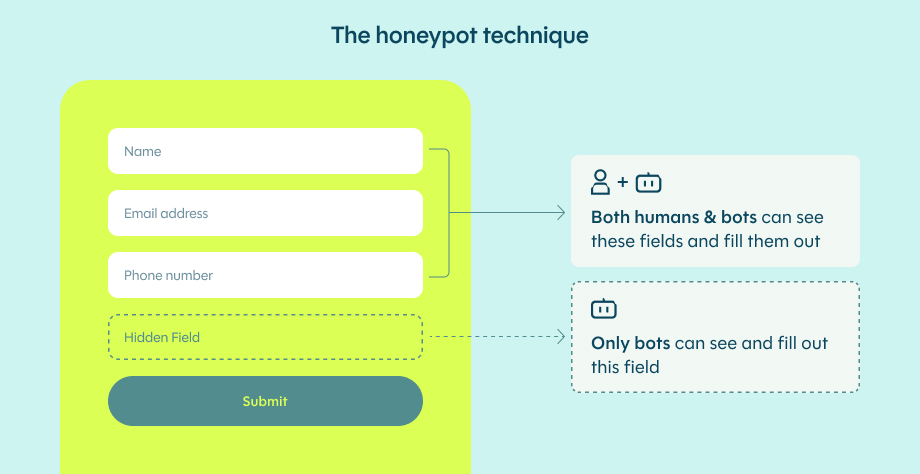
A honeypot tricks bots into giving away their true nature
Machine learning algorithms
AI-driven machine learning systems can automatically recognize complex bot patterns by analyzing large data sets. These algorithms not only detect suspicious behavior but also improve over time, making your bot detection efforts more effective as the system learns from each incident.
Machine learning models can identify subtle patterns that human analysts might miss. They continuously adapt to new bot tactics and can detect previously unknown attack methods. The effectiveness of machine learning detection improves with data volume and quality, making it particularly powerful for organizations with substantial traffic volumes.
How can a business keep up with scam bots?
Detecting and managing bot attacks is challenging enough. But maintaining consistent protection around the clock? That’s where most organizations struggle. You need a solution that continuously gathers and analyzes web request data in real-time, adapting to new threats without constant manual intervention.
DataDome’s bot protection solution blocks advanced bots before they reach your website, mobile app or API. It deploys in minutes on any web architecture and runs on autopilot. You will receive real-time notifications whenever your site is under attack, but no intervention is required. Once you have created an allow list of trusted partner bots, DataDome takes care of all unwanted traffic.
To protect against malicious vulnerability scanning, DataDome uses a two-layer bot detection engine that uses both AI and machine learning. Our algorithm analyzes billions of daily events and continuously updates itself to pinpoint both known and zero-day threats.
Wrapping up
Protecting your business from bot fraud can be quite challenging if you are not careful. Fraudsters will get better and better at finding ways to exploit your system, network, and other digital assets. If you don’t have a comprehensive strategy to defend against these scam bots, you are always at risk of various different types of bot fraud.
You should be proactive in protecting your assets from these bot frauds, and the key here is finding the right bot management solution. One that’s capable of advanced detection that distinguishes between humans, good bots, and malicious threats, with flexible response options tailored to each situation, and continuous monitoring that adapts to new attack patterns. That’s what we’ve built at DataDome.
Ready to stop bot fraud before it impacts your business? Contact DataDome today to see how our AI-powered bot protection can protect your websites, mobile apps, and APIs.
FAQs
Look for these red flags: bots and scammers often communicate with generic, overly formal language or respond unusually fast to messages. They typically push for quick decisions, ask for personal information or money early in conversations, and create artificial urgency (“limited time offer,” “act now”). Be especially wary of unsolicited contact via email, social media, or phone calls requesting sensitive information, payments, or downloads. Trust your instincts. If something feels off about their communication style, timing, or requests, it probably is.

Related posts

Why Layering a Specialist Bot & Agent Trust Solution With Your CDN Is Now Essential
Tell me more

Introducing DataDome’s AI Key Takeaways Feature: Understand Your Protection at a Glance
Tell me more

Beyond Detection Accuracy: Measuring the Real Business Impact of Bot Management
Tell me more
How Kiabi Cut Malicious Login Attempts & Gained Instant Threat Visibility
Tell me more

