
Instinct, Muse, & Dots Are Already Shopping Online. Here’s How to Enable Agentic Commerce Safely.
Shoppers are starting to hand their purchases to AI agents. Instinct, Muse, and Dots each let a customer ask for something in plain language and have an agent find it, check out, and report back. With the holiday shopping season close, expect agents to complete a growing share of orders.
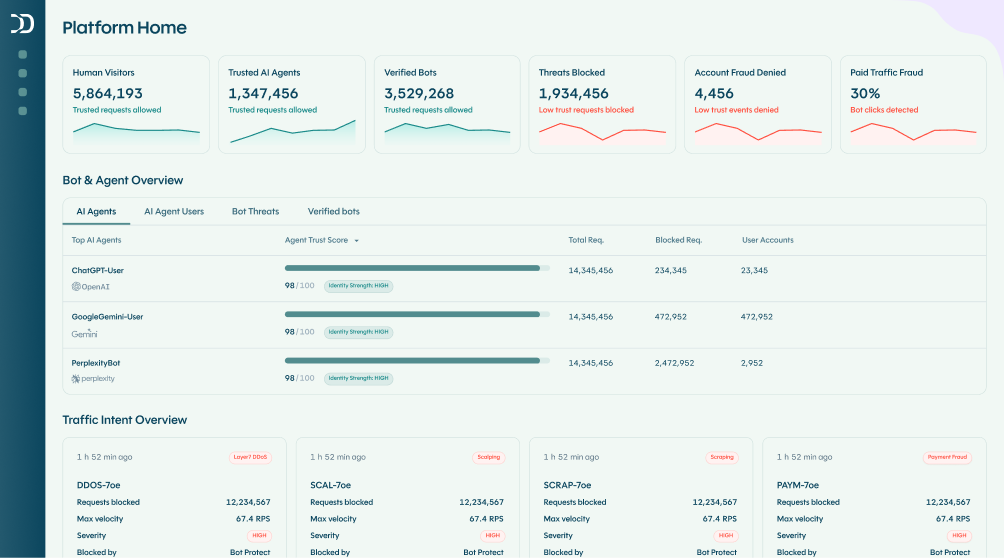
DataDome customers keep asking an important question: does DataDome detect Instinct, Muse, and Dots? It does. We tested each agent against our demo e-commerce site to show what these flows look like and how DataDome lets you welcome them safely.
Agentic commerce in action: One message, one order
We asked Instinct, an AI assistant you message on WhatsApp, to buy a $149.99 mechanical gaming keyboard from our demo shop.

Instinct found the product. When it needed an account, it sent a link to a secure vault for our credentials, saying it never sees the password.

After we replied “Go for it!”, it placed the order: $161.99 on the saved Visa, with delivery estimated for Oct. 29 to Nov. 2. It then sent back the order number.

The purchase went through like any other. For a retailer, that is the opportunity: a customer who never opens your site still completes a sale. It is also the challenge, because nothing in the traffic says an agent made the purchase. As the retailer or website, you lose visibility into who is behind the transaction, unless the agent authenticated as the customer.
Same purchase, three different flows
We gave Dots and Muse the same request. Both completed the order, each paying $161.99 on the saved Visa with delivery estimated for Oct. 29 to Nov. 2. The way each agent gets there is different.
- Instinct: Works from WhatsApp. It sends a secure vault link for credentials and returns the order number in the chat. Behind the scenes, it makes several requests to the same resource in case it gets blocked. When re-using the same session, Instinct may switch IP address and even hardware profile. Unlike Dots and Muse, it doesn’t give the user a browser to watch or control, defaulting to taking screenshots instead.
- Dots (OpenAI): Runs a real Chrome-based browser on a cloud virtual machine, which the user can watch or take over. It opened a secure sign-in prompt instead of asking for credentials in chat, asked for a shipping address, and waited for approval before clicking Pay.

Dots at checkout in its cloud browser. The user can watch or take over.
- Muse (Meta): Noticed our cart still held four items from an earlier run and asked whether to buy only the keyboard. It trimmed the cart, showed a final review, and placed the order once we approved.

Muse reports the finished purchase as a completed browser task, with the order confirmation as a preview in chat.
In every case, the agent shopped, signed in, and paid for the customer, who only approved the key steps. DataDome logged all three under our own Model labels:

DataDome successfully identified the request as Instinct, and the order number matches the one sent via WhatsApp.

DataDome also correctly identified each request from the two other orders as Dots and Muse.
We covered Muse in more depth in our earlier research. It doesn’t declare itself: no custom user-agent, no published IP range, no signed requests, just what looks like a standard desktop Chrome browser on Linux.
What gives it away is the browser itself. Sessions across unrelated sites showed near-identical client-side signals, the kind you’d expect when the same sandboxed environment is deployed over and over. That’s how DataDome identifies it.
Three agents, three different footprints
Over the same week (Oct. 17 to 23), DataDome saw Instinct, Muse, and Dots reach the pages, forms, logins, carts, and payment steps of a typical shopping journey. Their traffic looks very different from one agent to the next.
- Muse (Meta): 22.1 million requests. Most of it comes from cloud and CDN infrastructure: Cloudflare (59.2%) and Fastly (21.3%). It also reaches sensitive endpoints, including forms (7.8%), login (1.2%), cart (0.9%), and payment (0.5%).
- Dots (OpenAI): 1.4 million requests, 99.9% from Cloudflare. Its journey reaches forms (5.6%), login (2.9%), cart (1.8%), and payment (1.1%).
- Instinct: 2.6 million requests since DataDome began retaining Instinct traffic data on Oct. 19. It routes through residential proxies, so it appears on consumer and enterprise ISP networks and looks like ordinary visitor traffic. It reaches forms (4.9%), login (2.2%), cart (1.0%), and payment (0.4%).

Hourly requests from Muse, Dots, and Instinct to DataDome-protected traffic, Oct. 17 to 23, 2026. The vertical axis is logarithmic, so each step up represents a multiplication of volume, not a fixed increment. Muse’s volume is far higher than the other two, and a linear scale would flatten Dots and Instinct. DataDome began retaining traffic data on Instinct on Oct. 19.
Most of this traffic is browsing, but many agents also touch the steps where money and accounts are involved.

Share of each agent’s requests by endpoint type, Oct. 17 to 23, 2026. General page requests make up the remaining 88 to 91% of each agent’s traffic and are not shown. All three agents rank forms, then login, then cart. Dots has the highest share of traffic to sensitive end-points at 12.3%, ahead of Muse (10.7%) and Instinct (9.2%).
Identity alone is no longer enough
Most AI agents don’t identify themselves. Some do, and cryptographic signatures such as Web Bot Auth let you verify them on every request. But Instinct sends no signed request, and its first server-side request looks like any other visitor’s. Muse and Dots run from cloud infrastructure that thousands of other services share.
A user-agent string, an IP range, or an allowlist can’t tell you whether an agent is placing a legitimate order for a customer or a bot is impersonating that agent to take over accounts, scrape prices, or abuse checkout. To know what an agent is trying to do, you need intent-based detection.
What DataDome sees
DataDome saw the entire Instinct purchase: cart, shipping options, payment methods, order preview, checkout, and payment. The order number in our logs matches the one Instinct sent on WhatsApp.

DataDome request log from the demo checkout. The Model column shows the agent identified on each request, and the order number matches the one the agent returned. Domain, IP address, and ASN are redacted.

Every request carries the agent that made it, so you can see which agents reach your site, which flows they use, and how much of your traffic they represent. Our client-side signals identify these agents even when they declare nothing. Client-side detection has limits: Instinct often doesn’t keep a session, so coverage is strongest in some cases and weaker in others. We keep improving it as adoption grows.
How DataDome helps you enable agentic commerce safely
Agentic commerce works when you can welcome the agents shopping for your customers and stop the ones that are only looking to cause trouble and commit fraud. DataDome gives you the visibility and controls to do both, so a customer’s agent can complete an order without opening the door to fraud.
- See every agent. Know which agents visit your site, which pages and APIs they use, and how that traffic changes over time.
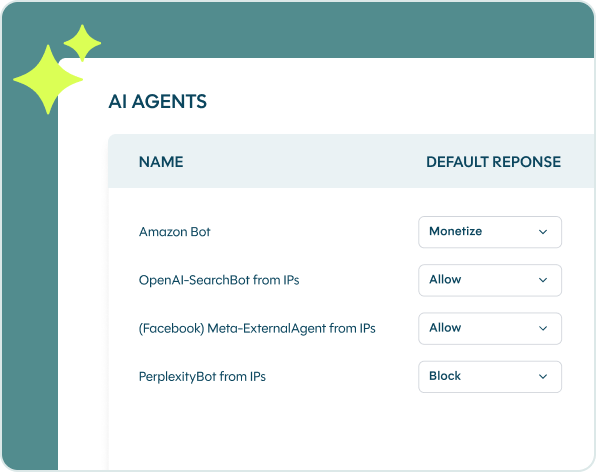
- Decide by agent and by action. Allow, challenge, rate-limit, or block an agent at the page, API, or action level. A trusted agent can browse and buy while the same agent can be stopped on a sensitive step.
- Detect intent in real-time, not just identity. Verified identity helps, and behavior shows what the agent is doing. That is how you tell a buyer-initiated purchase from an impersonation or an abuse attempt.
- Keep real purchases frictionless. Customers who send an agent to your store should get their order, not a CAPTCHA.
Agentic traffic is growing fast. DataDome saw about 25 billion AI agent requests in Q3 2026, up 41.5% from Q2, and agentic browser traffic rose 4.7x in September. Detection for Instinct, Muse, and Dots is available to DataDome customers today.
Be ready before the holiday rush
This holiday season, agents will place some of your orders. The retailers who benefit will be the ones who can see which agents are shopping, welcome the trusted ones, and stop the rest without slowing down real customers.
Book a demo to see how DataDome helps you enable agentic commerce on your site.

Related posts

How 1001Pneus Blocked Competitor Price Scrapers & Reclaimed Its Competitive Edge
Tell me more
The AI Traffic Report Q3 2026: Agentic Browser Traffic Jumped 4.7x in September as Meta's Muse Hits 29M Requests in 12 Days
Tell me more

How to Stop Bot Traffic From Crashing Your Site During Black Friday 2026
Tell me more

Which Industries Are Least Protected From Bots & Spoofed AI Agents in 2026?
Tell me more