
How to Stop Bot Traffic From Crashing Your Site During Black Friday 2026
Black Friday is the biggest revenue opportunity of the year for most retailers. It’s also the one day when the gap between “prepared” and “unprepared” shows up most visibly—in real time, at scale, with customers watching.
A slow site costs money. A crashed site costs more. And in 2026, the threat isn’t just a surge of eager shoppers. It’s a mix of legitimate traffic, scalper bots, AI shopping agents, and automated scrapers all hitting your infrastructure at once, and most websites aren’t set up to tell the difference.
DataDome’s 2026 State of Bot & Agent Security Report found that bad bot traffic increased 124% from July 2025 to June 2026, with AI traffic growing 82% over the same period.
And yet, our report also found that only 2% of retail and e-commerce websites are fully protected against bots and spoofed AI agents.
With malicious automated traffic growing 9x faster than human traffic, businesses will feel the impact of that preparedness gap come Black Friday.
Here’s how to get ready.
Key takeaways
- Bot traffic spikes sharply during high-demand sales events because scarcity and time pressure are exactly what automated campaigns are designed to exploit
- Undetected bot surges are a leading, avoidable cause of Black Friday site instability
- Bots and unauthorized agents can fill a waiting room and crowd out legitimate customers
- The fix is real-time intent detection to differentiate between trusted and malicious traffic, not just adding server capacity
Why does bot traffic spike on Black Friday?
Bot traffic typically refers to automated traffic generated by scripts and tools, including scrapers monitoring your pricing and inventory, scalper bots attempting bulk purchases, and credential-stuffing scripts targeting your login page.
Not all of it is malicious, but a large portion is, and it rises sharply around major sales events for a simple reason: scarcity attracts automation.
DataDome found that scalping activity increased 290% between July 2025 and June 2026, with median daily volume nearly quadrupling.
Scalper bots are built and deployed specifically for moments like Black Friday, where prices are low, inventory is in high demand, and demand is concentrated into a narrow window.
The result is that your highest-traffic day—Black Friday—is also likely your highest bot-traffic day, and the two problems compound each other.
How does bot traffic actually crash a website?
Bots don’t add load the way human shoppers do. A real customer browses, pauses, reads, maybe abandons cart. A bot sends requests in parallel, at machine speed, targeting exactly the endpoints that matter most.
During a Black Friday event, this can play out in multiple ways at once. For example:
- Scrapers hammer product pages continuously to monitor pricing and stock levels, generating enormous read load on pages that are already heavily trafficked.
- Scalper bots hit add-to-cart and checkout endpoints in rapid sequence, generating dozens or hundreds of requests per second to the same endpoint in an attempt to secure inventory before humans can react.
- Credential-stuffing bots flood login pages with lists of compromised username and password pairs, looking for accounts with stored payment methods or loyalty points to exploit.
Each of these generates traffic patterns that look like demand but behave nothing like shoppers. Together, they can overwhelm your servers, exhaust your database connections, and take down checkout infrastructure at exactly the moment it needs to work.
There’s also a fourth failure mode that’s less obvious: queue inflation. If you’re using a virtual waiting room to manage peak traffic, bots can fill it.
What does a bot-driven website crash cost you during Black Friday?
Downtime during a normal week is a bad day. Downtime during Black Friday is a bad day inside the highest-revenue window of your year, after months of promotional spend designed to drive traffic to exactly that moment.
Gartner estimates that IT downtime costs approximately $5,600 per minute across organizations of all sizes, meaning an hour of downtime costs upward of $336,000 on average. That number is likely far greater during peak holiday sales like Black Friday or Cyber Monday.
And an outage doesn’t just pause revenue while it lasts. It also costs you the customer who left and didn’t come back, the conversion rate impact from a broken or sluggish experience, and the reputational impact of a public failure on the most visible shopping day of the year.
How do you tell bot traffic from real shopper demand during traffic spikes?
A spike in requests on Black Friday morning could be thousands of eager shoppers, a coordinated scalping campaign, or, most likely, both at once. But the answer isn’t simply to block everything that isn’t human.
Because real consumers are increasingly using AI assistants to shop, blocking all automated traffic now means blocking legitimate customers. The goal should be to distinguish trusted traffic from malicious traffic, regardless of whether the session is human-operated or agent-operated.
That’s what intent-based detection does. Rather than checking traffic against known bad signatures at the entry point and moving on, it evaluates what each session is actually trying to do—continuously, throughout the entire session.
A human browsing casually looks different from a scalper bot cycling through checkout at machine speed. An authorized AI shopping agent looks different from an unauthorized scraper. Intent-based classification draws those distinctions in real time, on every request, without adding friction for the legitimate traffic you want to let through.
Why bots in your waiting room cost you the sale
A virtual waiting room should give legitimate customers a fair shot at your sale. But many bots never browse your site first. They join the waiting room directly, so detection at the door has little behavior to analyze, and some get through.
The result is queue inflation. Fraudsters using bots and AI agents take places in line, wait times grow for legitimate customers, and your demand signals get distorted. By the time real shoppers reach checkout, the inventory is gone.
Two fragmented systems, a bot tool at the entrance and a separate waiting room, create this blind spot. Traffic is evaluated once, then visibility is lost.
Priority Protect, DataDome’s virtual waiting room, closes that gap. It runs bot detection and AI agent trust policies inside the queue, so unauthorized bots and agents lose their place while legitimate customers and authorized agents keep theirs.
How to stop bot traffic before it crashes your site on Black Friday
The answer isn’t to add more servers. More capacity helps with genuine demand, but it doesn’t help if bots are consuming that capacity as fast as you provision it.
The fix is proper classification of your traffic to stop malicious automation before it reaches your infrastructure. Here’s what that looks like in practice.
Audit your traffic composition now. Before Black Friday, understand what percentage of your current traffic is automated. You can’t prepare for a problem you haven’t measured. Knowing your baseline makes it easier to spot anomalies when event traffic hits.
Stress-test your detection, not just your infrastructure. Load testing typically simulates human-paced traffic. It doesn’t simulate a coordinated scalper campaign hitting your checkout endpoints simultaneously. Test your detection under realistic attack conditions before the event, not during it.
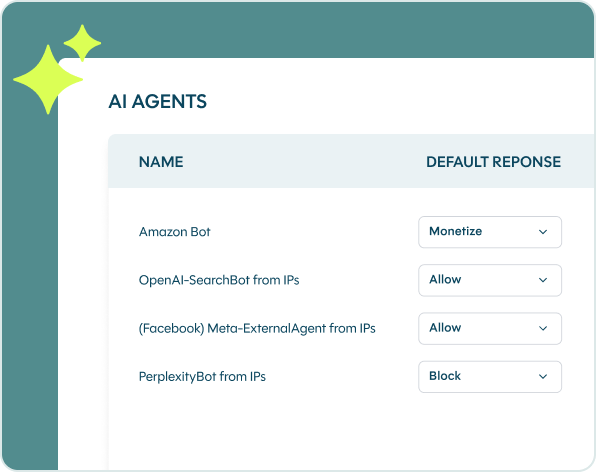
Set clear policies for AI agents. Decide in advance which AI agents you want to permit, such as authorized shopping assistants, and ensure your detection can apply differentiated policies to them. Blanket blocking of non-human traffic will catch bots and customers alike.
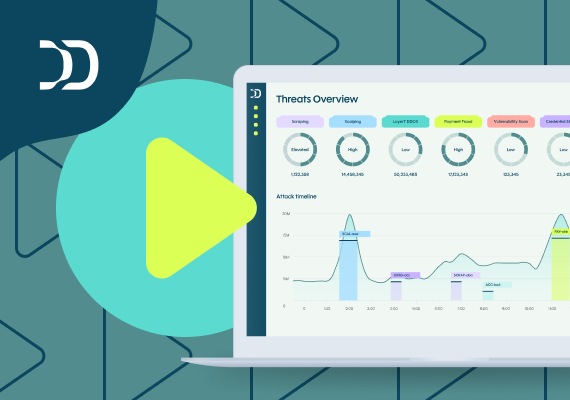
Monitor in real time during the event. Configure alerts for anomalous patterns: sudden spikes in requests to specific endpoints, unusual request velocity, geographic concentrations that don’t match your customer base. Also watch your waiting room: how many visitors are still waiting versus leaving the queue, and how much traffic was blocked versus queued. That tells you whether your settings match real demand, and lets you adjust before visitors walk away.
Protect the queue, not just the site. Understand whether your waiting room evaluates traffic inside the queue or only at entry. Bots that join directly give detection little to work with at the door, and they can inflate your queue while real customers wait.
Manage your traffic spikes with DataDome Priority Protect
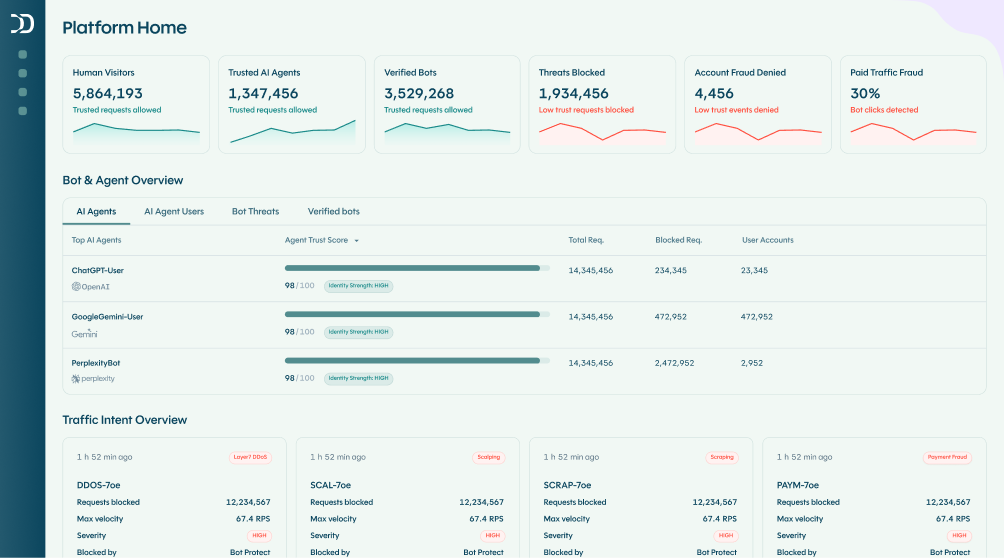
Priority Protect is DataDome’s virtual waiting room that combines real-time bot detection, AI agent trust management, and granular access controls into a single solution.
It takes a different approach from traditional waiting rooms by keeping DataDome’s bot detection running inside the waiting room, not just at the door, and it applies your AI agent policies to every visitor.
Priority Protect also gives you control over AI agents explicitly. You choose whether your waiting room admits humans only, or humans plus the AI agents you permit, and you can allow specific agent types rather than all of them. Real customers and their approved agents move through faster because they’re not competing with fraudulent traffic for queue position.

During high-traffic product drops or peak revenue moments like Black Friday, Priority Protect continuously monitors your site for sudden spikes in demand. When traffic exceeds your defined thresholds, the queue activates automatically, capturing incoming visitors before they reach your infrastructure.
Your customers see a fully branded waiting room with real-time queue positions and wait time estimates, while remaining on your domain the entire time. Configuration changes propagate in under 1 minute, allowing you to adjust capacity, release rates, or access policies in real time during the event.
If you’re an existing DataDome customer, Priority Protect is a single module upgrade. There’s no re-architecture, no new vendor evaluation, and setup takes less than an hour on supported platforms (Fastly, Cloudflare, CloudFront, Akamai, Nginx, and IIS). With Black Friday approaching, talk to your account manager now to get it in place before the rush.
Not yet a customer? Book a demo to learn more about DataDome.
FAQs
Yes, though the mechanism differs slightly. A DDoS attack is designed specifically to overwhelm your infrastructure through volume—it’s intentional disruption. Bot traffic during a Black Friday event is usually goal-directed: the bots want inventory or data, and the crash is a side effect of their volume. In practice, the infrastructure impact can look similar. The difference matters for detection: DDoS mitigation at the network layer doesn’t catch sophisticated application-layer bots that are trying to complete transactions, not just generate traffic.
Some bot traffic is normal and useful, like search engine crawlers, uptime monitors, and analytics tools. The problem is the proportion of malicious automated traffic, which is likely to be higher than usual for your site during planned retail events. “Normal” isn’t a fixed number; it depends on your site category and traffic patterns. What matters is whether you can see and classify it in real time.
Not reliably. CAPTCHAs stop unsophisticated bots, but modern bot operators specifically design their tools to bypass them through human CAPTCHA-solving farms, ML-based solvers, or behavioral mimicry that evades detection. Beyond efficacy, there’s a conversion cost: every CAPTCHA your legitimate customers encounter is friction. On Black Friday, friction is expensive. Behavioral detection that distinguishes bots from humans without visible challenges is a better approach for high-demand events.

Related posts

Which Industries Are Least Protected From Bots & Spoofed AI Agents in 2026?
Tell me more

Why Layering a Specialist Bot & Agent Trust Solution With Your CDN Is Now Essential
Tell me more
Introducing DataDome’s AI Key Takeaways Feature: Understand Your Protection at a Glance
Tell me more

Beyond Detection Accuracy: Measuring the Real Business Impact of Bot Management
Tell me more