


Bad Bot Traffic Is Growing 9x Faster Than Human Traffic: Takeaways From The 2026 State of Bot & Agent Security Report
DataDome’s mission is to free the web of fraudulent traffic. The State of Bot & Agent Security Report is one of the ways we work toward that goal, giving organizations a data-backed view of how automated traffic is evolving, where protection gaps exist, and what needs to change.
For the 2026 edition, we expanded our scope to match a more complex threat landscape. This year’s report covers two datasets: an anonymized traffic analysis across more than 75,000 customer sites from July 2025 through June 2026, plus a test of 21,491 popular websites, showing how each handles 10 distinct bot and spoofed AI agent types across four difficulty tiers.
The findings point in one clear direction. Automated traffic is growing faster than human traffic. It’s also becoming more sophisticated and reaching deeper into the customer journey, touching the login, account, and transaction flows that matter most to users and businesses alike.
Key findings from the 2026 report
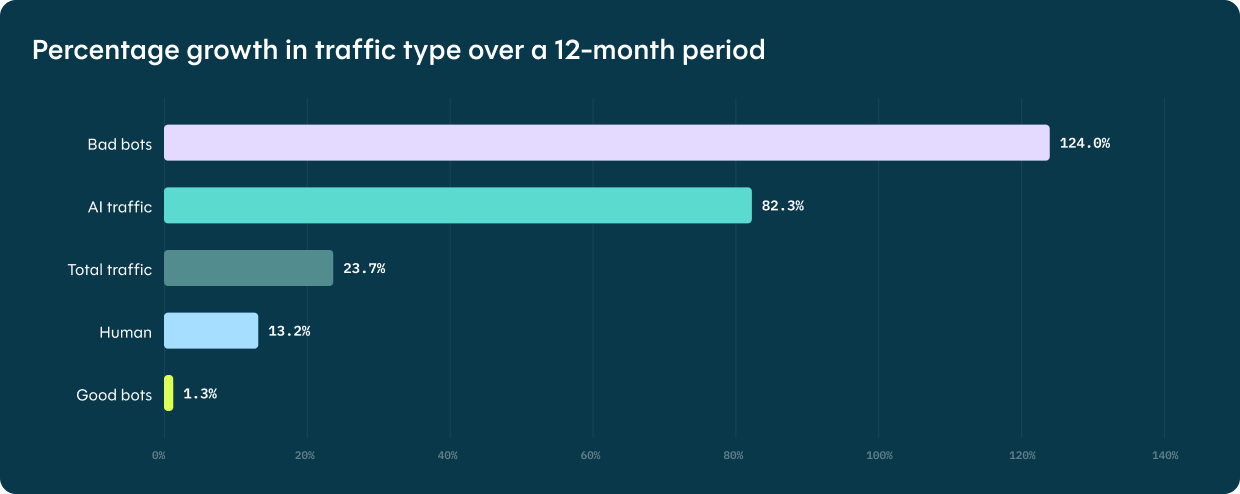
Bad bot traffic is growing 9x faster than human traffic
Bad bot traffic increased 124% between July 2025 and June 2026—more than 9x the growth rate of human traffic. AI traffic grew 82.3% over the same period, more than 6x the growth rate of human traffic. Together, bots and AI agents accounted for approximately 26.5% of all traffic analyzed across DataDome’s customer base.
Automated traffic is no longer a background consideration. It is a significant and growing share of the environment every organization needs to understand and govern.
Scraping is the dominant attack vector, and it’s accelerating
Scraping accounted for 70.9% of observed bad bot traffic and increased 185.2% during the study period, making it the largest and fastest-growing attack category by a wide margin.
One possible explanation is the growth of an AI data supply chain. Third-party data resellers and applications building AI agents may be collecting web content at scale to support model training and AI services, and this activity does not always identify itself as an AI crawler. It can operate through conventional scraping infrastructure, which means the actual impact of AI on the automated-threat landscape may be larger than what appears in traffic labeled as AI bots alone.
Scalping activity also surged 290.7%, with median daily volume nearly quadrupling, putting continued pressure on businesses to protect high-demand inventory and purchase flows.
AI agents are moving deeper into the customer journey
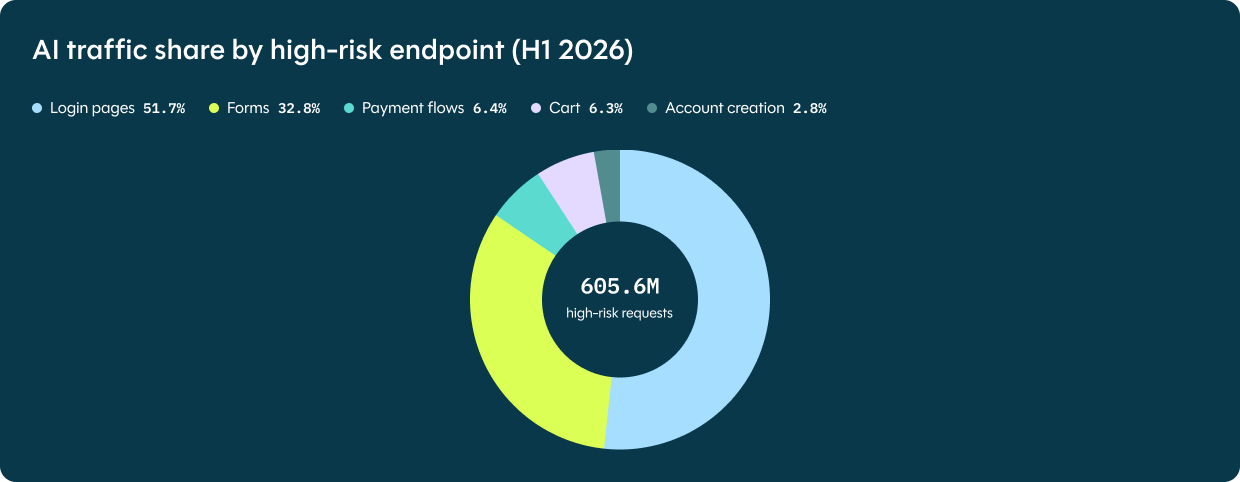
DataDome detected 52.7 billion AI agent and LLM crawler requests across our customer base during the 12-month study period. Total AI traffic grew 82.3%, and an increasing share of that traffic is reaching the endpoints that matter most.
In H1 2026, AI agents generated 605.6 million requests to high-risk endpoints, such as login pages, forms, carts, payment flows, and account-creation pages. Login pages accounted for 51.7% of that traffic. Monthly AI bot requests to login pages increased more than eightfold between January and June 2026, rising from 11.9 million to 99.7 million requests.
Not all of this is malicious. An AI agent reading product information to help a user research a purchase is different from automation systematically testing credentials on a login page. But they can look similar from the outside.
Among the top AI traffic sources, Meta-affiliated bots generated the largest share at 46.3%, followed by OpenAI-affiliated bots at 34.6%.
Identity-based controls are not keeping up
AI agent spoofing increased 45% between February and July 2026. A request can claim to be GPTBot, ClaudeBot, or any other recognized crawler without actually originating from that source. User-agent strings, IP reputation, and static allowlists provide useful signals, but they are not sufficient proof of identity, authorization, or intent.
The protection gap is widening
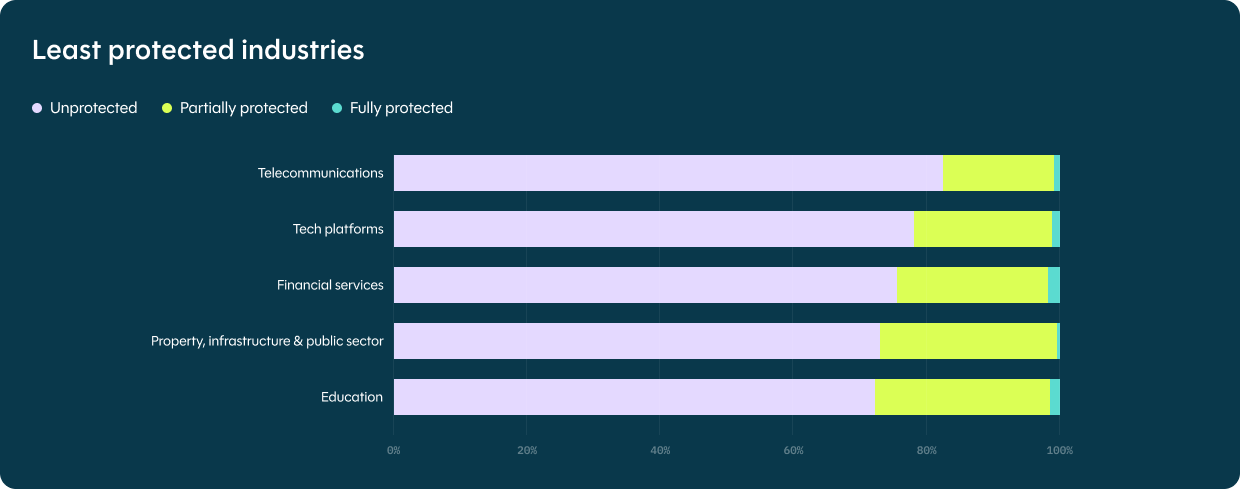
In the test of 21,491 websites, 65.3% were completely unprotected against bots and spoofed AI agents. Only 2.4% achieved full protection—down from 8.4% in 2024 and 2.8% in 2025. Full protection has declined for three consecutive years.
The decline is happening as bot tooling becomes more capable and more accessible. Anti-fingerprinting frameworks, automated browsers, and bot-as-a-service platforms have lowered the barrier for attackers. Meanwhile, even basic automation is going largely undetected: only 5.5% of tested sites stopped every basic bot type, and more than 7 in 10 websites allowed a spoofed AI agent through without any challenge.
The weakest industries in this year’s test were Telecommunications (82.9% of sites completely unprotected), followed by Tech platforms (77%) and Financial services (73.8%). Even the strongest-performing segment—Marketplaces and classifieds—had more than half of its sites fully unprotected.
The case for intent-based detection
The data reinforces a shift that has been building for several years. The right question in 2026 is no longer “Is this a bot or a human?” It is: “What is this visitor trying to do, and is that activity authorized and beneficial to the business?”
An AI agent that helps users discover products and information is fundamentally different from automation systematically testing credentials, even when the surface-level signals look similar.
Businesses that block all automated traffic lose the real value it can create. Businesses that allow everything through face fraud, content theft, and account abuse. The goal is real-time, intent-based traffic decisions: letting legitimate users and authorized automation through while stopping harmful activity before it causes damage.
Read the full report
The full State of Bot & Agent Security Report, 2026 Edition is available now.
It includes a detailed breakdown of attack vectors, AI traffic behavior by endpoint and industry, year-over-year protection benchmarks across 15 industries, and guidance on how to evaluate automated traffic based on intent, not just identity. Get your free copy today.

Related posts

Web Bot Auth & Know Your Agent: Why Identity Isn't Enough
Tell me more

DataDome Recognized as a Sample Vendor in the Gartner® Hype Cycle™ for Application Security, 2026
Tell me more
Key Takeaways From Our Conversation With Forrester on the State of Bot & Agent Trust Management
Tell me more

How to Block AI Bots, Crawlers, & Scrapers
Tell me more

