


AI Traffic Is Up 82%. Can You Tell Which Agents to Trust?
AI agents are changing how people search, shop, and research online. They are also changing the security challenge for businesses.
Between July 2025 and June 2026, DataDome detected 52.7 billion AI agent and LLM crawler requests across our customer base. AI traffic grew 82.3% over the same time period, and its share of total web requests rose from 1.2% to 1.7%.
AI traffic isn’t one thing. Some agents fetch public information for users. Others collect content at scale or act inside authenticated journeys. A name alone doesn’t tell you which one you’re dealing with.
The State of Bot & Agent Security Report 2026 shows how AI traffic is growing more sophisticated and targeting deeper into the customer journey, making visibility essential.
Here’s an overview of the report’s key AI findings.
AI traffic is concentrated and growing fast
DataDome’s 2026 State of Bot & Agent Security Report classified traffic from more than 100 named AI agents and LLM crawlers across the first half of 2026.
A few major platforms dominate the current ecosystem:
- Meta-affiliated bots: 46.3% of tracked AI traffic, up 164.9% between January and June 2026
- OpenAI-affiliated bots: 34.6%
- Huawei’s PetalBot and Amazon: 5.3% each
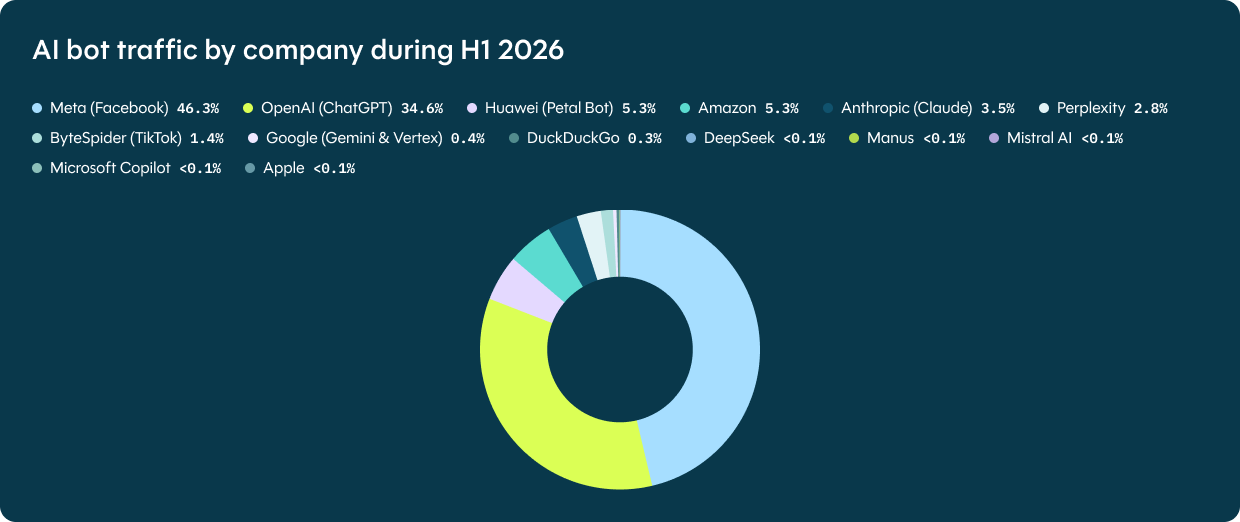
Google shows only 0.4%, but that is likely understated. Google routes AI activity through existing Googlebot infrastructure, so it doesn’t appear as dedicated AI traffic.
Smaller players can scale quickly: DuckDuckGo’s AI bot traffic grew 423% in H1 2026. At the current pace, overall AI traffic across DataDome’s network is on track to exceed 79.2 billion requests annually by 2027.
AI agents are moving into login, cart, and payment flows
Of the 29.02 billion AI bot requests we analyzed in H1 2026, 97.9% went to general content like homepages and informational pages. But 605.6 million requests reached high-risk endpoints: login pages, forms, carts, payment flows, and account creation.
- Login pages took 51.7% of that traffic, up from 23% in 2025
- Monthly AI requests to login pages grew 735.8% in six months, from 11.9 million in January to 99.7 million in June
- Payment-flow share tripled, from 2% to 6.4%
This doesn’t mean all of it is malicious. A legitimate agent may log in to check an order or a loyalty balance for an authorized user. But the same behavior can look like credential testing or account takeover reconnaissance. Endpoint type alone doesn’t reveal intent.
As AI agent traffic reaches deeper into the customer journey, businesses need to understand the intent behind each request, and whether its behavior matches its stated purpose.
Spoofing is weakening identity-based trust
A request that claims to be GPTBot or ClaudeBot may not come from OpenAI or Anthropic at all.
Our 2026 Future of Search and Discovery Report found that 80% of AI agents don’t properly identify themselves. With so few declaring a reliable identity, a user-agent string can’t be trusted on its own.
Our latest data shows how common impersonation has become. AI agent spoofing rose 45% between February and July 2026, and it increased across every category we tracked:
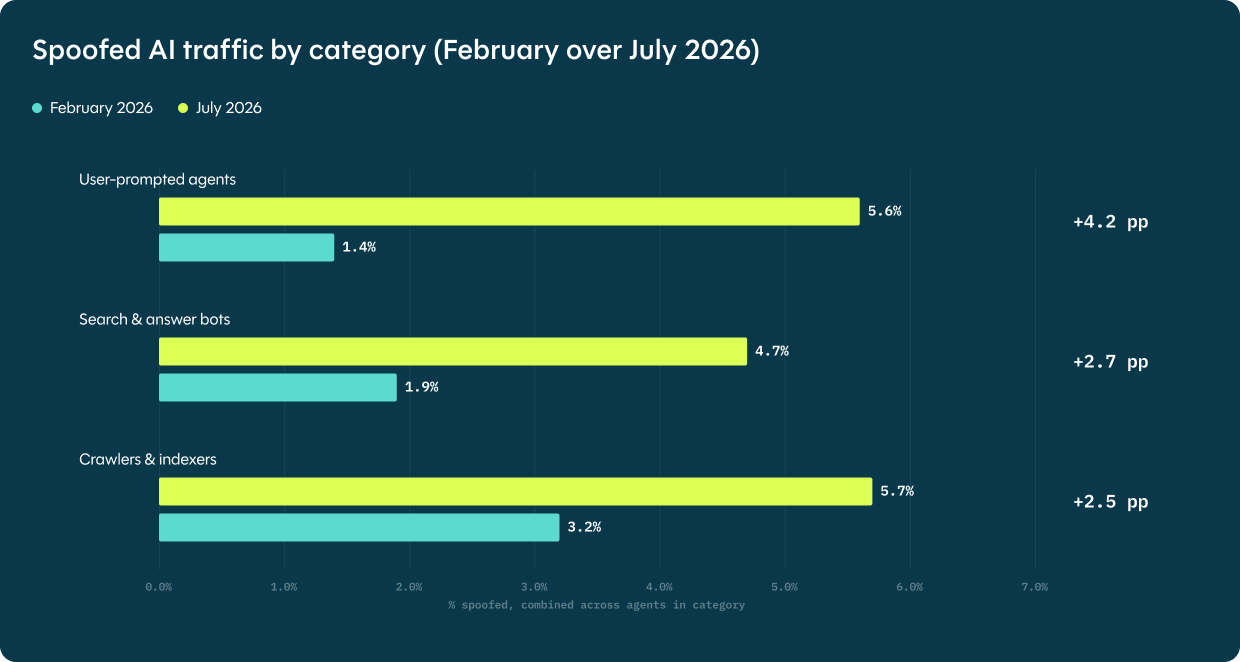
User-prompted agents saw the sharpest rise. These live assistants act on behalf of users and navigate sites directly, which makes them an increasingly attractive identity to impersonate.
By volume, Meta-ExternalAgent was the most impersonated agent, with 12.7 million spoofed requests in July alone.
Most websites are unprotected against spoofed AI agents
We tested 21,491 popular websites against 10 bot and spoofed AI agent types. 65.3% stopped none of them, and only 2.4% stopped all of them.
Spoofed AI agents were stopped more often than any other bot type: 29.3% of sites stopped at least one. The likely reason is that many sites have added rules blocking known identities like GPTBot and ClaudeBot, and spoofed versions of those names trip the same rules. That reflects name matching, not stronger verification.
On the other side of that number, more than 7 in 10 sites stopped no spoofed AI agent at all. Static allowlists and blocklists recognize a label. They can’t verify it, or judge whether the activity behind it is appropriate.
AI is also a new acquisition channel
Not all AI traffic is a threat.
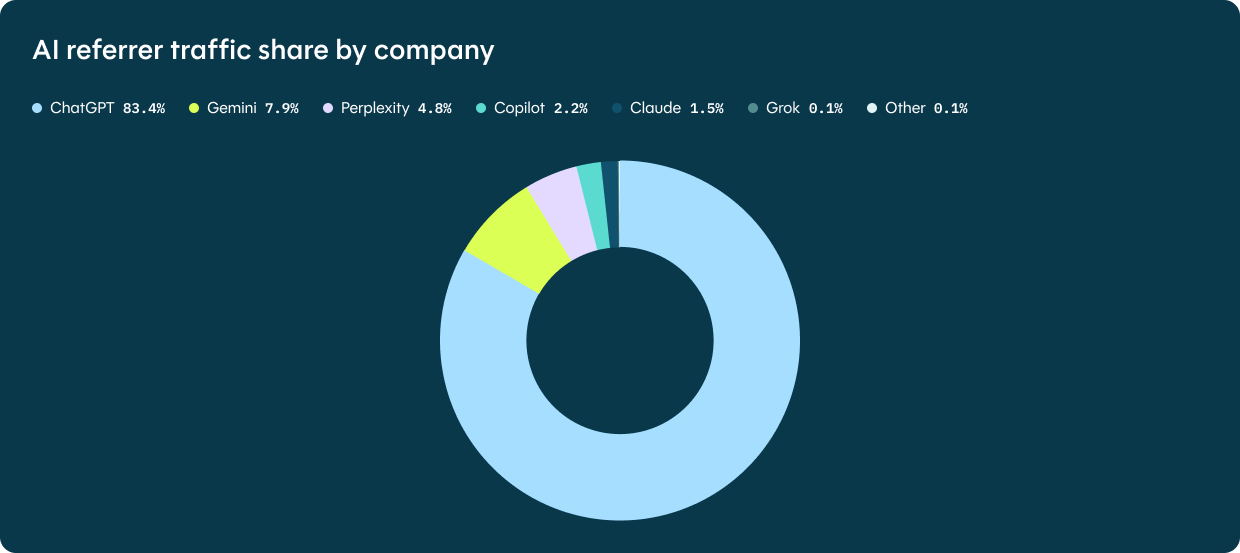
AI chat platforms referred 89.4 million visits to DataDome-protected sites in H1 2026, with ChatGPT driving 83.4% of them. These visitors often arrive with high intent and context an AI has already gathered, which standard analytics may not capture.
Blocking all AI traffic means losing this growing acquisition channel.
What to do: Detect intent, not just identity
AI agents are becoming active participants in commerce, productivity, and research. The right automation should operate freely, but that doesn’t mean letting everything in.
Traffic type alone does not determine risk. The question is: “What is this visitor trying to do, and does it benefit the business?”
DataDome’s intent-based detection answers it by evaluating behavioral sequencing, endpoint sensitivity, request rate, session context, and device and network signals. It does this in real time, across the full customer journey: login, APIs, forms, cart and payment flows, mobile apps, and MCP servers.
Test your site today to see if you’re protected against bots and spoofed AI agents, or book a demo to learn more about DataDome.
Read the full report
The 2026 State of Bot & Agent Security Report includes the complete AI traffic analysis, plus bot threat trends and protection benchmarks across 15 industries. Get your free copy.

Related posts

Why Layering a Specialist Bot & Agent Trust Solution With Your CDN Is Now Essential
Tell me more

Introducing DataDome’s AI Key Takeaways Feature: Understand Your Protection at a Glance
Tell me more

Meta’s Muse Is Bringing Agentic Browsing to the Masses. Here’s Why That Matters
Tell me more
Bad Bot Traffic Is Growing 9x Faster Than Human Traffic: Takeaways From The 2026 State of Bot & Agent Security Report
Tell me more

