
AI Agent Authentication and Authorization: Security Guide
AI agents are now shopping, booking, and transacting on behalf of users. But how do systems verify these agents are legitimate? And once verified, what should they be allowed to do?
AI agent authentication confirms identity. AI agent authorization controls access. Together, they form the technical foundation for the agentic era—though effective security requires pairing them with real-time intent detection to understand what agents are actually trying to do.
Key takeaways
- AI agent authentication confirms the identity of the agent making a request. AI agent authorization determines what that agent can actually do.
- Authentication and authorization are necessary but insufficient. Effective agent security requires real-time intent verification to understand what agents are trying to do, not just who they claim to be.
- Standard protocols like OAuth 2.1 and mTLS provide secure machine-to-machine authentication, while MCP (Model Context Protocol) is emerging as the standard for agent interactions.
- Traditional security models focused on humans don’t translate to autonomous agents. New frameworks like Agent Trust are needed.
- Least-privilege access and real-time behavioral verification are essential for managing autonomous agent permissions.
What is AI agent authentication?
AI agent authentication is the process of verifying the identity of an AI agent before it can access systems, APIs, or data. It answers a simple question: Is this agent actually who (or what) it claims to be?
Unlike human authentication, where you might enter a password or scan your fingerprint, AI agents need machine-to-machine credentials. These typically include cryptographic keys, certificates, or tokens that prove the agent’s identity without human intervention.
The stakes are significant. When an AI agent books travel, processes payments, or accesses customer data on your behalf, the receiving system needs to verify that the request came from an authorized source.
Authentication establishes identity—the essential first step in agent security. However, identity verification alone can’t detect when a properly credentialed agent has been spoofed by a malicious actor, which is why assessing intent is critical.
What is AI agent authorization?
While authentication confirms identity, AI agent authorization determines what an authenticated agent can actually do. It’s the difference between getting through the front door and being allowed into every room of the building. Authorization defines:
- Which APIs an agent can call
- What data it can read, write, or modify
- Which actions it can execute
- What resources it can access
For autonomous AI agents, authorization becomes especially critical. An agent booking a flight shouldn’t have access to your medical records. A customer service agent shouldn’t be able to process refunds above a certain amount without human approval.
Why AI agent security matters today
The urgency around agent authentication and authorization isn’t theoretical. Several converging trends make this a pressing business concern.
Agentic AI is scaling rapidly
According to Gartner, 33% of enterprise software applications will include agentic AI by 2028, up from less than 1% in 2024.¹ This projection extends to individual workflows: at least 15% of day-to-day work decisions will be made autonomously through agentic AI by 2028.
The commercial opportunity is massive
McKinsey estimates that agentic commerce (shopping powered by AI agents) could orchestrate up to $1 trillion in U.S. retail revenue by 2030, with global projections reaching $3-5 trillion.² Major players including OpenAI, Google, Stripe, and Shopify are already building agent-to-merchant infrastructure.
Security risks are escalating
Gartner predicts that by 2028, 25% of enterprise breaches will be traced back to AI agent abuse—from both external attackers and malicious internal actors.3 The threat surface expands dramatically when agents can initiate chains of events and interactions that aren’t visible to human operators.
Authentication methods for AI agents
Organizations have several proven approaches for authenticating AI agents, each with distinct tradeoffs.
OAuth 2.1 with client credentials
OAuth 2.1 is becoming the standard for AI agent authentication, particularly for agents that need to access protected resources on behalf of users. The client credentials flow issues each agent a unique client ID and secret, generating short-lived access tokens.
How it works:
- Agent presents credentials to authorization server
- Server validates credentials and returns access token
- Agent uses token to access protected resources
- Token expires, agent requests new one
Best for: Agents operating in web-based environments, accessing APIs, or interacting with SaaS platforms.
The Model Context Protocol (MCP) specification, initially introduced by Anthropic, mandates OAuth 2.1 for authorization. This is quickly becoming the standard for how AI agents interact with external tools and resources.
Mutual TLS (mTLS)
Mutual TLS provides two-way authentication where both the agent and the service verify each other’s identity using X.509 certificates. Unlike standard TLS where only the server proves identity, mTLS requires both parties to present certificates.
Best for: High-security environments, financial services, healthcare, and scenarios where bidirectional trust verification is critical.
Tradeoffs: More complex to implement and manage at scale. Certificate rotation and revocation require careful operational processes.
API keys and tokens
The simplest authentication method: each agent receives a unique key that it presents with every request.
Best for: Internal systems, low-risk operations, or development environments.
Critical limitation: API keys offer weak security for production agentic systems. They’re static credentials that can be stolen, difficult to scope, and don’t provide the granular control needed for autonomous agents..
Authorization models for AI agents
Once an agent is authenticated, authorization frameworks determine what actions it can take.
That said, authorization alone can’t detect when a properly credentialed agent begins behaving maliciously or erratically. That’s why intent-based detection is such an important part of AI agent security.
Role-based access control (RBAC)
RBAC groups permissions into predefined roles (admin, editor, viewer) assigned to agents. A support agent gets the “support” role with predefined capabilities; a deployment agent gets the “deployer” role.
Strengths: Simple to understand and audit. Works well for clearly defined agent functions.
Limitations: Can lead to permission creep. Struggles with dynamic, context-dependent scenarios.
Attribute-based access control (ABAC)
ABAC evaluates multiple attributes before granting access: agent identity, resource sensitivity, time of day, recent behavior patterns, current task context. For example: “Allow access to customer data only during business hours, only for customers who’ve opted into AI support, and only if the agent’s recent behavior matches expected patterns.”
Strengths: Highly flexible and context-aware. Can implement complex business logic.
Limitations: More difficult to audit and debug. Requires robust attribute management.
Relationship-based access control (ReBAC)
ReBAC determines access based on relationships between entities. An agent can access a document if the user it represents owns that document, or if the user belongs to a team that shares it.
Best for: Multi-tenant systems, collaborative environments, scenarios where access depends on organizational structures
The MCP authorization framework
The Model Context Protocol has emerged as a critical standard for AI agent interactions. Understanding its authorization model is essential for anyone building or securing agentic systems, and MCP security is becoming a dedicated discipline as adoption accelerates.
How MCP authorization works
MCP servers act as OAuth 2.1 resource servers, accepting protected resource requests using access tokens. When an AI agent (MCP client) needs to access a protected resource:
- Agent makes initial request to MCP server
- Server responds with 401 Unauthorized, providing a discovery link
- Agent discovers the authorization server and required scopes
- Agent initiates OAuth 2.1 authorization code flow with PKCE
- After user consent, agent receives access token
- Agent presents token to access resources
This flow ensures that agents can dynamically discover authorization requirements across heterogeneous systems, critical for agents that interact with thousands of unknown APIs.
Why PCKE matters
Proof Key for Code Exchange (PKCE) is mandated in OAuth 2.1 and essential for MCP contexts. Many AI agents run in environments where storing secrets securely is difficult: containers, serverless functions, or distributed systems.
PKCE allows public clients to use authorization code flow securely without relying on a client secret, reducing the risk of token interception. It binds the authorization code to the specific client that requested it.
How to authenticate AI agent step by step
Implementing robust agent authentication requires systematic attention to each component.
1. Establish unique agent identities
Every agent needs a unique, verifiable identity. This means:
- Issuing unique client IDs and credentials to each agent instance
- Registering agents in your identity management system
- Creating clear naming conventions and metadata for tracking
Don’t: Share credentials across multiple agents. If one is compromised, all are compromised.
2. Implement machine-to-machine (M2M) authentication
Configure your identity provider for OAuth 2.0 client credentials flow:
- Register each agent as an OAuth client
- Issue client ID and client secret (or certificate for mTLS)
- Configure appropriate scopes and permissions
- Set token expiration policies (shorter is safer)
3. Secure credential storage and rotation
Agent credentials require the same protection as human credentials—arguably more, since they often have broader access:
- Store credentials in secret management systems (HashiCorp Vault, AWS Secrets Manager)
- Implement automated credential rotation
- Never hardcode credentials in agent code
- Monitor credential usage for anomalies
4. Configure token lifecycle management
Access tokens should be:
- Short-lived (minutes to hours, not days)
- Scoped to specific resources and actions
- Automatically refreshed when needed
- Immediately revocable if an agent is compromised
5. Implement discovery protocols
For dynamic environments, agents need to discover authorization requirements automatically. Implement:
- OAuth 2.0 Authorization Server Metadata (RFC 8414)
- Protected Resource Metadata (RFC 9728)
- Dynamic Client Registration (RFC 7591) where appropriate
Best practices for how to authorize AI agents
Define granular, task-specific permission
Instead of broad role assignments, create precise capability sets tied to specific business functions:
- A support agent should have read access to customer profiles, permission to create tickets, and access to the knowledge base. Nothing more.
- A deployment agent needs the ability to execute builds, access logs, and deploy to staging environments, but shouldn’t touch customer data.
- An analytics agent can read aggregated data, generate reports, and access dashboards, but shouldn’t have write permissions anywhere.
The key is mapping each permission to a specific, justified business need. When you can’t articulate why an agent needs a particular capability, it probably doesn’t.
Implement context-aware authorization with intent detection
Static permissions don’t account for dynamic business conditions. Authorization policies should evaluate multiple factors in real time: the current task context, the sensitivity level of the data being requested, time and location factors, the agent’s recent behavioral history, and whether the user has provided explicit consent for this type of action.
This approach enables policies like “allow access to customer data only during business hours, only for customers who’ve opted into AI support, and only if the agent’s recent behavior matches expected patterns.” Context-aware authorization catches scenarios that static role assignments miss entirely.
In other words, authorization policies should evaluate not just what an agent is allowed to do, but what it’s trying to do. This means monitoring intent-based behavioral patterns and adjusting trust scores and access levels dynamically based on these signals.
Set time-bound access windows
Agents with elevated privileges shouldn’t maintain those privileges around the clock. Grant deployment access only during scheduled release windows. Set temporary elevated permissions that expire automatically after a defined period. Require re-authorization for sensitive operations rather than allowing indefinite access based on a single approval.
Time-boxing permissions shrinks the window for potential misuse, whether from a compromised agent or one simply operating outside its intended scope.
Design for human-in-the-loop conditions
Not everything should be automated. Define clear escalation thresholds where agent autonomy pauses for human approval: financial transactions above a certain amount, actions that affect customer data, decisions with compliance implications, and operations in production environments.
Build approval workflows that halt agent execution until human authorization is received. The goal isn’t to slow everything down. It’s to ensure humans remain in control of high-stakes decisions while agents handle routine operations autonomously.
Monitor and audit continuously
Authorization isn’t set-and-forget. Log every permission check and access decision. Track agent activity patterns over time to establish behavioral baselines. Alert on anomalous permission usage that deviates from those baselines. Review and prune unused permissions regularly. If an agent hasn’t used a capability in months, it probably doesn’t need it.
Continuous monitoring transforms authorization from a one-time gate into an ongoing verification process.
DataDome’s approach to securing AI agents
Traditional bot detection evolved from identifying simple automated traffic. The agentic era demands something fundamentally different: verifying not just who is acting, but why and how.
And the challenge extends beyond sophisticated agentic systems. Organizations must also manage LLM crawlers harvesting content for training data and block AI bots that automate attacks at scale, all while enabling legitimate agents to operate freely.
DataDome’s Agent Trust framework addresses this through real-time verification of:
- Identity: Cryptographic verification of agent credentials
- Intent: Behavioral analysis to detect whether agent actions align with stated purpose
- Authorization: Dynamic permission enforcement based on context
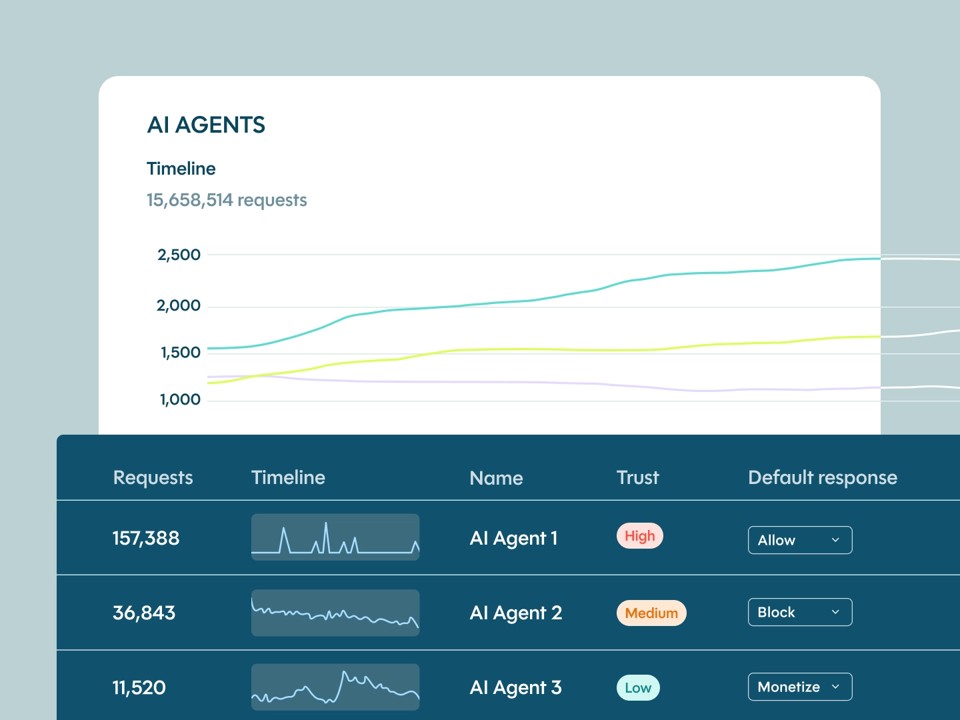
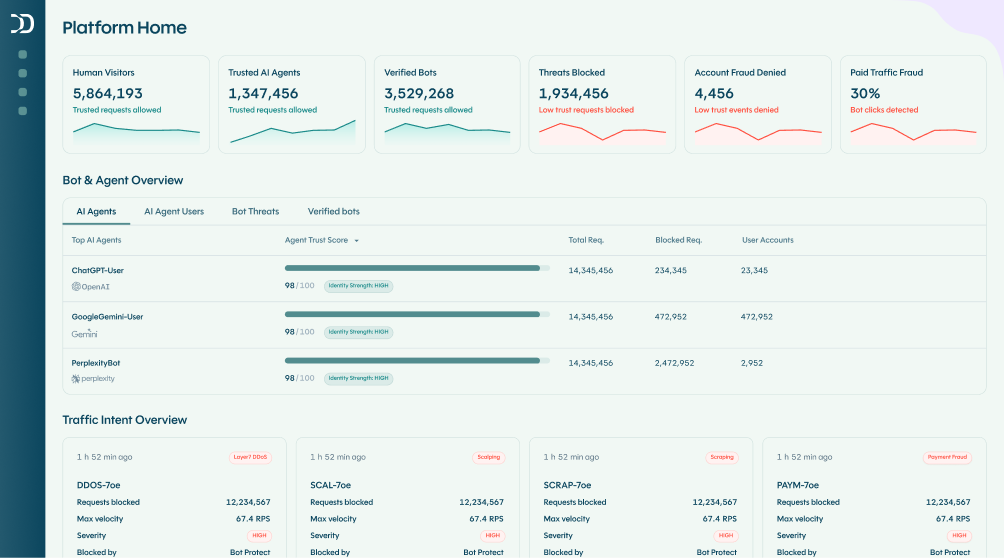
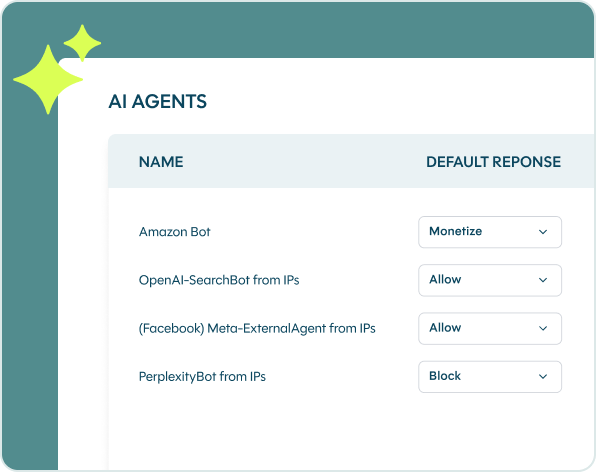
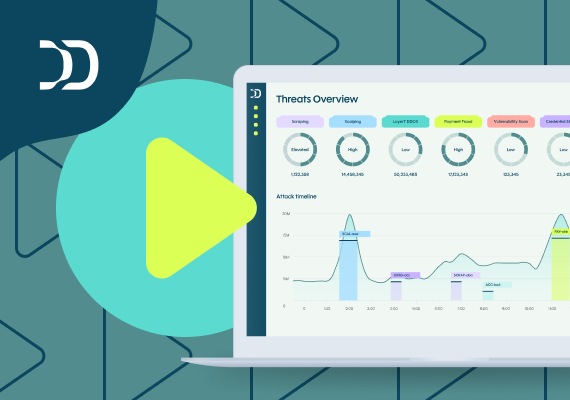
See your AI agent traffic clearly, trust the good agents, and automatically block the bad ones.
For organizations building or consuming MCP-based systems, DataDome’s MCP Protection provides security for Model Context Protocol endpoints, ensuring AI agents accessing your tools and data are legitimate, authorized, and behaving appropriately.
The key differentiator: trust isn’t binary. DataDome’s approach provides continuous, behavior-driven trust scoring that adjusts in milliseconds based on intent signals, not just one-time authentication at the door.
Conclusion
AI agent authentication and authorization are necessary requirements for any organization deploying autonomous AI, as is real-time intent detection. As agents handle more transactions, make more decisions, and access more sensitive systems, the security infrastructure supporting them must be equally sophisticated.
The technology to do so already exists. OAuth 2.1, MCP, and established access control models provide the building blocks. The challenge is implementation: designing systems that balance agent autonomy with appropriate controls, human oversight with operational efficiency.
Organizations that get this right will capture the productivity gains of agentic AI while managing risk. Those that don’t face a future where their most powerful tools become their greatest vulnerabilities.
DataDome’s Agent Trust Management platform helps businesses verify AI agent identity, intent, and authorization in real time, so you can embrace agentic commerce without compromising security. Request a demo to see how it works.
FAQ
Implement defense in depth: least-privilege permissions, time-bound access, behavioral monitoring, and circuit breakers that halt suspicious activity. Assume agents can be compromised and design containment accordingly. Limit blast radius through segmentation and ensure rapid credential revocation capabilities.
Log every authentication event, permission check, and significant action. Track behavioral patterns over time to establish baselines. Use anomaly detection to flag deviations. Ensure audit logs are tamper-resistant and support forensic investigation when incidents occur.
References
- https://www.gartner.com/en/articles/ai-agents
- https://www.mckinsey.com/capabilities/quantumblack/our-insights/the-agentic-commerce-opportunity-how-ai-agents-are-ushering-in-a-new-era-for-consumers-and-merchants
- https://www.gartner.com/en/newsroom/press-releases/2024-10-22-gartner-unveils-top-predictions-for-it-organizations-and-users-in-2025-and-beyond

Related posts
The AI Traffic Report Q3 2026: Agentic Browser Traffic Jumped 4.7x in September as Meta's Muse Hits 29M Requests in 12 Days
Tell me more

How to Stop Bot Traffic From Crashing Your Site During Black Friday 2026
Tell me more

Which Industries Are Least Protected From Bots & Spoofed AI Agents in 2026?
Tell me more

AI Traffic Is Up 82%. Can You Tell Which Agents to Trust?
Tell me more