


Multi-Layered AI: A New Requirement for Sophisticated Bot Protection
We’ve witnessed the power and potential of artificial intelligence (AI) brought to everyday life. What some may not realize is that cybersecurity is one of the industries most deeply impacted by AI innovation. While cybersecurity companies continue to explore new ways to harness AI, cybercriminals are busy doing the same, faster, and with fewer constraints. Gone are the days when cyberattacks were manually orchestrated on narrow targets. Now, attackers have automation, community, and generative tooling on their side, allowing them to operate at unprecedented scale and speed.
AI and automation also enable cybercriminals to deploy bot attacks that more closely mimic human behavior and easily bypass traditional defenses. We’re seeing everything from ticket scalping (think Taylor Swift ticket debacle) and account takeovers that result in massive data leaks, to scraping attacks carried out by LLM-powered agents and AI shopping assistants acting on behalf of users. And the list continues to grow.
These attacks are often highly distributed, leveraging single-use IP addresses, residential proxies, and traffic patterns engineered to evade detection. Many unfold as chained campaigns —scraping, followed by inventory hoarding, or account takeover, followed by payment fraud, fake signups, or loyalty point abuse. This sophistication extends to their ability to bypass traditional security measures like CAPTCHAs. They use advanced techniques and sometimes even integrate human-in-the-loop services to overcome defenses, as seen in CAPTCHA farming.
AI-powered bot attacks now represent a persistent and high-stakes business risk to enterprises, requiring equally sophisticated and comprehensive countermeasures. Enterprises can no longer depend on legacy, static solutions like WAFs or even simpler machine learning-based engines. Detecting and stopping these threats requires a multi-layered AI system designed to inspect every request in real time and adapt instantly to new behaviors.
Why DataDome’s Use of Machine Learning Is Unique
As AI has gone mainstream, companies have been quick to tout AI claims, making it increasingly harder for security professionals to determine which solutions actually use AI and which solutions are throwing it around to make their solution sound more sophisticated than it is.
DataDome stands apart for how we apply AI and machine learning at scale. Our system is designed to inspect every request, every time, across all endpoints. Our real-time AI detection engine processes a staggering 5 trillion signals per day and continuously scales new data across all protected endpoints instantly. DataDome’s AI detection engine takes it a step further by employing a two-pronged approach: it uses the fingerprints of HTTP traffic to gather server-side signals while leveraging browser and device metrics for client-side behavioral signals.
Our use of machine learning, rather than reliance on manual rule creation, allows us to adapt and respond to emerging threats at machine speed. The platform’s performance and protection capabilities are enhanced by its operation at the edge, utilizing a network of 30+ points of presence (PoPs). This setup enables DataDome to use available threat data in real time, no matter where traffic originates. The system is fully automated, giving security teams the freedom to focus on higher value priorities without sacrificing control.
Crucially, the DataDome Advanced Threat Research team plays an active role in how our AI evolves. They continuously track emerging attack methods, analyze traffic anomalies, and refine detection logic. Their work ensures that the models feeding our AI aren’t just large, they’re accurate and current.
Why is having a robust threat research team vital for successful bot management? Because AI is only as strong as the signals it learns from. By feeding our models with real-world intelligence and live feedback loops, we ensure our detection stays ahead of adversaries, no matter how quickly the threat landscape shifts.
And we haven’t even gotten to one of the most important aspects of our detection engine: our multi-layered AI.
The core competency of DataDome: Multi-layered AI
A sophisticated bot attack calls for an equally sophisticated defense. Our AI-powered detection engine uses multiple layers of AI/ML models that work in tandem, in real time, to determine in less than 2 milliseconds whether a request is malicious.
Why is a multi-layered approach so important? First, because today’s bots are designed to evade shallow detection. Some operate at the behavioral layer, others spoof device attributes or fingerprint headers, and a single detection method won’t catch them all. Second, different use cases call for different types of scrutiny. A model tuned for stopping ad fraud won’t catch account creation abuse the same way. By layering models, DataDome can adapt detection to specific threats, verticals, and risk tolerances.
This flexibility is especially important as the types of automation evolve. Not every company faces scraping from generative AI bots, but some do. Not every company is targeted by fake account creation or credential stuffing, but many are. DataDome’s layered AI approach adapts to these differences by analyzing a wide range of signals, aggregated across various levels: request, session, IP, and fingerprint, over different time windows.
Our detection engine applies a combination of ML techniques, such as behavioral analysis, supervised learning, genetic algorithms, time series analysis, and anomaly detection. It also accounts for verified bots and honors customer-specific rules. All of this happens with real-time inference and explainability, so teams can understand how and why a decision was made. The result is detection that’s fast, accurate, scalable, and tailored—not just to the threat, but to the business it targets. That includes the ability to distinguish between benign automation (like search crawlers and approved AI agents) and malicious traffic from unauthorized bots and LLM-based tools.
Below, we explain how each layer of our detection engine plays a critical role in stopping fraudulent traffic, whether it’s bots, unauthorized AI agents, LLM crawlers, or other forms of automated abuse.
Every Layer of Detection Matters
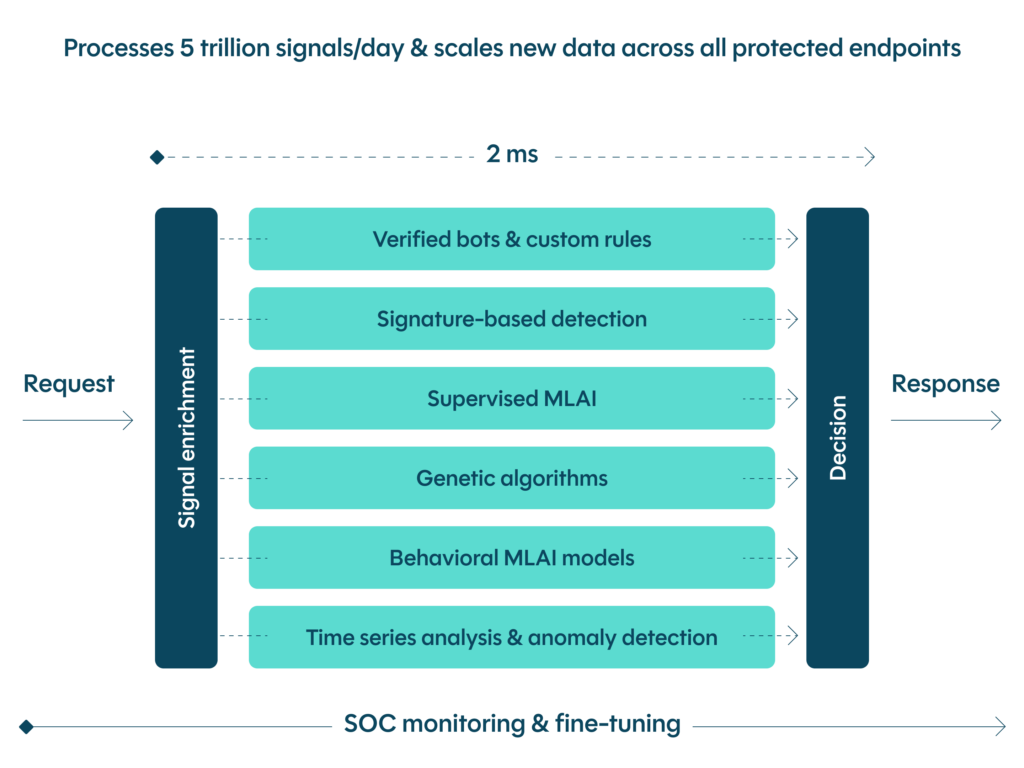
Verified bots & custom rules
DataDome scans for verified “good” bots and enforces any custom rules defined for your environment. This allows for flexibility and helps prevent false positives, so beneficial bots like Googlebot and Bingbot will continue to function without disruption.
Signature-based detection
Known bot signatures are cataloged and continuously updated. Incoming traffic is scanned against this list and blocked immediately if a match is found. Our signature repository is constantly evolving to reflect new threats, ensuring bots are blocked from the first request.
Supervised learning
Supervised ML models complement behavioral analysis by using labeled data to recognize and adapt to known (and unknown) bot patterns and their variants. The supervised models are generally applied to fingerprints and the context of a request, rather than behavioral inputs alone. These models are especially effective for identifying fraud signals in account takeovers, fake signups, and repeated abuse attempts from known bot infrastructures.
Importantly, DataDome collects these signals in a privacy-compliant manner; we never capture personal data or track individual users. Privacy is a core principle of our approach.
Genetic algorithms
Our detection engine uses genetic algorithms to autonomously evolve new detection logic. Inspired by DNA mutation, this technique mutates and tests combinations of rule predicates based on their effectiveness, measured via the time series of blocked traffic. It allows us to expand our signature-based detection in a fully unsupervised way.
Behavioral analysis
DataDome’s behavioral analysis goes beyond basic movement tracking—it’s designed to understand intent. Our models monitor two types of behavioral patterns: how the user interacts with the device (mouse movements, touchpoints, keystrokes, scrolling, etc.) and how they navigate across the site or app.
By analyzing these behaviors in context, our system distinguishes not just bots from humans, but malicious intent from legitimate activity. This intent-based approach is especially important in the age of AI agents and LLM crawlers, where traffic may appear human-like but carry risk. It allows us to apply the right decisioning logic without disrupting good automation.
Time series analysis
Time series analysis provides insights into traffic patterns over time, crucial for spotting new bot signatures. Once signatures are detected, they can be implemented into signature-based detection, rather than behavioral.
Anomaly detection
Anomaly detection is key in identifying unusual behaviors that deviate from established patterns, a vital tool for detecting malicious bot traffic. DataDome’s behavioral engine leverages Flink to analyze user activity in real time. The behavioral engine aggregates and analyzes traffic per IP, session, and fingerprint, which enables the engine to detect anomalous behavior at different levels, even if the attacker adapts its behavior.
To catch heavily distributed bots we also apply outlier detection at the entire website traffic level. This enables us to understand when the overall distribution of the traffic has changed and that something abnormal is happening. Once this is detected, we can trigger more specific AI models to understand which subset of the traffic is malicious. This layered approach also gives us visibility into the behavior of AI agents at scale, so we can separate useful automation from unauthorized or malicious AI activity.
Real-time inference & explainability
Real-time inference ensures that threats are identified and dealt with instantaneously, crucial for maintaining uninterrupted online operations. Moreover, the explainability aspect of DataDome’s AI models provides clear insights into why certain traffic is flagged as malicious, aiding in transparency and the continuous improvement of defense strategies.
DataDome is Your Shield Against Bots and Online Fraud
DataDome’s integration of diverse ML techniques, enriched with real-time processing, explainability, and advanced anomaly detection, places it at the forefront of bot detection and online fraud prevention. Its ability to continuously learn, adapt, and accurately predict bot behavior offers businesses a shield against current threats and future challenges.
As new attack methods and use cases appear, we continue to develop and deploy additional AI models to ensure our detection stays ahead.
Want a look at what bots might be attacking your business? Our free Vulnerability Scan can identify basic bots using common attack vectors your business may be vulnerable to. To identify more advanced bots, try DataDome for free or book a live demo today.

Related posts

Meta’s Muse Is Bringing Agentic Browsing to the Masses. Here’s Why That Matters
Tell me more
Bad Bot Traffic Is Growing 9x Faster Than Human Traffic: Takeaways From The 2026 State of Bot & Agent Security Report
Tell me more

Web Bot Auth & Know Your Agent: Why Identity Isn't Enough
Tell me more

DataDome Recognized as a Sample Vendor in the Gartner® Hype Cycle™ for Application Security, 2026
Tell me more

