


The DataDome Homepage: Your Command Center for Trust & Control
Security teams don’t have a data problem. They have a context problem.
Most bot and agent trust management platforms give you signals, blocked threats, traffic volume, and risk scores, scattered across separate dashboards for each product. Getting a complete picture means opening four tabs, stitching numbers together manually, and still not being certain you’re looking at the right thing.
That’s the product creating work instead of removing it. The DataDome homepage fixes that.
The threat landscape doesn’t wait
The traffic hitting your infrastructure today isn’t what it was two years ago.
Human visitors, verified bots, autonomous AI agents, malicious scrapers, credential stuffing campaigns—all moving at machine speed. Plus, a growing share of malicious traffic is designed to look legitimate.
Most security teams can’t tell you which agents are hitting their endpoints, what those agents are doing, or whether to trust them. Not because they don’t care, but because the tooling doesn’t give them that view.
DataDome’s network processed nearly 8 billion AI agent requests in the first two months of 2026 alone. This is live traffic across a wide range of industries—not a projection.
Fragmented visibility does more than slow teams down. It creates gaps, and those gaps are exactly where attackers find room to operate.
One homepage for a real-time view of every product
DataDome’s homepage displays your entire protection surface on a single screen, providing visibility into your traffic types, blocked threats, fraud prevented, and more.
These are cross-product signals that populate the moment you log in. It’s a real-time operational page, not just a summary or status page.
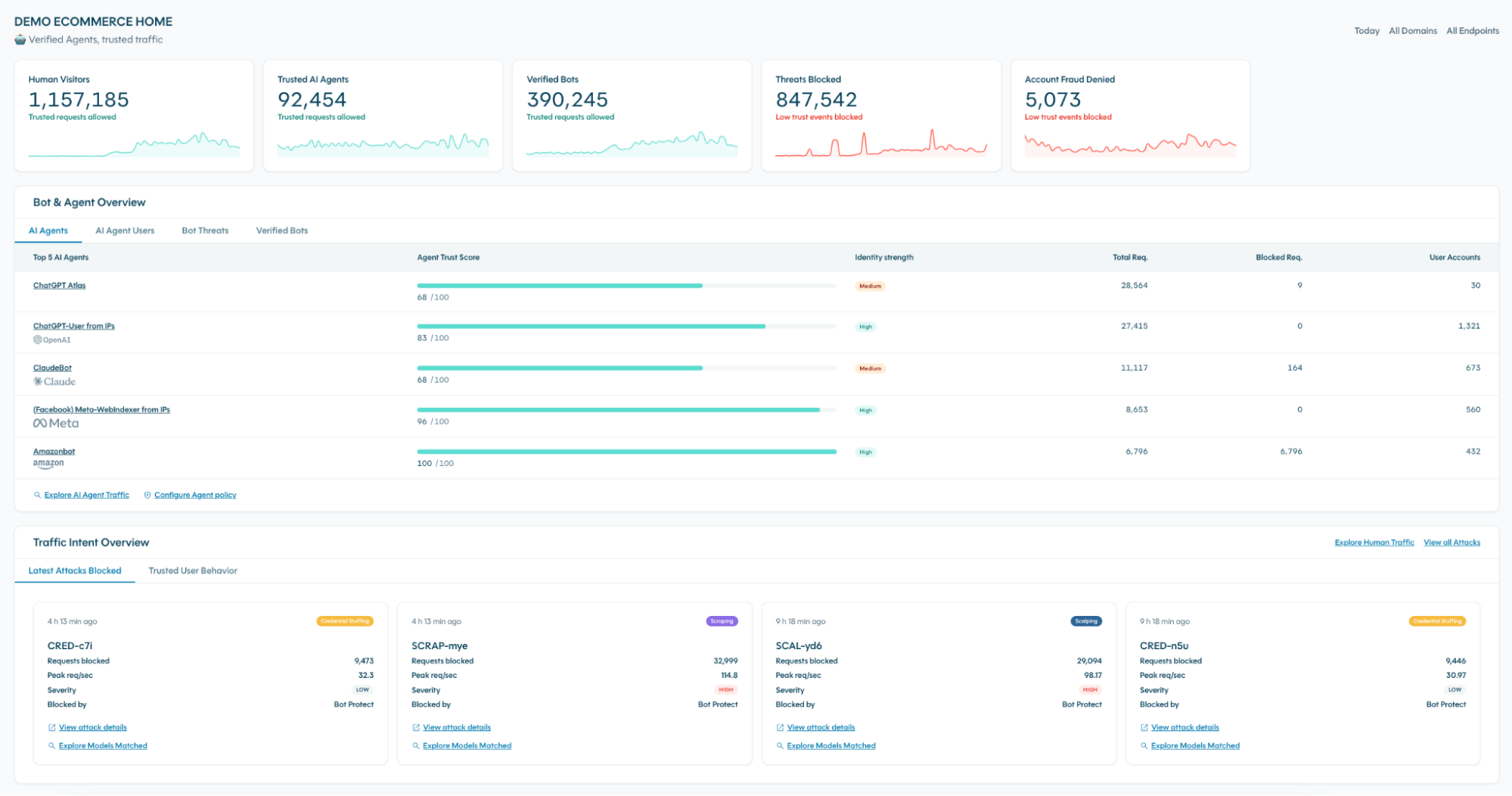
The homepage brings three critical views together in one place:
The first is trust at scale: See human visitors moving through, verified AI agents identified and scored, and AI bots categorized and handled according to policy. Beyond traffic volume, this overview shows DataDome distinguishing legitimate activity from untrusted automation in real time.
The second is threat reality: Monitor denied account fraud, paid traffic abuse, and live signals showing what protection is preventing in real time.
And then there is the layer most dashboards skip: intent. The traffic intent overview shows what the traffic was trying to do, such as a fake account creation campaign peaking at 155 requests per second.
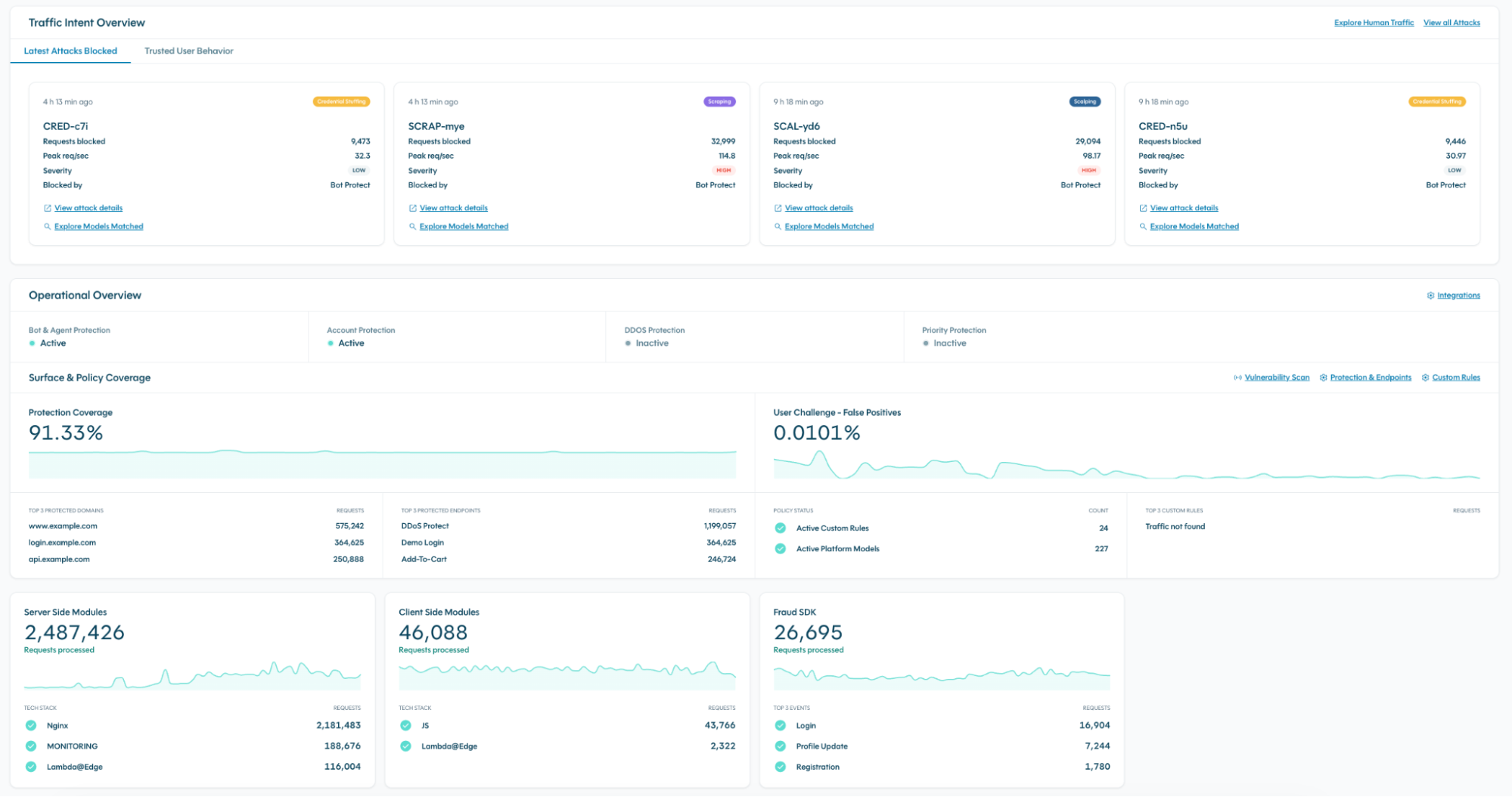
Designed for the security questions that matter most
Every element of the homepage is anchored to three questions security teams actually ask every day.
- Am I protected right now? At this exact moment, is protection running across every product?
- What has changed today? A threat campaign that looked low-risk yesterday may be spiking this morning. A new AI agent that appeared overnight may be legitimate, or it may be spoofed. DataDome’s homepage helps teams spot those changes quickly, so they can investigate issues before they escalate.
- Where should I focus? When signals live across different products with no unified view, prioritization becomes guesswork. The homepage collapses that into one surface so attention goes where it’s needed, not where you happened to click first.
AI agents: First-class traffic, first-class visibility
AI agents are now a first-class category on DataDome’s homepage, reflecting how fundamentally the traffic mix has shifted in recent years.
The Bot & Agent Overview shows which agents are hitting your endpoints, their dynamic trust scores, identity strength, request volume, and blocked requests.
Like in the example below: Amazonbot has a 100/100 trust score and high identity strength, ChatGPT Atlas has a 70 score and medium identity strength, and OpenAI-SearchBot has a 93 score and a high identity strength. These aren’t equivalent risk profiles, and treating them as such is the wrong call.
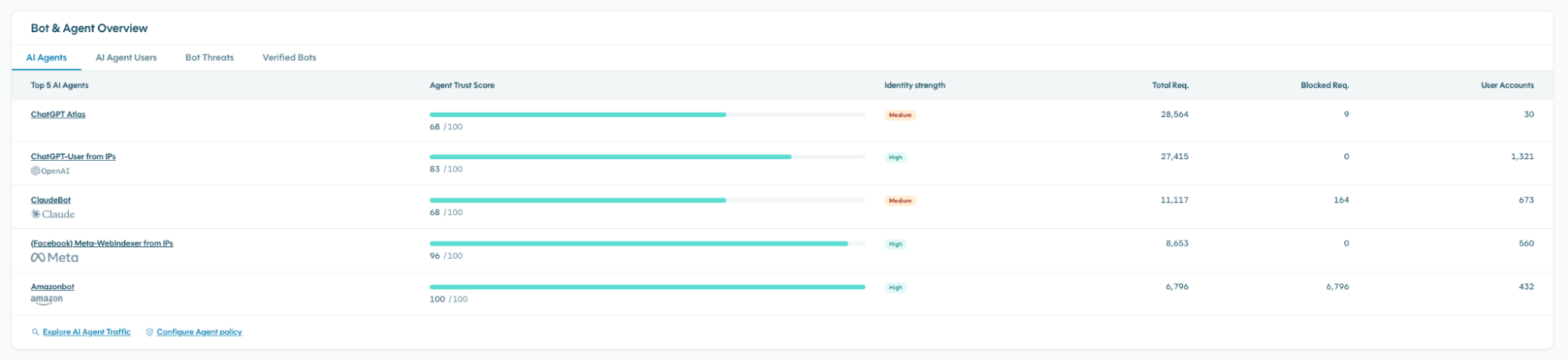
Identity alone doesn’t tell the whole story. According to DataDome’s Galileo research team, 80% of AI agents don’t properly identify themselves, and 80% of websites remain vulnerable to agent spoofing. A trust score built solely on what an agent claims to be is incomplete.
This is why DataDome’s Agent Trust score is built across three dimensions:
- Intent: What is this traffic actually trying to do? DataDome blocks traffic with malicious intent and allows it when the intent is legitimate. This precision is what eliminates false positives—legitimate users, verified crawlers, and business-critical automation get through.
- Provenance: Can the agent’s identity be independently verified? Any request can claim to be a trusted AI agent. Provenance validates across identity signals, behavioral patterns, and reputation.
- Continuity: Is trust holding over time? Automation that’s clean at a session’s start can turn malicious mid-session, which is why DataDome’s dynamic Agent Trust scores update in real time as behavior evolves.
Get the full picture with one login
The DataDome homepage is available to all customers and free trial users. Same experience, no staged rollout.
Log in and, within seconds, you see the full state of your protection. What’s changed, where to focus, which AI agents are on your infrastructure, and whether to trust them.
Not another dashboard to manage. Just one homepage that removes the guesswork.
Ready to see it in action? Book a live demo to learn more.

Related posts

Web Bot Auth & Know Your Agent: Why Identity Isn't Enough
Tell me more

DataDome Recognized as a Sample Vendor in the Gartner® Hype Cycle™ for Application Security, 2026
Tell me more

Key Takeaways From Our Conversation With Forrester on the State of Bot & Agent Trust Management
Tell me more

How to Block AI Bots, Crawlers, & Scrapers
Tell me more

