


What Is Invisible CAPTCHA? How Invisible reCAPTCHA Works
Bots now solve puzzles faster than people, so the best verification happens where no one sees it.
This guide explains how invisible CAPTCHA and invisible reCAPTCHA work, where they fall short, and how to choose a method that stops bots without frustrating real users.
What is a CAPTCHA?
A CAPTCHA (“Completely Automated Public Turing test to tell Computers and Humans Apart”) is a test that separates human visitors from bots. Learn how CAPTCHAs work, then read on for how invisible versions changed the model.
What is reCAPTCHA?
reCAPTCHA is Google’s brand of CAPTCHA, acquired in 2009. Its first version, reCAPTCHA v1, was a human-assisted optical character recognition (OCR) test. Users saw two words: a control word that OCR software could read, and a second word that only a human could decipher. Answer the control word correctly, and the test assumed your answer to the second was right too.
That approach looks primitive today, but it was a real innovation, which is why Google bought it. v1 stayed popular through the 2010s. In 2012 it added Google Street View photos and scanned words to raise difficulty, before Google shut it down in March 2018 in favor of newer reCAPTCHA versions, including invisible reCAPTCHA.
What is invisible reCAPTCHA?
Invisible reCAPTCHA is a version of reCAPTCHA v2, which comes in three forms:
- reCAPTCHA v2 for Android. Part of Google Play services’ SafetyNet APIs, it protects Android apps from bot traffic. It passes low-risk users immediately with no form, and challenges the user only when needed.
- The “I’m not a robot” checkbox. Google calls this the “no CAPTCHA reCAPTCHA” because most users only tick a box. Behind the scenes, Google analyzes behavior before, during, and after the click, such as mouse movement and browsing history. If it’s unsure, it serves the familiar “Select all images with…” test.
- Invisible reCAPTCHA v2. Here there is only a badge and no user interaction at all. Google analyzes signals like typing patterns, mouse movements, and browsing history. The check is triggered when the user clicks a built-in button or through a JavaScript API call. If Google is not sure the visitor is human, the user is prompted to solve a challenge.
What other invisible CAPTCHA approaches exist?
ReCAPTCHA isn’t the only option. Other providers use invisible or low-friction modes such as passive modes and checkbox-free checks. Others rely on proof-of-work, where the visitor’s browser silently solves a computational task. They differ in method, but most work in one of three ways:
- Behavioral and device analysis: reads signals like mouse movement, typing patterns, and device attributes.
- Risk scoring: assigns each request a score, and the site owner decides what to do with it.
- Proof-of-work: makes each request cost computing time, which slows bots at scale.
Each has trade-offs: Behavioral analysis can misjudge unusual but legitimate users, risk scoring needs tuning, and proof-of-work adds a time cost for every visitor—including humans.
Is invisible reCAPTCHA a perfect solution?
No. No invisible verification method is free of trade-offs, and reCAPTCHA v2, including the invisible version, is no exception.
Most users know the feeling of a sudden image puzzle appearing when Google’s check isn’t confident. Invisible reCAPTCHA works well when it works, but when it doesn’t, it hurts the user experience.
There’s a bigger problem. Bots now solve CAPTCHAs better and faster than humans. Sophisticated bots use AI to pass challenges with high accuracy, so puzzle difficulty is no longer a viable defense. And reCAPTCHA struggles against CAPTCHA farms.
So the real question isn’t whether a method is ever visible. It’s which signals it uses to decide, and how rarely a visible step is needed.
Why are CAPTCHA farms the weak point of every invisible CAPTCHA?
A CAPTCHA farm is a business that supplies human workers, typically in low-cost regions, to solve CAPTCHAs on demand. CAPTCHA bots use these services so that even unsophisticated bots can beat invisible reCAPTCHA. When a challenge appears, the bot passes it to the farm, a worker solves it, and the response token goes back to the attacker, who uses it to continue the attack.
The economics favor attackers. Some farm services solve 1,000 reCAPTCHA v2 challenges for about $1, so attackers don’t need an expensive, sophisticated bot to get through.
The scale can be extreme. In June 2026, DataDome blocked a CAPTCHA farm built to defeat the slider challenge on a sports ticketing platform. The operation made 18.8 million bypass attempts in about 24 hours, from 3.2 million unique IPs across more than 22,000 ASNs. Every attempt was blocked before a single ticket reached a scalper, and real fans saw no disruption.
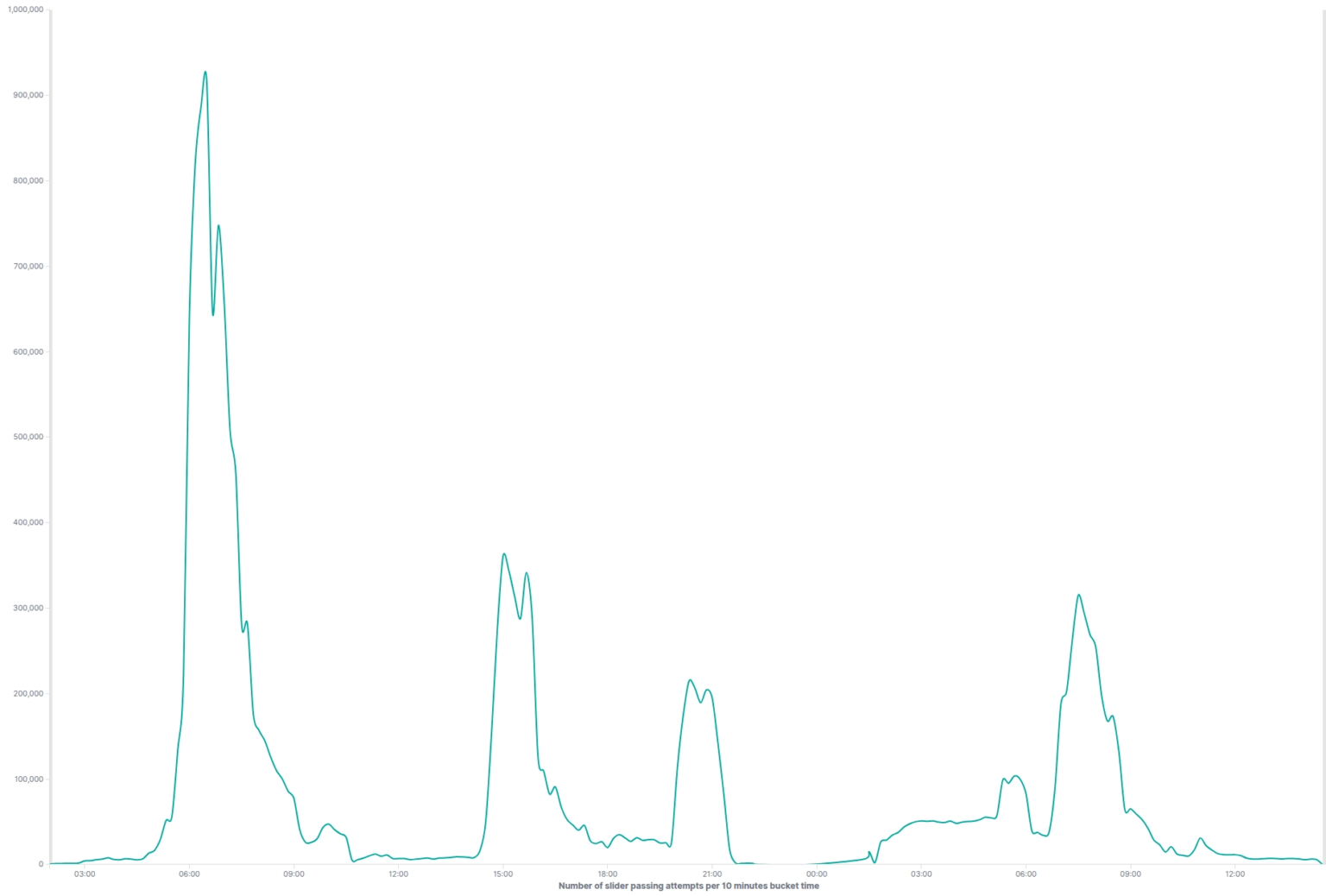
Bypass attempts blocked by DataDome during the attack
The lesson applies to any invisible or visible challenge: if the check can be outsourced, it can be bypassed. Detection has to look beyond the challenge itself.
What is the difference between invisible CAPTCHA and reCAPTCHA v3?
The limits of reCAPTCHA v2, including its invisible mode, led Google to build reCAPTCHA v3. It keeps the invisible concept but removes challenges entirely. Google continuously monitors how a user interacts with a site and returns a score between 0 and 1 for each request. The closer to 0, the more likely it’s a bot. The closer to 1, the more likely it’s human.
What gets monitored and how it’s scored varies by site. Administrators can define specific actions and examples of normal human behavior on each page to help the tool spot deviations.
For most users, v3 is less disruptive than v2 because there’s nothing to solve. But it isn’t perfect.
Why isn’t reCAPTCHA v3 the perfect solution?
reCAPTCHA v3 offers the best user experience of any reCAPTCHA version, but three issues matter when you implement it.
1. Mapping scores to actions is on you
v3 is harder to implement than invisible reCAPTCHA because the site administrator must decide what each score means for every action. For each one, you choose between three responses:
- Pass the user and permit the request.
- Serve a reCAPTCHA v2 challenge when the score is inconclusive.
- Block the user immediately.
For example, you might block below 0.2, challenge between 0.5 and 0.6, and allow above 0.6. Across many actions, this gets complicated, and the tradeoff is constant: stricter thresholds block more legitimate users, and looser ones let more bots in.
2. You can’t easily tell if your thresholds are right
v3 reports the distribution of scores per action, but that rarely proves a threshold is correct. Is a fast form submission suspicious? Some people type and think fast.
Meanwhile, bots can deliberately slow down to fool a threshold. Setting thresholds accurately takes data from a wide range of users, which is expensive to collect and analyze.
3. Accuracy depends on data v3 doesn’t have at first
v3 predicts bot or human from behavior, so it needs a large volume of behavioral data to learn what normal looks like on your site. Until it has that data, it relies on basic client-side fingerprinting, and bots can bypass that relatively easily.
How do you choose the right type of verification?
AI-powered bots now bypass traditional CAPTCHAs, so verification has to shift from puzzle-solving to behavioral and device analysis. Look for a method that:
- Verifies visitors in the background, without adding friction for legitimate users.
- Uses more than one signal, so no single check can be outsourced to a CAPTCHA farm.
- Adds a verification step only when it needs more evidence, and keeps that step quick.
- Doesn’t push threshold tuning onto your team.
How does DataDome approach invisible verification?
DataDome’s CAPTCHA alternative solution replaces puzzle-solving with a two-tier model that keeps friction low for real users:
- Device Check: an invisible, no-interaction evaluation of device, network, and behavioral signals. Most legitimate visitors are verified here and never see a challenge.
- Slider: when Device Check needs more evidence, the visitor completes a simple interaction that takes under two seconds, instead of a traditional CAPTCHA puzzle.
No invisible method is free of trade-offs, so the question is how rarely a visible step is needed and what happens when it is. Because the decision rests on multiple signals rather than a solved challenge, a CAPTCHA farm can’t pass it just by outsourcing a puzzle. That’s the difference between verifying a response and verifying a visitor.
This protects your websites, mobile apps, and APIs without slowing down real users. Book a demo to learn more about DataDome.
Invisible reCAPTCHA FAQs
Not always. It runs in the background for most users, but if Google can’t confidently classify a visitor, it falls back to a visible challenge. Many invisible methods share this limitation. The honest measure isn’t whether a method is ever visible, but how rarely it needs to be.
Invisible reCAPTCHA is a mode of reCAPTCHA v2 that runs a background check and shows a puzzle when uncertain. reCAPTCHA v3 never shows a challenge. It scores every request from 0 to 1 and leaves it to the site owner to decide what to do with borderline scores.
Yes. Sophisticated bots use AI to mimic human behavior, and CAPTCHA farms let attackers route any challenge to a human worker for as little as $1 per 1,000 solves. “Invisible” doesn’t mean unbeatable.
Several providers offer background verification with different tradeoffs: some use behavioral and device signals, others proof-of-work delays, others risk scoring. None is invisible to every visitor in every scenario. The real differentiator is how a provider handles the edge cases when a signal alone isn’t enough.
DataDome’s CAPTCHA alternative solution starts with Device Check, an invisible evaluation of device, network, and behavioral signals. Only when more evidence is needed does it show the Slider, a simple interaction that takes under two seconds.

Related posts
Why Layering a Specialist Bot & Agent Trust Solution With Your CDN Is Now Essential
Tell me more
Introducing DataDome’s AI Key Takeaways Feature: Understand Your Protection at a Glance
Tell me more

Beyond Detection Accuracy: Measuring the Real Business Impact of Bot Management
Tell me more
How Kiabi Cut Malicious Login Attempts & Gained Instant Threat Visibility
Tell me more

