
What is DDoS protection?
Distributed Denial of Service (DDoS) protection are the strategies, technologies, and services designed to defend organizations against DDoS attacks. At its core, it acts as a shield between your digital assets and malicious traffic, ensuring genuine users can access your services while filtering out attack traffic. The most powerful DDoS protection solutions operate continuously, analyzing traffic patterns and responding to threats in real-time to maintain service availability.
Think of DDoS protection as a sophisticated traffic control system for your digital infrastructure. Just as a well-designed highway system includes multiple layers of traffic management, from traffic lights to speed monitors to emergency response systems, DDoS protection uses multiple layers of defense to keep your digital services running smoothly.
Understanding the DDoS landscape
The scale and sophistication of DDoS attacks have grown dramatically in recent years. Industry analysis projected that the number of DDoS threats reached 15.4 million by 2023, nearly doubling from 7.9 million in 2018(1). These attacks have evolved from simple flooding techniques to complex, multi-vector assaults that can overwhelm even well-prepared organizations.
The impact of an attack cannot be underestimated. During a large-scale DDoS attack on one of DataDome’s clients, malicious traffic surged to 2.87 million requests per minute, orchestrated through networks of up to 311,000 distinct IP addresses. In general, organizations face costs averaging $6,000 per minute during an attack(2), with typical attacks lasting up to 12 hours. This translates to potential losses of $360,000 per hour or over $4.3 million per attack, a devastating blow for all but the biggest organizations.
Because of “DDoS-as-a-Service” platforms, it’s also never been easier to launch an attack. Cybercriminals can now rent botnets and launch sophisticated attacks without technical expertise, leading to a proliferation of attacks against organizations of all sizes. The average organization with standard security measures like a Web Application Firewall (WAF) and Content Delivery Network (CDN) will find themselves vulnerable, with bot-driven DDoS attacks comprising over 20% of their application traffic.
The motivations behind DDoS and DoS attacks can vary widely:
- Hacktivism: Attackers target organizations they ideologically oppose
- Cyber warfare: Government entities target critical infrastructure of adversary states
- Criminal extortion: Organizations face ransom demands to prevent or stop attacks
- Competitive sabotage: Unethical organizations target competitors to gain market advantage
- Misdirection: Attacks serve as smokescreens for other malicious activities
The true cost of DDoS attacks
The full impact of a DDoS attack extends far beyond the immediate technical challenges. Let’s examine the comprehensive consequences that organizations face:
Emergency response and overtime costs
When a DDoS attack strikes, organizations must mobilize their IT and security teams immediately, often requiring round-the-clock coverage. This sudden need for extended operations typically results in significant overtime costs.
Security teams may need to work in shifts to monitor and respond to the attack, while IT personnel must maintain critical systems and implement DDoS mitigation strategies. Organizations often need to bring in external consultants or cybersecurity experts at premium rates, further increasing the financial burden.
Customer trust and business loss
The impact on customer trust can be devastating and long-lasting. When services become unavailable, customers face disruptions to their own activities, leading to frustration and dissatisfaction. For e-commerce platforms, even short periods of downtime can result in substantial lost sales, with customers potentially turning to competitors.
B2B organizations may face a breach of service level agreements (SLAs), leading to penalties and damaged business relationships. Whether B2B or B2C, customers who experience service disruptions are more likely to share their negative experiences with others, worsening the impact on your brand.
Brand reputation damage
News of service outages spreads rapidly across social media and news platforms. This immediate visibility can cause lasting damage to a company’s reputation, particularly if it handles the situation poorly or experiences repeated attacks.
The perception of vulnerability can make potential customers hesitant to engage with the organization, while competitors may seize the opportunity to position themselves as more reliable alternatives. Rebuilding a damaged reputation often requires significant investment in marketing and public relations efforts.
Regulatory compliance issues
DDoS attacks can trigger regulatory compliance violations, particularly in industries handling sensitive data or critical services. Financial institutions may face scrutiny from banking regulators for service interruptions, while healthcare organizations could violate HIPAA requirements if patient data becomes inaccessible.
Non-compliance can result in substantial fines, mandatory audits, and increased regulatory oversight. Organizations may need to demonstrate improved security measures and undergo costly certification processes to maintain their compliance status.
Legal exposure and customer liability
Organizations may face legal consequences from affected customers, particularly if the attack results in financial losses or a breach of contract. Class action lawsuits can emerge when large numbers of customers experience significant disruptions.
Additionally, shareholders might take legal action if the attack significantly impacts stock value or if the organization is found to have inadequately prepared for such threats. Legal defense costs and potential settlements can add substantially to the overall impact of an attack.
Impact on employee productivity
The ripple effects of a DDoS attack often extend throughout the business, affecting employees’ ability to perform their jobs effectively. When critical systems become unavailable, employees may be unable to access necessary tools and resources, leading to idle time and missed deadlines.
Customer service teams may become overwhelmed with support requests, while sales teams struggle to close deals due to system unavailability. The cumulative effect of this lost productivity can be substantial, particularly for organizations heavily dependent on digital systems and online services.
The anatomy of a DDoS attack
To understand DDoS protection, it’s essential to first grasp how attacks work. A DDoS attack happens when multiple compromised systems orchestrate a coordinated attack against a target, overwhelming it with malicious traffic. Unlike traditional cyberattacks that seek to breach security for data theft, DDoS attacks aim to render services unavailable to legitimate users. DDoS attacks typically follow one or several of the following patterns:
Volumetric attacks
Volumetric attacks are the most common form of DDoS attack, designed to overwhelm network layer bandwidth with massive amounts of traffic. These attacks typically exploit UDP (User Datagram Protocol) or ICMP (Internet Control Message Protocol) to generate enormous traffic volumes.
In a UDP flood attack, hackers send a deluge of UDP packets to random ports on a target system, forcing it to process and respond to each request until resources are exhausted. DNS amplification attacks, another volumetric variant, are particularly dangerous because they can turn small queries into much larger responses, multiplying the attack’s impact on the target system.
Protocol attacks
Protocol attacks, also known as state-exhaustion attacks, target server resources and intermediate communication equipment like firewalls and load balancers.
The most notorious example is the SYN flood attack, which exploits the TCP three-way handshake process. Attackers send numerous SYN packets with spoofed source addresses, forcing the server to maintain half-open connections while waiting for acknowledgments that never arrive. This eventually exhausts the server’s connection table resources, preventing legitimate users from establishing connections.
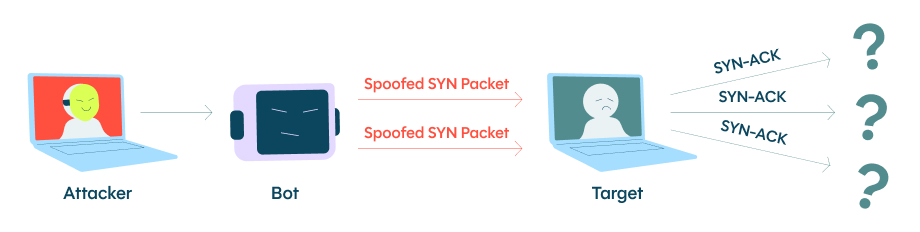
SYN flood attacks can quickly drain your server’s resources
Application layer attacks
Application layer attacks, also called Layer 7 attacks, represent the most sophisticated category, targeting specific web application features or endpoints. These attacks are particularly challenging to detect because they often mimic legitimate user behavior.
HTTP floods, for example, send seemingly valid HTTP GET or POST requests to a web server, but at a volume that overwhelms the system. “Low and slow” attacks take a more subtle approach, maintaining connections for extended periods while sending minimal traffic, gradually depleting server resources without triggering traditional volume-based detection methods.
As technology evolves, new attack types continue to emerge. The proliferation of IoT devices has created new opportunities for attackers to build massive botnets capable of generating unprecedented traffic volumes. Additionally, attackers are beginning to leverage artificial intelligence to make their attacks more sophisticated, enabling them to better mimic legitimate traffic patterns and adapt their strategies in real-time.
Types of DDoS protection
Cloud-based protection
Cloud-based DDoS protection services provide a first line of defense by filtering traffic before it reaches your network. These services can absorb massive amounts of malicious traffic while allowing legitimate requests to pass through. The advantage of cloud-based protection lies in its scalability and ability to handle large-volume attacks without impacting your infrastructure.
On-premise solutions
On-premise DDoS protection involves hardware and software deployed within your network infrastructure. These solutions provide more granular control over traffic and can be particularly effective against application-layer attacks. They work in conjunction with cloud-based services to provide comprehensive protection.
Hybrid protection
Many organizations opt for a hybrid approach, combining both cloud and on-premises solutions. This provides the best of both worlds: the scalability of cloud protection and the precise control of on-premise solutions.
Best practices for DDoS protection
Establish a baseline
At its foundation, organizations must establish comprehensive traffic monitoring and analysis capabilities. Understanding normal traffic patterns creates a baseline that allows security teams to quickly identify potential attacks. This includes monitoring not just overall traffic volumes, but also analyzing typical protocol usage, common source locations, and seasonal variations in traffic patterns.
Test and update regularly
Regular testing and updates play a crucial role in maintaining effective protection. Organizations should conduct periodic penetration testing and DDoS simulations to validate their defenses and identify potential weaknesses. These tests should mirror real-world attack scenarios as closely as possible while maintaining safe operating conditions. Additionally, all protection systems and procedures should be regularly updated to address new attack vectors and evolving threats.
Optimize network architecture
Network architecture optimization represents another critical aspect of DDoS protection. Organizations should design their infrastructure with resilience in mind, implementing redundant internet connections, deploying appropriate load balancing solutions, and maintaining excess bandwidth capacity. This approach helps ensure that systems can withstand attack traffic while continuing to serve legitimate users.
How to create an effective DDoS protection plan
Begin with a risk assessment
A robust DDoS protection plan must go beyond technical measures. The foundation of this plan begins with a thorough risk assessment that identifies critical assets and potential vulnerabilities. Organizations should carefully evaluate which services are most crucial to their operations and which would cause the most significant disruption if compromised.
Prepare your team
Team preparation and training form essential components of any protection plan. Technical staff must understand their roles during an attack and be familiar with response procedures. Regular drills help ensure that teams can execute these procedures effectively under pressure. Additionally, organizations should establish clear communication channels and protocols for coordinating responses across different departments and with external stakeholders.
Create a detailed attack procedure plan
The plan should include detailed procedures for attack detection and classification. When suspicious traffic patterns emerge, teams need clear guidelines for determining whether they’re facing a DDoS attack and what type of attack they’re dealing with. This assessment helps determine the appropriate response measures and ensures that defensive resources are deployed effectively.
Document response procedures
Response procedures should be clearly documented and regularly reviewed. These procedures should outline specific steps for different types of attacks, including criteria for activating various levels of response. The plan should also include procedures for engaging external support when needed, whether from DDoS mitigation service providers or other security partners.
Do a post-incident analysis
Post-incident analysis represents a crucial but often overlooked component of preventing DDoS attacks. After each attack or simulation, organizations should conduct thorough reviews to identify what worked well and what could be improved. These lessons learned should be incorporated into updated protection plans and procedures, creating a cycle of continuous improvement in the organization’s DDoS defenses.
Address business continuity
An effective protection plan must also address business continuity considerations. Organizations should identify alternative methods for maintaining critical operations during an attack and establish clear priorities for service restoration. This includes maintaining updated contact lists for key personnel and external partners, as well as documenting procedures for failover to backup systems or alternative service delivery methods.
The four stages of DDoS mitigation
Effective DDoS mitigation follows four critical stages:
1. Detection
Powerful DDoS protection systems use advanced analytics and machine learning to identify potential attacks quickly. This includes monitoring for traffic anomalies, unusual patterns, and known attack signatures.
2. Response
Once an attack is detected, the system must respond rapidly to prevent service disruption. This might involve automatically rerouting traffic, implementing filtering rules, or activating additional network resources.
3. Mitigation
During this stage, systems work to neutralize the attack while maintaining service for legitimate users. This often involves a combination of traffic scrubbing, rate limiting, and other defensive measures.
4. Analysis and adaptation
After an attack, organizations must analyze the incident to improve their defenses. This includes understanding the attack vectors used, evaluating the effectiveness of the response, and updating protection measures accordingly.
Benefits of professional DDoS mitigation services
Professional DDoS mitigation services have become essential for protecting modern digital businesses. Leading solutions like DataDome’s DDoS Protect are engineered to detect and block threats that traditional defenses miss, operating at speeds under 2 milliseconds. Here are the key benefits of a professional DDoS mitigation service:
- Real-time protection and business continuity
- Prevent business-impacting downtime and service disruptions
- Block sophisticated Layer 7 DDoS attacks that mimic legitimate traffic
- Maintain seamless operation of critical customer services
- Enhanced visibility and control
- Gain instant insights into Layer 7 DDoS attack traffic patterns
- Monitor both long-term trends and individual attack details
- Reduce time needed to understand and investigate service disruptions
- Automated security management
- Deploy countermeasures automatically against DDoS attacks
- Prevent loss of employee productivity during attacks
- Enable hands-free security through automated blocking
- Cost and resource optimization
- Minimize costs associated with web security infrastructure
- Reduce need for specialized in-house security teams
- Optimize resource allocation during attacks
- Brand and reputation protection
- Protect customer trust through reliable service delivery
- Defend against extortion, ransomware, and evolving threats
- Ensure positive user experience during attack attempts
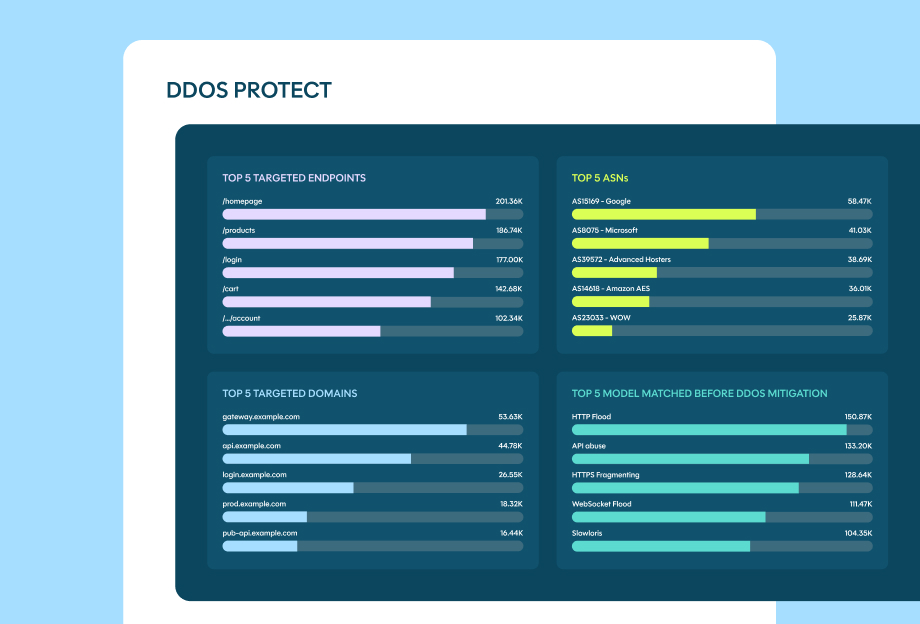
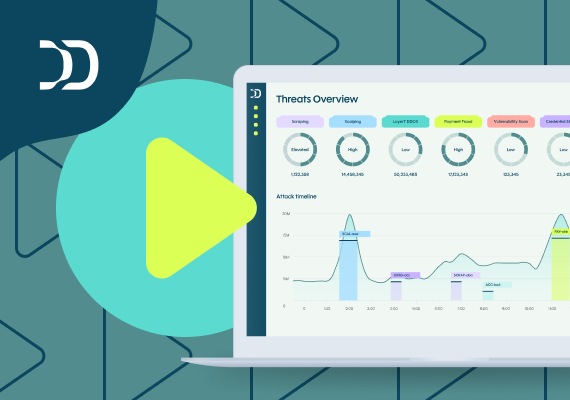
DDoS Protect gives you valuable insights into the DDoS attacks it stopped
Because websites, mobile apps, and APIs are critical to modern business operations, organizations can’t afford to rely on outdated DDoS defenses. Professional DDoS mitigation services like DataDome’s DDoS Protect provide the sophisticated, real-time protection necessary to defend against heavy cybersecurity attacks while ensuring business continuity.
Conclusion
As DDoS attacks continue to evolve in sophistication and scale, robust protection becomes increasingly crucial for organizations of all sizes. Effective DDoS protection requires a comprehensive approach that combines technology, expertise, and planning. By understanding the nature of these attacks and implementing appropriate protective measures, organizations can protect their digital assets against this growing threat.
Remember that DDoS protection isn’t just about having the right technology. It’s about creating a resilient digital infrastructure that can withstand and adapt to evolving threats. As attacks become more sophisticated, your protection strategies must evolve as well, making DDoS protection an ongoing journey rather than a destination.
Start securing your websites, mobile apps, and APIs today with DataDome’s advanced DDoS protection. Book a live product demo today to understand how DataDome can protect your business while maintaining seamless performance for your users.
References

Related posts

How Kiabi Cut Malicious Login Attempts & Gained Instant Threat Visibility
Tell me more

The Agentic Threats & Industry Trends Defining 2026 (So Far)
Tell me more

Attacks on Sports-Betting Platforms Ramp Up Amid 2026 FIFA World Cup
Tell me more

How to Prevent Botnet Attacks & Detect Them Early
Tell me more