


How to Mitigate a DDoS Attack: A Comprehensive Guide for Businesses
The threat of Distributed Denial of Service (DDoS) attacks looms larger than ever. Recent data from the Zayo Group reveals a 106% increase in attack frequency from H2 2023 to H1 2024. The average DDoS attack now lasts 45 minutes—an 18% increase from the previous year—costing unprotected organizations approximately $270,000 per attack at a rate of $6,000 per minute.(1)
The financial implications are staggering. With the average cost of website downtime reaching $2 million, businesses cannot afford to ignore DDoS protection. Yet, DataDome’s 2024 Global Bot Security report painted an alarming picture: 65% of websites remain completely unprotected against even simple bot attacks, while 94% are vulnerable to ad fraud, content scraping, and DDoS threats.
This guide will walk you through everything you need to know about DDoS mitigation. We’ll explore the fundamentals of DDoS protection, key factors in choosing a mitigation provider, and critical technical considerations including network capacity, processing power, and response times.
You’ll learn about different types of protection for both network and application layers, how to protect secondary assets, and important factors in pricing and service level agreements. By the end, you’ll have a clear understanding of how to evaluate and implement effective DDoS protection for your business.
TLDR of DDoS mitigation
- DDoS attacks have more than doubled in frequency since 2023, with attacks lasting longer and causing more damage.
- The average attack costs organizations $6,000 per minute, with total website downtime costs reaching $2 million.
- Most businesses remain dangerously unprepared, with 65% lacking basic protection.
- Effective DDoS mitigation requires a multi-layered approach combining network capacity, processing power, and intelligent traffic filtering.
- The choice between always-on and on-demand protection depends on your business needs and risk profile.
DDoS mitigation explained
DDoS mitigation is about the techniques and tools used to protect systems against distributed denial of service attacks. These attacks attempt to overwhelm your systems by flooding them with massive amounts of internet traffic from multiple sources simultaneously. A real-world example illustrates the severity: A leading US news website recently faced a massive layer 7 DDoS attack that peaked at 86 million requests per 30 minutes. That’s approximately 55,000 requests per second.
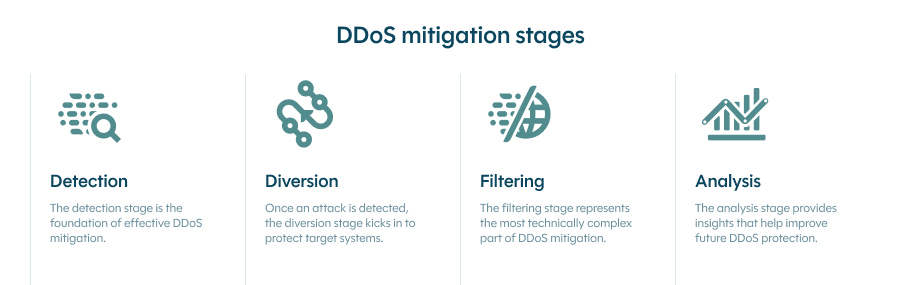
Effective DDoS mitigation follows the following four stages:
- Detection
- Diversion
- Filtering
- Analysis
Detection
The detection stage is the foundation of effective DDoS mitigation. Modern detection systems continuously monitor network traffic for anomalies that could indicate an attack in progress. These systems analyze multiple factors simultaneously, including traffic volume, geographic origins, protocol patterns, and user behavior signatures. They establish baseline traffic patterns using advanced machine learning algorithms, so they can quickly identify deviations that could signal an attack.
Detection systems must balance sensitivity with accuracy. Too sensitive, and they generate false positives that impact real users. Not sensitive enough, and they miss the early stages of an attack. The most effective systems adapt their detection thresholds based on historical traffic patterns and current threat intelligence, so they can provide early warning while minimizing false alarms.
Diversion
Once an attack is detected, the diversion stage kicks in to protect target systems. It’s a critical phase that involves rapidly redirecting incoming traffic to specialized scrubbing centers where it can be analyzed and filtered. Advanced diversion systems use sophisticated routing algorithms to make real-time decisions about traffic handling, often distributing the load across multiple points of presence (POPs) to prevent any single node from becoming overwhelmed.
The key to effective diversion lies in minimizing downtime for real users while handling attack traffic. This involves smart routing decisions based on factors like geographic proximity, current server load, and attack characteristics. Advanced systems can seamlessly failover to backup infrastructure and automatically scale their capacity to handle incoming traffic surges.
Filtering
The filtering stage represents the most technically complex part of DDoS mitigation. Here, sophisticated systems work to separate legitimate traffic from attack traffic in real-time. Modern filtering employs multiple techniques simultaneously, including deep packet inspection, rate limiting, and behavioral analysis. These systems must process massive amounts of traffic while maintaining low latency for legitimate users.
Advanced filtering systems go beyond simple traffic pattern matching. They analyze user behavior patterns, implement challenge-response mechanisms for suspicious traffic, and use machine learning to identify sophisticated attack patterns. The best systems can adapt their filtering rules in real-time based on changing attack patterns to ensure protection against even complex, multi-vector attacks.
Analysis
The analysis stage provides insights that help improve future DDoS protection. During and after an attack, detailed analysis helps security teams understand attack patterns, identify vulnerabilities, and refine defense strategies. This involves examining traffic logs, studying attack vectors, investigating source IPs, and assessing the effectiveness of mitigation measures.
Sophisticated analysis systems provide real-time dashboards and detailed reports that help security teams understand attack characteristics and mitigation effectiveness. This information is invaluable for tuning defense systems and preparing for future attacks. The best analysis tools can correlate data across multiple attacks to identify patterns and predict future threat vectors, so they can be more proactive in their defence.
Choosing a mitigation provider
The selection of a DDoS mitigation provider represents one of the most crucial decisions in your security strategy. Consumer-facing industries are particularly vulnerable to malicious bot activities and face growing risks of financial losses, data breaches, and reputational harm. The need for robust, multi-layered protection against these bots has never been more crucial.
Leading providers in the space include Cloudflare, Akamai, Imperva, and DataDome. Each offers a distinct approach to DDoS protection. Your choice should depend on several key factors, which we’ll explore in detail.
Network capacity
Network capacity serves as a critical baseline metric when evaluating DDoS mitigation providers. Most cloud-based solutions nowadays offer multi-terabit-per-second (Tbps) networks that provide substantial bandwidth to absorb large-scale attacks. This capacity far exceeds what individual organizations could achieve with on-premise solutions, making cloud-based mitigation particularly effective against volumetric attacks.
When assessing a provider’s network capacity, consider not just the raw bandwidth numbers but also how that capacity is distributed geographically. The total network capacity should align with your peak traffic requirements plus a substantial buffer for attack traffic.
Remember that if an attack exceeds your provider’s bandwidth capacity, even the most sophisticated filtering systems become irrelevant. Most enterprise-grade providers maintain networks in the multi-Tbps range to ensure adequate headroom for both normal operations and attack prevention.
Processing capacity
Beyond raw bandwidth, processing capacity plays an equally vital role in DDoS mitigation. Modern attacks frequently exceed 50 million packets per second (Mpps), with some reaching 200-300 Mpps. Your mitigation solution must process this traffic efficiently while maintaining normal operations.
Two key factors determine processing effectiveness:
- Forwarding rate capabilities measured in Mpps
- Traffic routing methods (DNS or BGP) and their implementation
Latency considerations
Latency impacts user experience and can affect your business operations even when you’re not under attack. Your DDoS mitigation solution should minimize additional latency through a globally distributed network of PoPs and efficient routing algorithms.
Consider these factors when evaluating latency:
- Geographic distribution of PoPs relative to your user base
- Distance between your data centers and the nearest mitigation nodes
- Routing optimization techniques employed by the provider
Time to mitigation
The speed of response to an attack often determines its impact on your business. Modern DDoS attacks can take systems offline within minutes, while recovery could take hours. Always-on protection typically offers the fastest response times, often mitigating attacks within seconds of detection.
But not all always-on solutions perform equally. During your evaluation process, test response times under various attack scenarios to ensure they meet your business requirements.
Network layer mitigation
Network layer attacks attempt to overwhelm your infrastructure with sheer volume. Effective mitigation requires a combination of techniques:
- Null routing for immediate threat response
- Sinkholing to redirect malicious traffic
- Advanced scrubbing to separate legitimate requests from attack traffic
- IP address masking to protect origin servers
Each technique offers distinct advantages and limitations, making a multi-layered approach essential for robust protection.
Application layer mitigation
Application layer (Layer 7) attacks pose a particular challenge because they typically mimic legitimate user behavior. Advanced mitigation solutions often employ sophisticated detection methods:
- Behavioral analysis to identify suspicious patterns
- Machine learning algorithms for real-time threat assessment
- Advanced challenge mechanisms that minimize impact on legitimate users
Protection of secondary assets
A comprehensive DDoS mitigation strategy must protect all critical infrastructure components, including:
- DNS servers
- Email systems
- FTP servers
- Backend applications
- Management platforms
Each component requires specific protection measures tailored to its function and vulnerability profile.
Protection of individual IPs
Modern DDoS protection extends beyond traditional network ranges to protect individual IP addresses and cloud assets. This granular approach allows businesses to:
- Protect specific applications or services
- Maintain separate security policies for different assets
- Optimize protection costs by focusing on critical systems
Pricing and SLA Considerations
DDoS mitigation services typically offer several pricing models:
- Pay-as-you-go based on attack volume
- Fixed monthly fees with defined protection levels
- Hybrid models combining base protection with variable costs
When evaluating costs, consider:
- Service level agreements (SLAs) with uptime guarantees
- Support response times and availability
- Additional services included in the base price
How DataDome’s anti-DDoS solution helps
DataDome offers Layer 7 DDoS protection that protects against DDoS attacks through:
- Real-time threat detection using advanced machine learning
- Global network capacity with strategically placed PoPs
- Multi-layered protection against both network and application layer attacks
- Transparent pricing with predictable costs
Recently, DataDome blocked a 2.45-billion-request DDoS attack against a high-traffic content platform. This attack never triggered rate limits, demonstrating why detection must operate at the behavioral and fingerprint level, reasoning about aggregate patterns rather than single-source volume.
Comprehensive DDoS protection isn’t optional anymore. It’s a business necessity. As attacks grow in frequency, sophistication, and impact, organizations must implement robust mitigation strategies to ensure business continuity while protecting their websites, mobile apps, and APIs.
Book a live product demo with one of our security experts to see how you can protect your business today.
DDoS Mitigation FAQ
The most effective DDoS protection combines multiple layers of defense through a cloud-based solution that offers both network and application layer protection. The ideal solution typically combines an always-on cloud security service with intelligent traffic filtering, backed by a provider with substantial network capacity and multiple global points of presence. This multi-layered approach ensures protection against both simple volumetric attacks and sophisticated application-layer threats.
A DNS amplification attack exploits vulnerabilities in Domain Name System servers to overwhelm target systems. The attacker sends small DNS queries to open DNS resolvers using a spoofed source IP address (the victim’s address), crafted to generate responses 50-100 times bigger than the original request. When these amplified responses are sent back, they flood the victim’s network with massive amounts of traffic, allowing attackers to generate enormous attack volume with relatively few initial requests.
Data centers must implement a comprehensive security strategy that goes beyond traditional perimeter defenses. This includes deploying advanced DDoS mitigation systems, maintaining real-time network monitoring capabilities, implementing robust access controls, and regularly updating security policies. Key preparations should include establishing redundant network connections, maintaining excess capacity for traffic spikes, and developing detailed incident response plans.
Modern DDoS protection systems use a combination of behavioral analysis, machine learning, and traffic pattern recognition to distinguish between legitimate users and attackers. These systems analyze factors including IP reputation, geographic location, browser fingerprints, request patterns, and session behavior. Legitimate users typically display consistent, human-like behavior patterns, while automated attacks like botnets often show repetitive patterns or unnaturally fast request rates.

Related posts

The Agentic Threats & Industry Trends Defining 2026 (So Far)
Tell me more

Attacks on Sports-Betting Platforms Ramp Up Amid 2026 FIFA World Cup
Tell me more

How to Prevent Botnet Attacks & Detect Them Early
Tell me more
How DataDome Stopped a 2.45B-Request DDoS Attack Against a High-Traffic Content Platform
Tell me more

