


What to Look For in Bot & Agent Trust Management Software: 7 Key Capabilities
If you’re responsible for keeping websites, mobile apps, and APIs safe and profitable, you’ve probably made some version of this observation in the last year: “We have more and more AI traffic, but we’re not sure what that means for our business.”
That’s the agentic commerce problem in a nutshell. Some AI agents are useful, high-converting assistants for real customers. Others are stealing content, abusing business logic, or probing for weak spots to launch attacks or commit fraud. Some sit in a gray area: legitimate tools that get repurposed, compromised, or simply used in ways you didn’t authorize.
And most businesses lack the visibility needed to tell the difference. Galileo, DataDome’s threat research team, recently reported that 80% of AI agents don’t properly identify themselves when visiting websites.
In The Guide to Readying Your Business for Agentic Commerce, we lay out the solution to this problem. What businesses need right now is bot & agent trust management software: a centralized platform that authenticates, classifies, and governs AI agent interactions in real time by giving you visibility, control, and trust.
Below is a capability checklist you can use to assess your current tools and spot gaps worth prioritizing. For more context and guidance behind each item, refer to the full guide.
1. Visibility: Who’s accessing what, and how often
Before you can govern agent traffic, you need to see it in an operationally useful way. At a minimum, you want real-time identification and classification of AI agents and LLM crawlers, plus segmentation so you can measure volumes by type.
It also needs to be easy to answer basic questions like “Which endpoints are agents hitting?” because that is how you spot risk (login, signup, checkout, high-value APIs) and value (product discovery, inventory lookups, support flows).
2. Agent verification & trust scoring
Once you can see agents, the next question is: How much do you trust each one?
Agent verification is the identity layer. It includes confirming signals like expected IP ranges, user-agent strings, and authentication tokens where applicable. That gets you part of the way, but in practice, you also need a dynamic trust score that updates based on behavior, reputation, and historical patterns.
Web Bot Auth, an emerging IETF authentication standard, strengthens this layer by using cryptographic verification to confirm agent identity. DataDome Bot Protect supports Web Bot Auth, enabling you to validate not just who an agent claims to be, but to prove it through secure authentication protocols.
3. Intent-based detection
Classic fraud questions often focus on, “Is this user legitimate?” Agent traffic forces a different question: “What is this traffic trying to do?”
Intent-based detection looks at behavioral signals, contextual patterns, and anomalies to separate legitimate automation from scraping, abuse, and fraud. This becomes important when identity checks pass, but the behavior still doesn’t make sense. For example, an agent that claims to compare prices but systematically pulls your entire catalog at a rate no real shopping assistant would need.
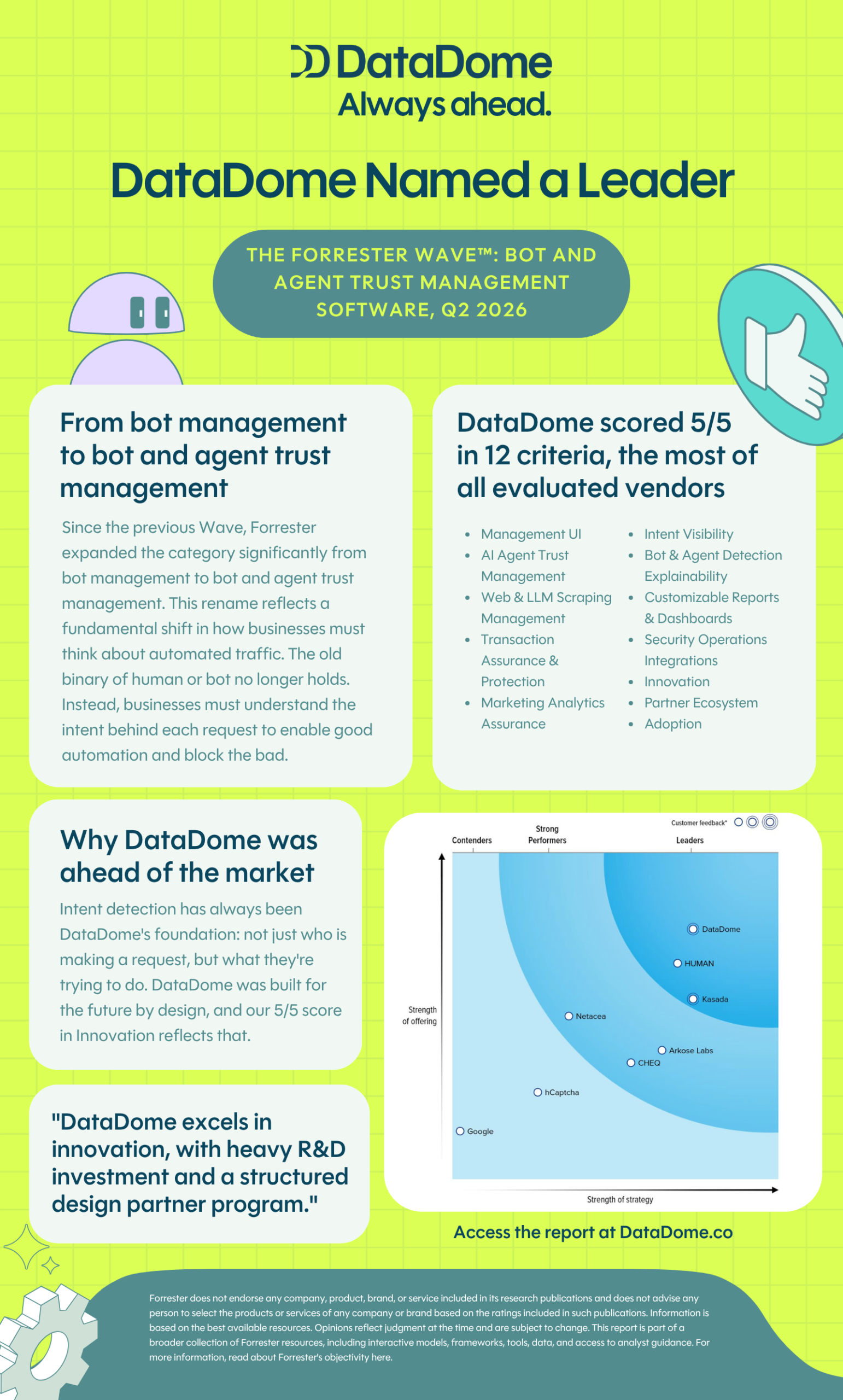
DataDome was named a Leader in The Forrester Wave™: Bot and Agent Trust Management Software, Q2 2026, with the highest possible scores in 12 criteria, including intent visibility:
4. MCP protection
Model Context Protocol (MCP) is emerging as a way for agents to communicate intent and context when interacting with external systems. That transparency is useful, but it also creates new places to attack: more machine-to-machine traffic patterns, more assumptions, and more ways to smuggle malicious requests into “legitimate” workflows.
If MCP is on your roadmap (or already present in your ecosystem), you want controls that can inspect MCP traffic, validate requests, and block malicious interactions while still allowing legitimate agent communication. DataDome’s MCP protection does exactly that—detecting, classifying, and verifying every MCP request in real time to stop attacks before they reach your servers.
5. Control & access management
Detection without enforcement is just reporting. Once you have visibility and a trust model, you need policy controls that let you decide which agents can access which endpoints, and what behaviors are allowed.
Practically, that means endpoint-level permissions, dynamic allowlisting and blocklisting, and ratelimiting so you can prevent abuse without blocking entirely. A helpful way to think about this is “fine-grained permissions for automation.” You may be comfortable letting an agent read product pages and check shipping estimates, but not create accounts, not enumerate user data, and not touch checkout without additional proof and constraints.
6. Real-time response & continuous session monitoring
Agent abuse isn’t always obvious on the first request. Often, you need to see how behavior evolves across a session.
Therefore, you want both real-time enforcement at the edge when something is clearly disallowed, and continuous monitoring that follows the agent through the session without losing context. The operational goal is to make decisions quickly, but also to make them with enough context to be accurate.
7. Monetization
One of the more interesting shifts with agent traffic is that “allow vs. block” is sometimes the wrong framing. If you have high-value content, proprietary data, or premium APIs, agent access can be a revenue stream.
A bot & agent trust management platform that integrates AI monetization can enable you to charge for agent access and create new revenue streams, tailored to different scenarios. For example, you might charge a news-scraping bot $0.001 per article, an e-commerce AI bot $0.01 for each price check, but decide to give free access to bots that have proven to provide a mutual benefit.
What’s next?
If you want to operationalize these capabilities quickly, DataDome can help. Our bot and agent trust management approach is designed to give you agent-aware visibility, verification, and policy enforcement across websites and APIs, so you can support legitimate agents while reducing exposure to abuse.
If this is a priority for your team, schedule a demo to see DataDome’s real-time bot and agent trust features in practice.

Related posts

Web Bot Auth & Know Your Agent: Why Identity Isn't Enough
Tell me more

DataDome Recognized as a Sample Vendor in the Gartner® Hype Cycle™ for Application Security, 2026
Tell me more
Key Takeaways From Our Conversation With Forrester on the State of Bot & Agent Trust Management
Tell me more

How to Block AI Bots, Crawlers, & Scrapers
Tell me more

