


The Cyberfraud Kill Chain: How Fraudsters Operate in the Age of AI
Cybercriminals and fraudsters are no longer lone actors running small-scale scams. Today, they operate like professional organizations: automating their workflows, outsourcing labor to global marketplaces, and increasingly deploying AI agents that act convincingly like humans.
What used to be isolated incidents of payment fraud or account abuse have evolved into full-scale, multi-stage campaigns. They follow a disciplined, repeatable playbook, refined with automation, AI, and human-in-the-loop orchestration. From reconnaissance to monetization, fraudsters move methodically across the user journey and exploit every weak spot in apps, APIs, and business logic. For security leaders, the message is clear: cyberfraud is now a cybersecurity problem.
The good news? Every step in the kill chain is a chance to act: to disrupt the attacker’s progress and prevent downstream damage. But taking advantage of those moments requires mapping detection and response directly to the attacker’s playbook, and ensuring that security, fraud, and operational teams are aligned on the signals that matter most.
In short: to build an effective defense, you must think like the adversary.
That’s why we’re sharing an excerpt from our recently published CISO’s Guide to Cyberfraud Protection. Download the guide to learn how to align teams and structures to the attacker’s framework, design an intent-based defense strategy, and advance your organization’s fraud protection maturity.
Understanding the cyberfraud kill chain
Modern fraudsters run sophisticated campaigns that exploit every step in the user journey. With AI as a force multiplier, their operations are faster, cheaper, and harder to spot.
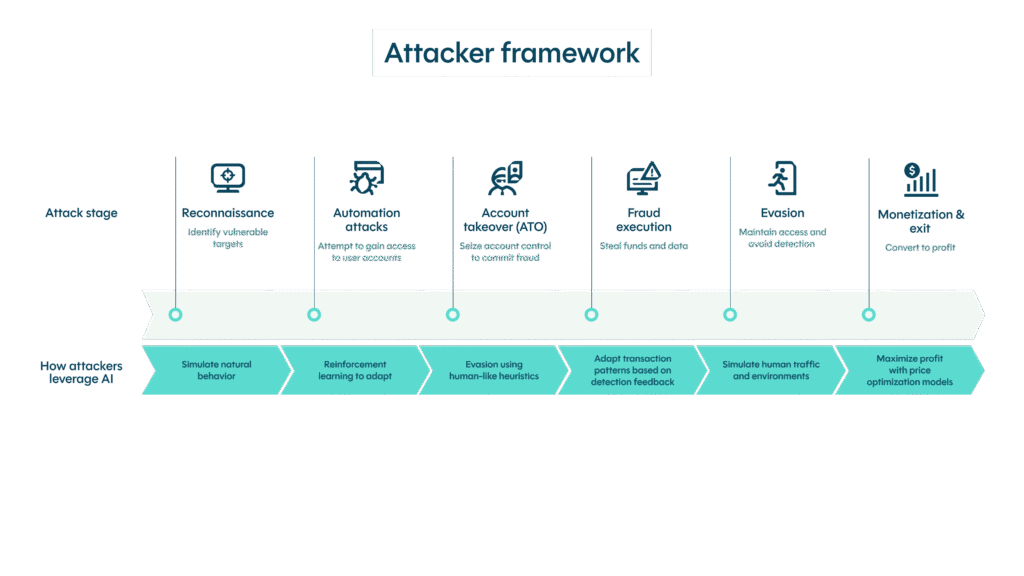
Cyberfraud attacks typically follow a structured, repeatable pattern refined through automation, AI, and human-in-the-loop orchestration.
Each phase of the kill chain represents both a challenge and an opportunity: a point where you can disrupt the attackers’ plans and prevent downstream damage. To do so, you need to map your detection and response capabilities to the attacker’s process, and ensure that fraud, cybersecurity, and operational teams act in concert.
Attackers consistently move through these phases: reconnaissance, automation, account takeover, fraud execution, evasion, and monetization. The strongest defenses anticipate these moves, shut them down early, and continuously feed insights back into detection systems.
A new approach to defense: Cyberfraud fusion
The traditional divide between cybersecurity and fraud prevention no longer works. Attackers don’t distinguish between exploiting systems and exploiting customers; they blend both into seamless campaigns.
You must do the same. Effective cyberfraud protection now requires:
- Breaking down silos between fraud and security teams
- Continuous, connected defenses across the entire user journey
- Intent-based strategies that shift focus from “who the user is” to “what the user intends to do”
- AI-powered protection loops that adapt at the same pace as attackers
As privacy regulations tighten and identity signals weaken, detection must move beyond static verification toward real-time behavioral and contextual intelligence.
What’s your next step?
Fraud and cybersecurity are now one fight. Attackers have a playbook. You need one too.
Download A CISO’s Guide to Cyberfraud Protection to learn how to anticipate attacker moves, disrupt them early, and build a unified defense across the entire user journey.

Related posts

Meta's Muse Doesn't Declare Itself. Here's Why That Matters
Tell me more

How Kiabi Cut Malicious Login Attempts & Gained Instant Threat Visibility
Tell me more
Bad Bot Traffic Is Growing 9x Faster Than Human Traffic: Takeaways From The 2026 State of Bot & Agent Security Report
Tell me more

Web Bot Auth & Know Your Agent: Why Identity Isn't Enough
Tell me more

