
What is Content Scraping & How Can You Prevent It?
Scraper bots don’t ask permission. They visit your site, copy your content, and republish it elsewhere—sometimes within minutes of you posting it. By the time you notice, a duplicate version of your article could already be outranking the original.
Content scraping affects publishers, e-commerce brands, and anyone who puts original material online. It can hurt your search rankings, expose your pricing to competitors, and send customers to fraudulent versions of your site.
This guide covers what content scraping is, how to identify it, and how to stop it.
Key takeaways
- Content scraping is automated copying of original content without permission, usually done using scraper bots.
- Scraped content that is republished without authorization can constitute copyright infringement, and can damage SEO rankings and hurt brand trust.
- There are legitimate ways to use scraped content, such as for market research purposes or price comparisons.
- robots.txt helps, but advanced bot management is needed to protect against sophisticated scrapers.
- Almost any website can be targeted by scraping bots, but publishers, media brands, marketplaces, and e-commerce sites are some of the most vulnerable to scraping.
What is content scraping?
Content scraping is the automated copying of text, images, video, or other web content without the site owner’s permission. A content scraper—usually a bot—visits your pages, extracts what it finds, and copies that content elsewhere.
It’s worth clarifying how the term relates to similar ones. Web scraping is a broad category covering any automated extraction of data from websites. Data scraping often refers to collecting structured data like prices, contact details, or product specs, and it’s often done for internal use. Content scraping specifically targets original content, usually with intent to republish it on another site.
If you publish original articles, run a product catalog, or display pricing, your site is a potential target for website content scraping.
How does content scraping work?
Automated scraper tools are capable of scraping massive amounts of original content from thousands of web pages in a short amount of time. The entirety of a targeted website’s content can be duplicated in seconds.
Most content scraping starts with a crawler mapping your site’s structure. Once target pages are identified, scraper bots extract and copy content at scale.
Here’s the typical flow:
- A crawler bot analyzes your site’s links, pages, and HTML structure.
- The crawler identifies the pages it wants—blog posts, product descriptions, pricing tables.
- A scraper bot extracts the content by copying text, capturing images, or downloading video.
- The copied content is republished elsewhere, often without attribution.
Basic scrapers work by parsing HTML directly. More advanced ones use browser automation and JavaScript rendering to reach dynamically loaded content. Some use IP rotation and user-agent rotation to avoid triggering detection rules.
A skilled coder can write their own web crawlers and scraper bots, but this is a laborious process. Most people who want to engage in content scraping or data scraping use digital tools that are purposefully built to locate and collect data from websites.
What content do scrapers target?
Scrapers go after content that’s easy to copy and valuable to republish. If your site produces original content in any of these categories, it’s a realistic target:
| Content type | Who gets targeted most |
| Blog posts, news, and opinion pieces | Publishers, media brands |
| Product descriptions and pricing pages | E-commerce, marketplaces |
| Reviews, ratings, and listings | Classifieds, aggregators |
| Technical and research content | SaaS, academic sites |
| Images and video | Content-heavy brands |
| Contact details and pricing data | B2B sites, service directories |
When is scraping legitimate and when is it a problem?
Content scraping has a variety of applications, and isn’t always used for illegitimate or malicious purposes. Many companies scrape content for use in aggregation, for market research purposes, or comparison purposes.
While scraping is not inherently illegal in the majority of countries, what is done with the scraped content is what determines whether the behavior is problematic.
Here’s an overview of when content scraping might be legitimate, and when it might not be:
Legitimate uses
- Search indexing: Search engines crawl and index web content by design. Googlebot is technically a web scraper.
- Market research: Companies collect publicly available data to monitor pricing trends or competitor activity.
- Price comparison: Aggregators pull pricing data to show consumers multiple options in one place.
- Academic research: Researchers sometimes collect public content for analysis or studies.
- Web archiving: Services like the Wayback Machine preserve publicly available content for historical purposes.
Problem cases
- Plagiarism: Scraped articles or posts republished without credit or permission.
- Spoofed websites: Fake storefronts cloned from your content to deceive customers and steal payment information.
- Phishing and spam: Contact scraping used to build lists for phishing campaigns or mass email spam, including email scraping.
- Price undercutting: Competitors scrape your pricing data to undercut you in real time.
- Fake listings and reviews: Scraped content used to populate fraudulent marketplaces.
How can content scraping hurt your website?
Scraping can hit your rankings, revenue, trust, and site performance all at once:
SEO impacts
When duplicate content appears on other sites, search engines don’t always identify the original source correctly. You can lose ranking credit for content you created. In some cases, the scraped copy outranks the source. Google’s spam policies may also penalize sites associated with a high volume of scraped content, meaning even the original publisher can take a hit.
Revenue loss
Competitors who scrape your pricing pages can undercut you in real time. Publishers lose traffic—and ad revenue—to sites republishing their content. E-commerce brands lose sales to fake storefronts or counterfeit product pages built from scraped catalogs.
DataDome recently blocked a highly sophisticated scraping attack on a leading review platform. Attackers deployed 855,000 unique IP addresses to generate 80 million malicious requests over 13 days, attempting to harvest proprietary business data at scale.
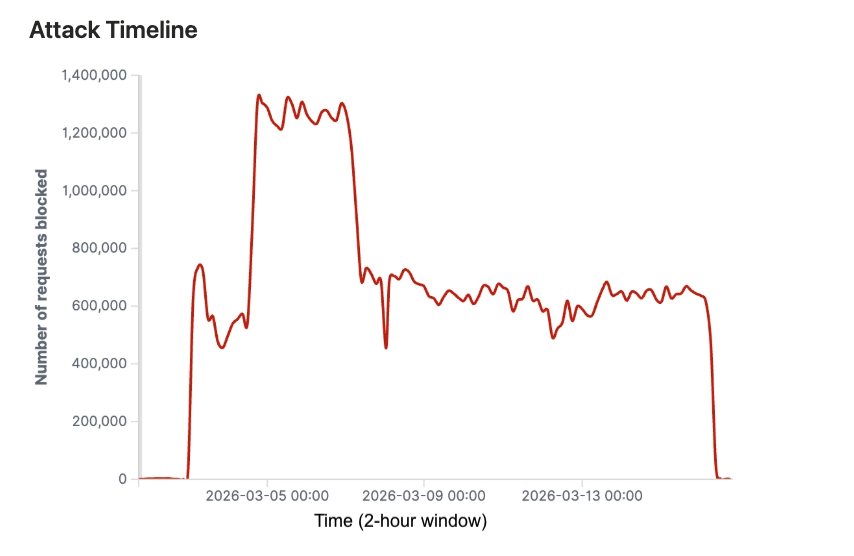
At this scale, even partial success would’ve yielded millions of scraped business listings, user reviews, and rating data worth substantial sums of money on the secondary market due to the commercial value of the content.
DataDome successfully stopped this attack without adding friction for legitimate users of the platform.
Operational issues
Scraper bots consume bandwidth and server resources. Heavy automated bot traffic slows your site, pollutes your analytics with non-human sessions, and drives up infrastructure costs. In extreme cases, bot-driven traffic patterns can mirror a distributed denial of service (DDoS) attack.
Customer trust & brand reputation
Spoofed sites built from scraped content confuse customers. If someone gets defrauded by a fake version of your site, your brand takes the reputational hit even though you’re the victim.
How do you identify content scraping?
Look for duplicate content, unusual traffic patterns, and suspicious linking behavior.
- Search for your own content: Paste a unique headline or distinctive phrase from a recent article into Google. If it shows up verbatim on another site, your content has been scraped.
- Watch your traffic: Sudden spikes from unfamiliar IP ranges, or high request volumes to content-heavy pages, can indicate scraper activity.
- Use monitoring tools: Google Alerts, pingback notifications (on platforms like WordPress), and keyword tools can surface instances of your content appearing elsewhere.
- Review your server logs: Rapid repeated requests to the same pages, unusual user-agent strings, or access patterns outside normal hours are worth investigating.
How to prevent content scraping: 4 methods
The following methods can help you reduce and eliminate content scraping on your site:
1. Use robots.txt and meta directives
robots.txt is a standard file that tells compliant bots which pages they can crawl. Combined with meta robots tags and the X-Robots-Tag HTTP header, you can signal that certain content shouldn’t be indexed or scraped.
That said, only bots that follow the rules will respect these signals. Malicious scraper bots built for content theft ignore robots.txt entirely. It’s a useful first signal, not a reliable barrier.
2. Add technical friction
CSS obfuscation and JavaScript obfuscation can make it harder for basic scrapers to extract clean content. Rate limiting—capping how many requests an IP can make in a set window—slows down scripts that hit your pages repeatedly.
CAPTCHAs can interrupt automated requests, but they also create friction for real users, and sophisticated bots can solve them. They’re most useful as a fallback challenge rather than a primary defense.
This layer works against simple, low-sophistication scrapers. It’s weaker against distributed scraping or browser automation tools that mimic human behavior.
3. Control access with WAF, API limits, and challenge flows
If your content is delivered via an API or sits behind a login, access control matters as much as page-level protection.
A web application firewall (WAF) can block known bad actors and filter traffic based on rules and request signatures. API rate limiting caps how many requests a client can make in a given timeframe. Challenge flows can require verification before content loads.
These controls reduce exposure but aren’t enough on their own against scrapers that look and behave like legitimate users.
4. Use advanced bot management
When scrapers rotate IPs, spoof browsers, or use automation to mimic human browsing behavior, rule-based systems can’t keep up. You need intent-based detection.
DataDome analyzes every request in real time to distinguish between legitimate users, good bots like Googlebot, and malicious scraper bots. Detection happens in under 2 milliseconds, with a false positive rate below 0.01%, so real users aren’t affected.
This is the layer that catches what everything else misses.
Takeaways
Content scraping is a copying problem, a trust problem, and a performance problem—often all three at once. Scraped content can hurt your search rankings, hand competitors your pricing, slow your site, and confuse your customers with spoofed pages they didn’t ask for.
The problem is that most scraping today isn’t low-effort. Attackers rotate through tens of thousands of residential IPs, spoof browser fingerprints and user-agents, and use challenge-solving services to bypass CAPTCHAs.
Bot management is the only layer that can stop what the others miss. It analyzes behavior across sessions, detects inconsistencies that signature-based tools can’t see, and adapts as attackers change tactics. Other methods are worth having—but without bot management, there’s always a way through.
DataDome’s content scraping protection detects and blocks scraper bots in under 2 milliseconds without slowing down legitimate users. Test your website’s defenses with a free Vulnerability Scan today to see if you’re properly protected against malicious automation.
Content scraping FAQs
A content scraper is an automated bot that visits websites and extracts content—text, images, video, or other media—without authorization. They range from simple scripts that parse HTML to sophisticated browser automation tools capable of bypassing basic detection.
Yes. Search engines crawl and scrape the web by design. Price comparison sites, market research firms, and academic researchers all use web scraping for legitimate purposes. The difference is consent and use: legitimate scrapers respect site policies and don’t republish content without authorization.
Yes, it can. When duplicate content appears on other sites, search engines may not always identify the original source and may not rank it first. Widely scraped content can lose ranking credit, see lower search visibility, and in some cases face demotion under Google’s spam policies.
It stops compliant bots—such as legitimate search engine crawlers—that follow the standard. Malicious scrapers and automated bots built for content theft ignore robots.txt. It’s a useful signal, not reliable protection on its own.
Web scraping is a broad term for any automated extraction of data from websites. Content scraping is a specific type focused on copying original content—articles, product descriptions, images, video—with the intent to republish it elsewhere.

Related posts
How 1001Pneus Blocked Competitor Price Scrapers & Reclaimed Its Competitive Edge
Tell me more

Beyond Detection Accuracy: Measuring the Real Business Impact of Bot Management
Tell me more

How to Block AI Bots, Crawlers, & Scrapers
Tell me more
Libération Leverages DataDome + Arc XP to Neutralize Malicious AI Scraping in <2 Milliseconds
Tell me more