
How to Stop Scalpers & Prevent Scalping on Your Website
You refresh the page. The product just dropped. “Out of stock.”
It happened in seconds—not because thousands of fans moved faster than you, but because bots did. Scalper bots can sweep an entire inventory before most customers finish loading the page. The goods end up on resale sites at triple the price, and your customers are left empty-handed.
For businesses selling limited-edition products, this isn’t just a customer frustration problem. It drives up infrastructure costs, burns engineering hours, and erodes trust with every botched launch.
Scalping activity increased 290.7% between July 2025 and June 2026, with median daily volume nearly quadrupling, according to The State of Bot & Agent Security Report 2026. Scalpers are getting more sophisticated, especially with the rise of AI shopping agents.
The same report also found that only 2.4% of websites are fully protected against bots and spoofed AI agents, down from 8.4% in 2024. Attacks are accelerating, and the protection gap is widening.
What is a scalper bot?
A scalper bot is an automated program that performs scalping—purchasing limited-edition goods (such as event tickets or limited product drops) to resell at a higher price. Because bots can complete the checkout process in a fraction of the time it takes a human, they can buy thousands of goods the moment they go on sale. Scalped inventory is usually resold at a premium, since it’s not available from the original retailer.
Why stop scalper bots?
If you sell limited-edition products online, scalper bots—also called “grinch bots“ or “shopping bots“—are likely already targeting your site.
During a recent midnight ticket sale for a major sporting event, DataDome detected that 31% of all queue traffic was bots—2.4 million out of 7.8 million requests didn’t come from a real customer. Every one of those fake requests was queued up ahead of the people you actually wanted to sell to.
The customer damage is immediate. Inventory disappears in seconds, real buyers get shut out, and the same products appear on resale sites within minutes—often at two or three times the original price. Your brand will likely take the blame in the form of negative reviews, social posts, and lost customer trust.
The operational damage runs longer. Scalper bot traffic eats up bandwidth, drives up server costs, and keeps your engineering team in firefighting mode. Even after a launch ends, the bots don’t stop—they keep probing, mapping your defenses, and coming back with updated tactics for your next drop.
Understanding the different types of scalper bots
Scalper bots aren’t all the same. They target different products, operate at different levels of automation, and are built for different parts of the purchase journey. Here are the main types to know.
- Sneaker bots: The most well-known type of scalper bot. Sneaker bots fully automate the process of finding and purchasing limited-edition footwear the moment it drops—and sometimes list it on resale sites before the sale even ends.
- Ticket scalping bots: Ticket bots operate the same way but target event tickets—concerts, sports, and theatre. They’re the reason a sold-out notice can appear within seconds of a sale going live.
- General inventory bots: Beyond sneakers and tickets, scalper bots target any product where demand outpaces supply: gaming consoles, graphics cards, luxury goods, collectibles. These bots monitor release pages and automate checkout just like their specialized counterparts.
- Monitor bots: Not a purchase bot, but an essential part of the scalping pipeline. Monitor bots (also called “drop checkers”) constantly scan product pages, social feeds, and retailer sites for new releases. When something drops, they alert operators or automatically trigger a purchase bot. Their constant pinging is also why scalper traffic hits your server before a sale even starts.
- Account creation bots: Used to bypass per-customer purchase limits. These bots automate the sign-up process, creating hundreds or thousands of fake user accounts so scalpers can make multiple purchases under different identities.
How do scalper bots work?
Scalper bots manage three distinct tasks to outrun human buyers every time:
1. Monitor target websites
Known as “drop checking” or “spinning,” this involves constantly checking retailer websites, apps, and social feeds for new releases. Some bots even guess at new product SKUs to find pages before they’re publicly announced.
Scalper bot developers often license their tools and run online communities known as “cook groups.” Users pay a monthly fee to receive tips and information, often getting instant notifications when a popular product becomes available.
This constant monitoring generates significant traffic volume—hurting your site speed and inflating infrastructure costs even before a sale begins.
2. Add to cart
Add to cart is the critical moment. To make multiple purchases without being detected, scalper bots must bypass security controls: inventory limits, CAPTCHAs, and more.
Scalping bots typically use residential proxy networks, so each request comes from a different IP address. Many use residential IP addresses with clean reputations.
The most sophisticated scalper bot operators will shave additional milliseconds off the acquisition process by spreading their servers geographically to exploit the latency of data signals. During a real-time product drop, those milliseconds matter.
3. Autocomplete checkout
After successfully selecting the items to buy, scalper bots can also automate the purchase by logging into premade accounts, or they can enter all the required information to use a guest account.
Finally, bots complete the order using a credit card that either belongs to the bot operator or has been stolen specifically for use in fraudulent online transactions—known as carding.
How to stop scalper bots: 5 anti-scalping techniques
If you’re looking to prevent scalping on your website, here are 5 anti-scalping techniques to help.
1. Device and browser fingerprinting
Browser fingerprinting identifies bots by the device and browser parameters they use. Scalper bots run at scale and can’t switch devices between requests, so they’re sometimes identifiable through consistent device signatures—and can be blocked accordingly.
2. Validate browser requests
Similarly, you can check the JavaScript agent of a browser and verify it’s making expected browser calls. Scalper bots often run on modified browsers, so unusual patterns in how a request behaves can flag it as automated.
3. Check IP reputation
Some scalper operations use cheap or low-quality IP addresses that have no business being on your site. IP reputation alone isn’t foolproof—sophisticated scalpers rotate through residential IPs with clean histories—but combined with other signals, it’s a useful filter.
4. Behavioral analysis
Most bots don’t act like humans. They move in straight lines through your site, skipping browsing, heading straight to checkout. Real users meander, scroll, hover, and hesitate. Behavioral analysis spots the difference.
That said, today’s more advanced bots increasingly simulate human behavior, which is why behavioral signals need to work alongside other detection methods—not on their own.
5. Use a virtual waiting room for high-traffic sales
Using a modern virtual waiting room during high-demand sales neutralizes a bot’s speed advantage by creating a fair queue.
But not all waiting rooms are created equal. Legacy queue systems fail because they only check traffic at entry—bots that get in can still cause damage inside the queue.
DataDome’s Priority Protect is built differently. It’s the only It’s the only intent-aware virtual waiting room with continuous bot detection throughout the session. It analyzes 5 trillion signals daily and removes fraudulent traffic—including bots that turn malicious mid-session and AI agents disguised as legitimate buyers—before they inflate wait times or crowd out real customers.
Prevent scalping with DataDome
None of the techniques above guarantees success in isolation. The best scalper bot operators are skilled, quick to adopt new technology, and actively work to reverse-engineer your defenses. They use residential proxies, IoT devices, and now AI agent impersonation to avoid detection.
The solution is a bot and agent trust management tool that analyzes intent—not just volume or known signatures—in real time.
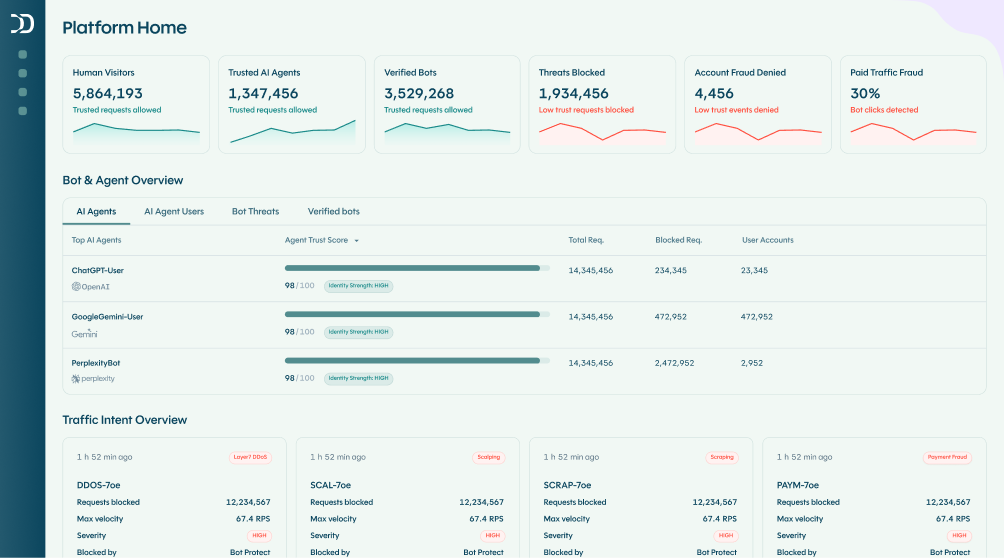
DataDome does just that, combining multi-layered AI detection with real-time mitigation across websites, mobile apps, and APIs to stop scalping in real time.
DataDome offers:
- Bot Protect: Detects and blocks scalper bots from the first request, using thousands of AI models that analyze intent across 5 trillion signals daily—with sub-2ms latency and a 99.99% detection accuracy rate.
- Priority Protect: DataDome’s intent-aware virtual waiting room. Unlike traditional queue systems, it continuously validates every request throughout the session—catching bots and malicious AI agents that adapt their behavior once inside the queue.
- Account Protect: Stops the fake account creation that scalpers rely on to bypass per-customer purchase limits.
- DataDome Device Check: Invisible verification that stops threats in under 1 second without adding friction for genuine users.
The DataDome solution runs on autopilot—no action is required on your side. But if a massive scalper bot attack comes your way, our Galileo threat research team will monitor and manually mitigate the attack as required.
In a recent case, DataDome’s Galileo team blocked 16 million malicious ticket scalping requests from 3.9 million unique IPs targeting a global sports organization over six days, with zero tickets lost to scalpers.
For most businesses, blocking scalping delivers immediate ROI: fewer unhappy customers, lower infrastructure costs, and engineering teams freed from reactive firefighting.
Want to see DataDome’s anti-scalping solution in action? Book a demo today to learn more.
Anti-scalping FAQs
Scalpers are increasingly disguising bots as legitimate AI shopping agents, using proper API credentials and realistic behavior patterns to bypass traditional defenses. Detecting them requires intent-based analysis, not just identity checks.
Anti-scalping protection refers to the combination of technical measures—bot detection, behavioral analysis, virtual waiting rooms, and device fingerprinting—used to stop automated bots from purchasing limited inventory before real customers can. Effective anti-scalping protection goes beyond simple rate limiting or CAPTCHAs to detect the intent behind traffic in real time.
Ticketing, e-commerce (especially limited-edition releases like sneakers, collectibles, and gaming hardware), and retail are most commonly targeted. Any site that sells high-demand, limited-supply items is at risk.
Basic virtual waiting rooms don’t. They only check traffic at entry, which means bots that enter the queue can still cause damage. But a modern virtual waiting room like DataDome Priority Protect that continuously validates every request throughout the session, removing bots and malicious AI agents before they can inflate queue times or claim inventory does.

Related posts

How 1001Pneus Blocked Competitor Price Scrapers & Reclaimed Its Competitive Edge
Tell me more

How to Stop Bot Traffic From Crashing Your Site During Black Friday 2026
Tell me more

Which Industries Are Least Protected From Bots & Spoofed AI Agents in 2026?
Tell me more
Why Layering a Specialist Bot & Agent Trust Solution With Your CDN Is Now Essential
Tell me more