


CAPTCHA vs. reCAPTCHA: What’s The Difference?
If you’ve ever clicked “I’m not a robot” or identified traffic lights in fuzzy images online, you’ve encountered CAPTCHA technology. While these security tests might seem like minor inconveniences, they represent a crucial battleground in cybersecurity where the stakes are higher than most people realize.
With nearly 2 in 3 global websites remaining completely unprotected against simple bot attacks, understanding the difference between CAPTCHA and reCAPTCHA is essential knowledge for anyone running a website or concerned about online security.
Key takeaways
- CAPTCHA is the category, reCAPTCHA is Google’s version: CAPTCHA refers to any test designed to tell humans and bots apart, while reCAPTCHA is Google’s specific implementation of this technology.
- Traditional CAPTCHAs are failing: 50% of passed reCAPTCHAs are completed by bots, making them less effective than many businesses realize.
- User experience suffers: reCAPTCHA v2 can take up to 20 seconds to complete and often requires multiple attempts, leading to abandoned conversions.
- Privacy concerns exist: reCAPTCHA relies heavily on cookies and data sharing with Google, which may not comply with GDPR regulations.
- Modern bots are sophisticated: Advanced bots were detected less than 5% of the time in recent testing, indicating traditional CAPTCHAs alone aren’t sufficient protection.
- Integrated solutions work better: Combining CAPTCHA with advanced bot detection provides more accurate protection while minimizing user friction.
Do you know the difference between CAPTCHA and reCAPTCHA?
Both CAPTCHA and reCAPTCHA refer to a common form of defense against bots and a wide range of nefarious online activities. Effective CAPTCHAs aim to prevent malicious hackers from disrupting your website’s services and causing various issues by programming bots to act like real human users.
In fact, almost 40% of all internet traffic is non-human. Spammers and cybercriminals use bots to attack platforms by slowing them down, leaving spam comments, stealing personal data, attempting brute force attacks, and committing digital ad fraud.
What is a CAPTCHA?
CAPTCHA can sound a bit complicated, especially when we’re talking about reCAPTCHA v2 vs v3. In short, CAPTCHA stands for “Completely Automated Public Turing test to tell Computers and Humans Apart”. It’s a challenge that requires internet users to pass a test to prove they’re humans, not bots, before they can continue to access a web page or platform. Since bots tend to abuse input pages, you’re most likely to find CAPTCHA tests on login pages and pages with contact forms.
Invented in 1997, just as bots, scams, and cyberattacks were beginning to pick up speed, the first CAPTCHA test was originally intended as a low-level, extra layer of security against malicious hackers and spambots (not a first line of defense).
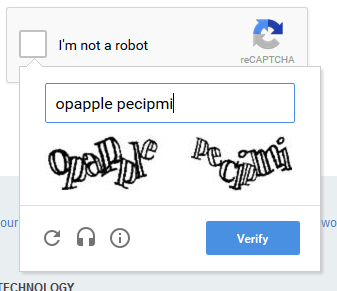
Some CAPTCHAs are harder than others
The original CAPTCHA test generated words that were obscured by twisted letters and slight background noise. To pass the test, users had to figure out the word and type it in. Copy/paste was not permitted, so computers had a hard time deciphering the message.
Over time, traditional CAPTCHAs have evolved to include images and varying levels of difficulty in an attempt to keep up with adapting bots, increasing their impact on the user experience.
What is reCAPTCHA?
reCAPTCHA is a CAPTCHA system developed by scientist Luis von Ahn. It was originally released in 2007 and later acquired by Google in 2009. This security mechanism is designed to distinguish between human users and automated bots by presenting users with challenges like image identification or puzzle-solving.
It typically appears as a checkbox or an interactive element on websites and, by analyzing user interactions, helps protect against spam and unauthorized activities, allowing genuine users to proceed while deterring malicious automation.
3 Types of reCAPTCHA
Since 2009, Google has introduced several different reCAPTCHA versions.
1. ReCAPTCHA v1
The first version of Google’s reCAPTCHA looked a lot like the original CAPTCHAs from the late 90s. The user was given a distorted message they had to decipher to continue to the next page. Google shut down v1 of reCAPTCHA in March 2018.
2. ReCAPTCHA v2
V2 is the most common type of reCAPTCHA, still in use by many websites. V2 aims to verify legitimate interactions through:
- No CAPTCHA reCAPTCHA: The user clicks on the famous “I’m not a robot” checkbox, and the risk analysis algorithm either automatically lets them through or challenges them with an image CAPTCHA (often featuring an image from Google’s massive street view library).
- The Invisible reCAPTCHA badge: A company can hide the “I’m not a robot” checkbox by binding it to an existing button on its website. For example, when a user clicks on the login button, the “I’m not a robot” verification process could take place automatically. The invisible reCAPTCHA badge can also be invoked via a JavaScript API call.
3. ReCAPTCHA v3
ReCAPTCHA v3 allows users through without having to click on the “I’m not a robot” checkbox. It’s a JavaScript API behind the scenes that returns a score based on the user’s previous actions on your website, and requests further authentication if that score is close to 0.
CAPTCHA vs reCAPTCHA: Key differences
The key difference between CAPTCHA and ReCAPTCHA is that a CAPTCHA is any website authentication test designed to tell humans and computers apart. We often refer to CAPTCHAs as reverse Turing tests because a machine administers an authentication challenge for a human to solve.
There are several types of CAPTCHAs owned by different companies/providers. ReCAPTCHA is Google’s popular CAPTCHA service, used for basic bot protection and other purposes. For example, with reCAPTCHA word tests (common before version 2 was released in 2013), Google used images from scanned books to help digitize The New York Times archives and books from Google Books.
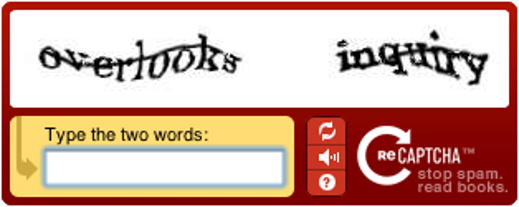
reCAPTCHA v1 before it was shut down
But Google didn’t stop at digitization. Ever since image identification became a part of the tests with v2, Google has been using user input to improve its machine learning models and train its computer programs.
Limitations of traditional CAPTCHAs for bot protection
50% of passed reCAPTCHAs are completed by bots, according to our aggregate customer data. Needless to say, reCAPTCHA—like other traditional CAPTCHAs—is far from infallible. ReCAPTCHA v2, the most common version, relies heavily on cookies to work correctly, which is problematic for two reasons:
- Users are not always willing to share their cookies and other data with Google.
- As French regulator CNIL discovered, end users of platforms with reCAPTCHA don’t always get presented with an option around sharing their data. That means the use of reCAPTCHA often does not comply with GDPR and similar data privacy regulations.
Privacy-conscious end-users—who often use VPNs to browse the internet and try to avoid Google services—end up having to perform multiple tests every day on websites that use reCAPTCHA v2. Ultimately, reCAPTCHA v2 kills conversions. We can’t blame users for not wanting to sort through taxis and traffic lights every time they need to submit a form.
Unfortunately, reCAPTCHA v3 tried to be more user friendly, but it introduces new challenges for site administrators who need to configure specific actions based on v3’s generated scores. Also, the popularity of reCAPTCHA gives cybercriminals more incentive and access to develop AI bots that can bypass the system.
A complete bot management solution with a built-in CAPTCHA
At the end of the day, 50% of “users” that pass reCAPTCHAs are actually bots—a metric worth repeating. The reason? One CAPTCHA result is not enough information to accurately detect sophisticated bots.
The solution? DataDome’s specialized bot protection software blocks bots with 99.99% accuracy, ensuring the vast majority of your human users never see a CAPTCHA. Now, on the rare (0.01%) occasion a human does see a CAPTCHA, we optimize that too. DataDome has its own integrated CAPTCHA that completes the feedback loop with our behavioral machine learning detection.
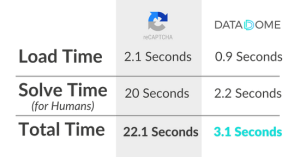
DataDome’s CAPTCHA is specifically engineered to be user friendly, privacy compliant, and 100% secure. It can be easily solved (and only passed) by human users in under 3 seconds, versus the ~20 seconds required by reCAPTCHA.
Our CAPTCHA uses a massive in-memory pattern database and a blend of AI and machine learning to determine whether a visitor is an actual user or a bot within a few milliseconds. (It’s also fast and easy to deploy—no architecture changes or DNS rerouting needed.)
CAPTCHA vs. reCAPTCHA vs. the DataDome CAPTCHA
| Feature | Traditional CAPTCHA | reCAPTCHA (Google) | DataDome CAPTCHA |
| Completion time | 15-30 seconds | ~20 seconds | Under 3 seconds |
| Bot detection rate | 40-60% effective | 50% of passes are bots | 99.99% accuracy |
| User experience | Poor. Distorted text, several attempts | Moderate. Image puzzles, frustrating | Excellent. Quick and intuitive |
| Privacy compliance | Generally compliant | GDPR concerns. Shares data with Google | Fully compliant. No data sharing |
| Data collection | Minimal | Extensive cookie and behavioral data | Privacy-focused, minimal collection |
| Deployment complexity | Simple | Moderate. Requires Google integration | Simple. No architecture changes |
| Accessibility | Poor: Difficult for visually impaired | Limited accessibility options | Designed with accessibility in mind |
| Mobile experience | Very poor | Challenging on mobile devices | Optimized for mobile |
| False positives | High. Legitimate users often fail | Moderate. VPN users struggle | Extremely low (0.01%) |
| Bot sophistication | Basic bots only | Basic to moderate bots | Advanced AI-powered bots |
| Integration method | Standalone widget | JavaScript API or widget | Integrated with bot detection platform |
| Cost | Free/low cost | Free with data trade-off | Part of comprehensive solution |
| Multi-language support | Limited | Good | Excellent |
| Real-time analysis | No | Limited | Yes. Millisecond detection |
| Support & updates | Varies by provider | Google support | 24/7 expert support |
ReCAPTCHA vs CAPTCHA: The bottom line
A CAPTCHA is a test designed to differentiate between real human users and malicious bots. ReCAPTCHA is a CAPTCHA system developed by Google. Advanced bots threaten all websites that rely on traditional CAPTCHAs alone to keep cybercriminals at bay. Businesses can keep their platforms safe by using an integrated CAPTCHA built into a sophisticated and personalized bot protection solution.
If you want to keep your endpoints safe while ensuring user data is private and user experience is optimized, check out DataDome’s CAPTCHA solution.
FAQ
reCAPTCHA is Google’s overall CAPTCHA system that includes multiple versions, while invisible CAPTCHA refers to a specific implementation method where the challenge runs in the background without requiring explicit user interaction. Invisible reCAPTCHA (part of reCAPTCHA v2) eliminates the “I’m not a robot” checkbox by binding the verification process to existing website buttons, only presenting a visual challenge when the system can’t confidently verify the user’s legitimacy.
The “best” CAPTCHA depends on your specific needs, but modern integrated solutions like DataDome’s CAPTCHA significantly outperform traditional options. While reCAPTCHA v3 offers better user experience than v2, it still allows a significant percentage of bot traffic to pass through. It also raises privacy concerns. For businesses prioritizing security, user experience, and privacy compliance, integrated CAPTCHA solutions within comprehensive bot management platforms deliver superior results.
Yes, Google reCAPTCHA v3 is free to use for most websites, with Google providing up to 1 million assessments per month at no cost. However, this “free” service comes with hidden costs including user data sharing with Google, potential GDPR compliance issues, and the need for additional development resources to properly configure score thresholds and implement appropriate actions based on v3’s risk scores.
reCAPTCHA v2 creates significant user friction compared to v3’s invisible operation, requiring users to actively click checkboxes and often solve image puzzles that can take up to 20 seconds to complete. This visible challenge process leads to higher abandonment rates and frustrated users, particularly on mobile devices, while v2’s reliance on cookies makes it problematic for privacy-conscious users and those using VPNs.
reCAPTCHA significantly improves user experience by replacing difficult-to-read distorted text with more intuitive image-based challenges and risk analysis algorithms. Instead of deciphering scrambled letters, users can simply click “I’m not a robot” or identify objects in clear photographs, while reCAPTCHA v3 runs invisibly in the background without requiring any direct interaction in most cases.
reCAPTCHA enhances security through advanced risk analysis algorithms that evaluate multiple behavioral signals beyond simple text recognition, including mouse movements, typing patterns, and browsing history. Unlike traditional CAPTCHAs that rely solely on image or text challenges, reCAPTCHA’s machine learning models continuously evolve and benefit from Google’s vast data ecosystem to build more accurate risk profiles, though it still allows approximately 50% of bot traffic to pass through.

Related posts
DataDome Recognized as a Sample Vendor in the Gartner® Hype Cycle™ for Application Security, 2026
Tell me more

Key Takeaways From Our Conversation With Forrester on the State of Bot & Agent Trust Management
Tell me more
How to Block AI Bots, Crawlers, & Scrapers
Tell me more
How DataDome Stopped a CAPTCHA Farm Behind 18.8 Million Ticket Scalping Attempts
Tell me more

